



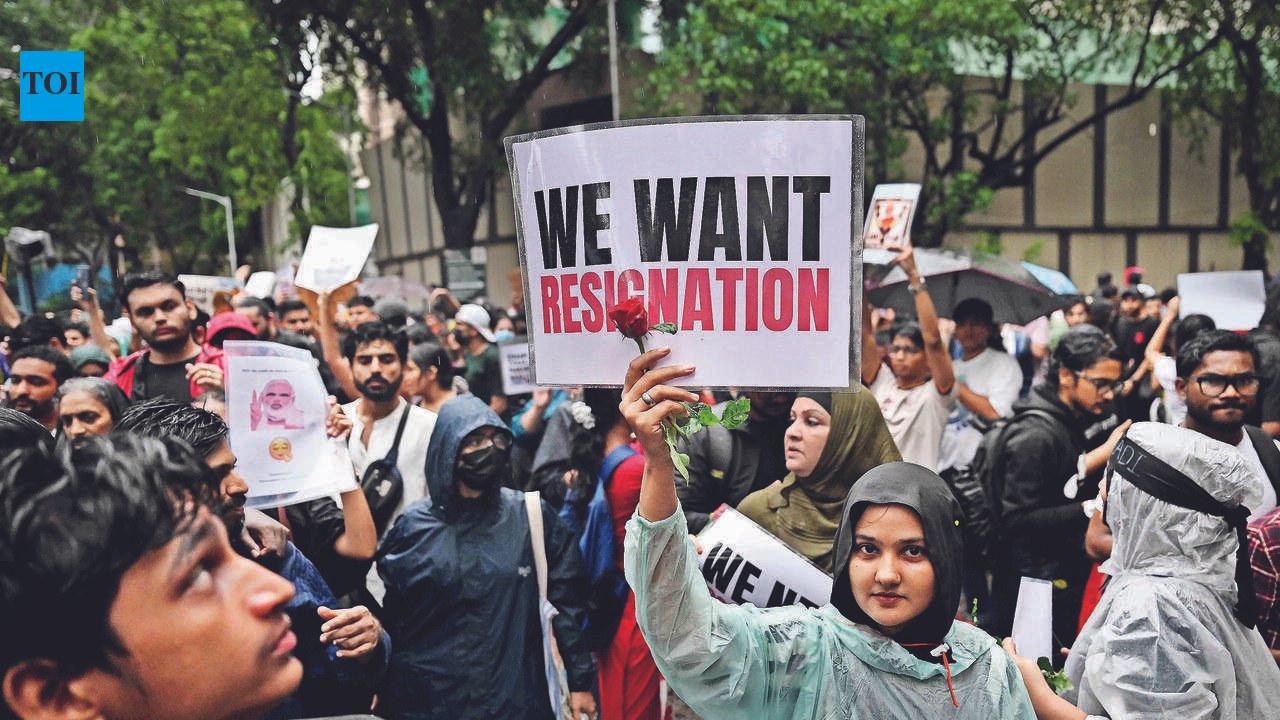
Not far from a statue of BR Ambedkar, the architect of India’s Constitution, stood a 35-year-old woman holding a copy of the document. The NGO worker joining the students’ protest near Chembur’s Dr Babasaheb Ambedkar Garden, looked unfazed by a last-minute relocation. Chembur was one of many pockets where demonstrations sprang up after organisers said police had rescinded permission for Azad Maidan, the city’s only officially designated protest site. “Protests are by their very nature disruptive. The point is to get the govt to listen to you,” she said. “So, having a designated space defeats the purpose, right? Wouldn’t it mean giving the police more control over the protest?”Her question goes to the heart of the question. The city has a notified protest ground in Azad Maidan, but it’s highly regulated and requires prior police permission and places limits on the size of the gathering as well as the timings. It’s a designated space that struggles to be seen. “Azad Maidan is like a black hole,” says Amita Bhattacharya, who took part in the Aarey agitation. “People walking on the road next to the Maidan also don’t get to know that a protest is going on in the Maidan.” So, the harder question is whether dissent can ever be contained within such a space by issuing prohibitory orders.Mumbai has a long history of political mobilisation. August Kranti Maidan, then Gowalia Tank, witnessed Mahatma Gandhi’s ‘Do or Die’ call in 1942. The city later saw the Royal Indian Navy uprising, the Samyukta Maharashtra movement, Datta Samant’s 1982 textile strike, Dalit Panther mobilisations and, more recently, anti-CAA protests playing out across open grounds.What the city lacked though was a legally recognised venue for public dissent. Azad Maidan became that space almost by default. Its location—close to Mantralaya, Bombay High Court and CST—made it the natural endpoint for marches. In 1997, after residents around Nariman Point complained about noise and traffic disruption near Mantralaya, the high court passed an interim order directing protest marches to culminate there. The arrangement was meant to be temporary. Instead, it governed Mumbai for nearly three decades.It took until March 2025 for the court to direct the state to notify Azad Maidan as the city’s designated protest site. The Public Meetings, Agitations and Processions Rules, 2025, however, turned it into a highly regulated space requiring permission, limiting protests from 9 am to 6 pm on working days, a cap of 5,000 participants, no indefinite occupations, and curbs during festivals, legislative sessions, VIP movement or on security grounds.The rules were almost immediately tested. The Manoj Jarange-led Maratha reservation agitation, though permitted only at Azad Maidan, spilled over into south Mumbai, bringing traffic to a standstill. This sharpened the older debate around the lack of sufficient public spaces for dissent.Around the world, democracies wrestle with the same tension: how to protect the right to protest while managing the disruption it inevitably causes. New York, for instance, has no equivalent of Azad Maidan or Jantar Mantar — peaceful assembly on streets, sidewalks and in parks is broadly protected without a permit, and only marches that block traffic or use amplified sound need one. But that openness too has limits: when Occupy Wall Street protesters tried to hold Zuccotti Park overnight in 2011, police cleared the encampment, and a court later let them return only without tents or sleeping bags.Urban scholar Tali Hatuka has argued that protest does not strictly need a sanctioned space at all: in situations of extreme grievance, people find ways around whatever barriers exist. What cities can do, in Hatuka’s view, is keep public space open rather than fenced.In Mumbai, though, accessible public spaces are on the decline. Pankaj Joshi, Principal Director, Urban Centre Mumbai, says Mumbai has roughly 1.2 square metres of public open space per person, far below cities such as Singapore, which provides around 39 sq m per resident. India’s own URDPFI planning guidelines recommend 10-12 sq m of open space per person — suggesting Mumbai’s shrinking public spaces are not an inevitable consequence of high population density, but rather the result of faulty urban planning. “Recently, the govt has begun diluting open spaces further by allowing developers to construct on playgrounds and recreation grounds through provisions in DCPR,” says Joshi.Oamkar, a youth who took part in the recent protests, says access to most public spaces in Mumbai is controlled. “What we need is open spaces where we can simply gather.”


