


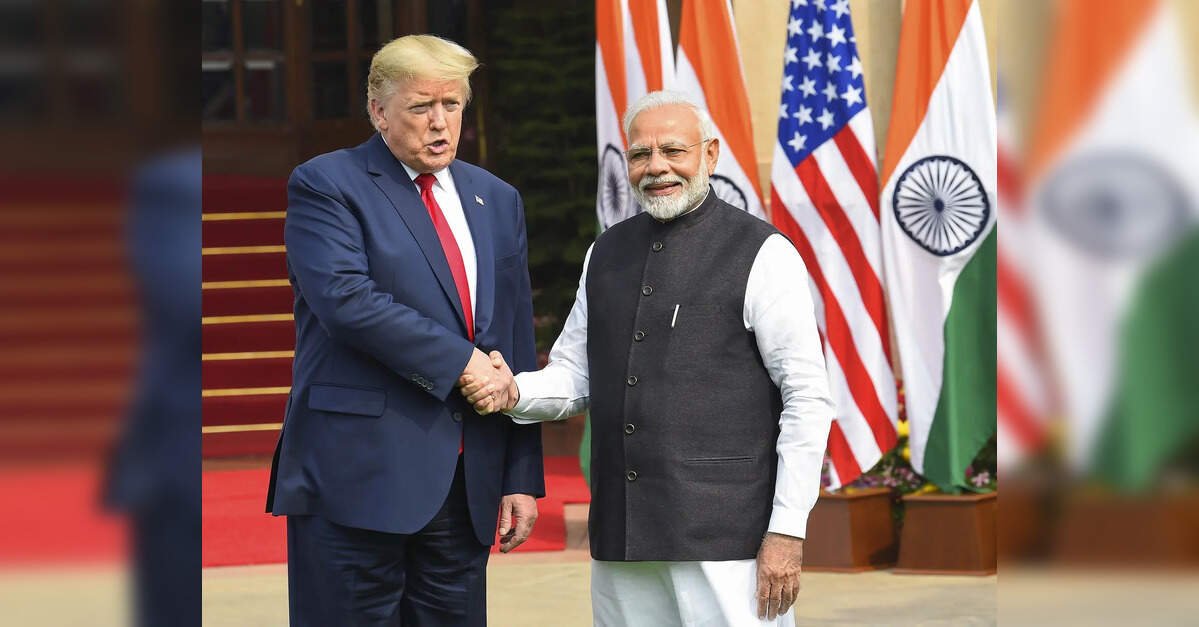
The US–India trade agreement, quickly christened the “daddy of all deals” after India’s expansive pact with the European Union, marks a sharp turn in bilateral economic ties. At its core is a dramatic reset of tariffs. Washington is cutting duties on Indian goods from a coercive 50 percent to about 18 percent, while Trump has said that India is moving towards zero tariffs on a range of US imports. The headline relief is substantial. The underlying signals are more complex.For Indian exporters, the tariff rollback offers breathing room. Sectors such as textiles, gems, jewellery and labour-intensive manufacturing, all heavily exposed to the US market, stand to gain from the easing of what had become a hostile trade environment. Legally, however, the move does not quite restore normalcy. The tariffs themselves had long sat on shaky ground under WTO rules, but the paralysis of the WTO appellate body since 2019 effectively allowed unilateral actions to go unchecked.
To many trade lawyers, the agreement represents relief rather than resolution. Prof. (Dr.) Prabhash Ranjan, professor and vice dean (research) at Jindal Global Law School and director of the Centre for International Investment and Trade Laws, describes it as a limited reset rather than a return to normal trade relations. “It is a short-term relief from what Indian exporters have faced over the last six months, not a restoration of the earlier tariff regime,” he says. “Before the Trump-era tariffs, Indian exports entered the US at 2 to 3 percent duties. Even after this deal, tariffs are at 18 percent, which is still far from the US’s WTO-bound commitments.”
The broader concern is the steady erosion of the most-favoured-nation principle. Differential tariffs now confer competitive advantage on preferred partners rather than through rules-based neutrality.
“If India has agreed to lower tariffs on US goods, MFN obligations kick in. Other countries can legitimately demand the same treatment for their exports. India already has those obligations under WTO law, and the pressure to extend similar concessions will follow,” Ranjan notes, arguing that New Delhi must continue to anchor its trade policy in multilateral principles rather than one-sided reciprocal arrangements.
That fragmentation is compounded by uncertainty over the legal character of the understanding itself. Deepak Raju, counsel at Sidley Austin, points out that “the new India-US deal appears to be an exchange of political undertakings, rather than an ‘agreement’ laid out in legal terms. As such, there is no dispute settlement mechanism to enforce its terms.” In practical terms, this means that if one side reneges on its commitments, the other side’s primary remedy would be to roll back its own concessions rather than invoke a formal adjudicatory process.
Nowhere is this tension clearer than in the energy clauses hanging over the agreement. US officials have explicitly linked tariff relief to India curbing purchases of Russian oil and increasing imports from the US and possibly Venezuela. Prime Minister Narendra Modi’s public statements have carefully avoided confirming any such explicit commitment. However, if a 25 percent punitive tariff imposed for buying Russian oil is being withdrawn, the inference is that India has agreed, at least in principle, to alter its sourcing behaviour. The Kremlin has said that India has not yet indicated that it will stop buying Russian oil.
Trade agreements, however, rarely enforce such shifts overnight. Governments typically stagger obligations to avoid domestic shocks. India’s recent trade deals show this pattern, such as long transition periods for tariff elimination on sensitive industrial goods. A similar phased approach to diversifying oil imports would be economically rational. India has benefited materially from discounted Russian crude, and an abrupt halt would raise energy costs and inflationary pressure. Until the agreement text is published, the precise benchmarks, timelines and dispute-settlement mechanisms remain unknown, leaving compliance risk an open question.
At a strategic level, the deal reflects India’s evolving posture from rigid strategic autonomy to pragmatic recalibration. Energy procurement has historically been driven by market logic rather than alliance politics. That principle has not disappeared, but it is now being balanced against trade access, supply-chain security and export competitiveness. India’s deepening engagement with the EU, Israel, New Zealand and other partners points to diversification rather than alignment.
This tension between autonomy and pragmatism is already visible across India’s trade diplomacy. Arjun Goswami, director – public policy at Cyril Amarchand Mangaldas, observes that “the text of the FTA will indicate how far India has compromised for pragmatic reasons. Generally India is pursuing strategic autonomy with a shot of pragmatic calibration.” He points to the strategic autonomy embedded in the India-EU FTA, alongside budgetary signals such as pausing investments in projects like the Chabahar port, as evidence of selective recalibration rather than wholesale alignment.
Agriculture remains the most politically sensitive fault line. The sector employs close to half of India’s workforce and is acutely vulnerable to competition from subsidised US farm products. Past trade negotiations suggest that New Delhi is alert to these risks and has sought to balance protection with access.
Recent FTAs illustrate this approach. According to Ankur Sharma, partner at Lakshmikumaran and Sridharan Attorneys, “in its recent FTAs, India has adopted a strategic approach in carefully safeguarding sensitive sectors and MSMEs while securing meaningful market access for high-potential sectors.” He points to the India-EU FTA, where segments such as dairy, poultry, cereals and certain fruits and vegetables were shielded even as India secured commitments in IT and IT-enabled services, professional services, education and financial services. Whether a comparable balance has been achieved in the US deal will only become clear once official documents are released.
This broader trade activism may also explain Washington’s urgency. With India signing multiple agreements and actively courting alternative supply chains, US exporters risked losing ground. The deal can be read as an attempt to anchor India more firmly within an American-centric trade and energy ecosystem, particularly after last year’s tariff shocks.
“This also seems to be emanating as a balancing act by the US due to various trade agreements being explored by India with other nations/ continents,” explains Manish Mishra, partner and head of indirect tax at JSA Advocates & Solicitors.
At a practical level, the agreement shifts the regional competitive balance in India’s favour. Because the US still maintains relatively high tariffs on many export competitors, Indian exporters now face lower duties than several South Asian and Southeast Asian rivals in the American market. This means Indian goods could be priced more attractively for US buyers, at least in the near term.
For exporters, this means relief without certainty. While Indian firms benefit economically, the broader environment remains volatile, shaped less by multilateral trade rules and more by geopolitical considerations. As Raju cautions, “Indian exporters benefit from the tariff reduction in the short term, but continue to suffer from considerable uncertainty because US tariffs are driven by geopolitical considerations with little regard to multilateral rules.”


