



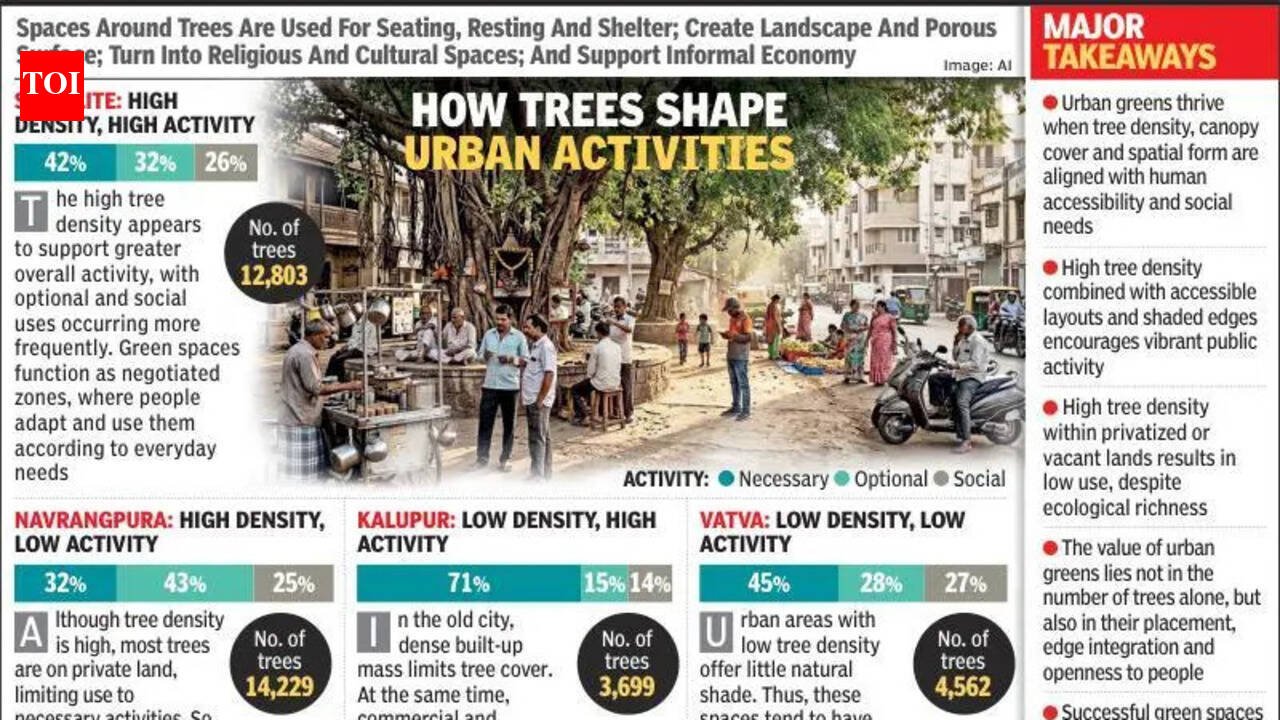
Ahmedabad: The shikanji vendor knows that without a tree overhead, there is no business on a scorching Ahmedabad afternoon. The existence of small roadside temples is almost unthinkable without trees around them. These are not planned green spaces, yet these are the spaces where much of the city’s everyday life quietly unfolds.A study by CEPT University students has found that Ahmedabad’s tree cover is unevenly distributed, with roughly 60% of surveyed areas in both eastern and western parts recording only 10-12 full grown trees per square kilometre. The study, titled “Dynamic Urban Spaces: Greens”, was conducted during the monsoon semester under tutor Daniel D’Souza and teaching assistant Jeel Gajjar. The unit had 14 students who covered 156 precincts of 1×1 sq km in the city. The study encompassed data on trees, walkability, edge conditions, road hierarchy, activities, land use, plot details and building footprints.Researchers counted a total of 2.49 lakh trees across the study area, with high-density clusters concentrated in central and western Ahmedabad and sparser coverage in the eastern and southern parts. Of the precincts studied, 28% had between 10 and 35 trees per square kilometre, while only 12% had more than 35.One of the findings was that the city’s green cover is not solely the outcome of official planning. It owes as much to informal, people-driven practices that complement urban design.“Each space — whether a yoga lawn, exercise garden, vendor street, or informal playground — shows how the physical structure of urban greens actively shapes and sustains collective behaviours… Urban greens are not limited to formal parks but extend into everyday, informal and improvised spaces such as parks with greenery, landscaped green space with high-rise buildings, and large green lawns,” the study states.Roadside trees, the researchers observed, are integral to everyday city life. The road edges, too, reflect this informality, with vendors and tea stalls turning ordinary corners into spaces of livelihood and social interaction.


