



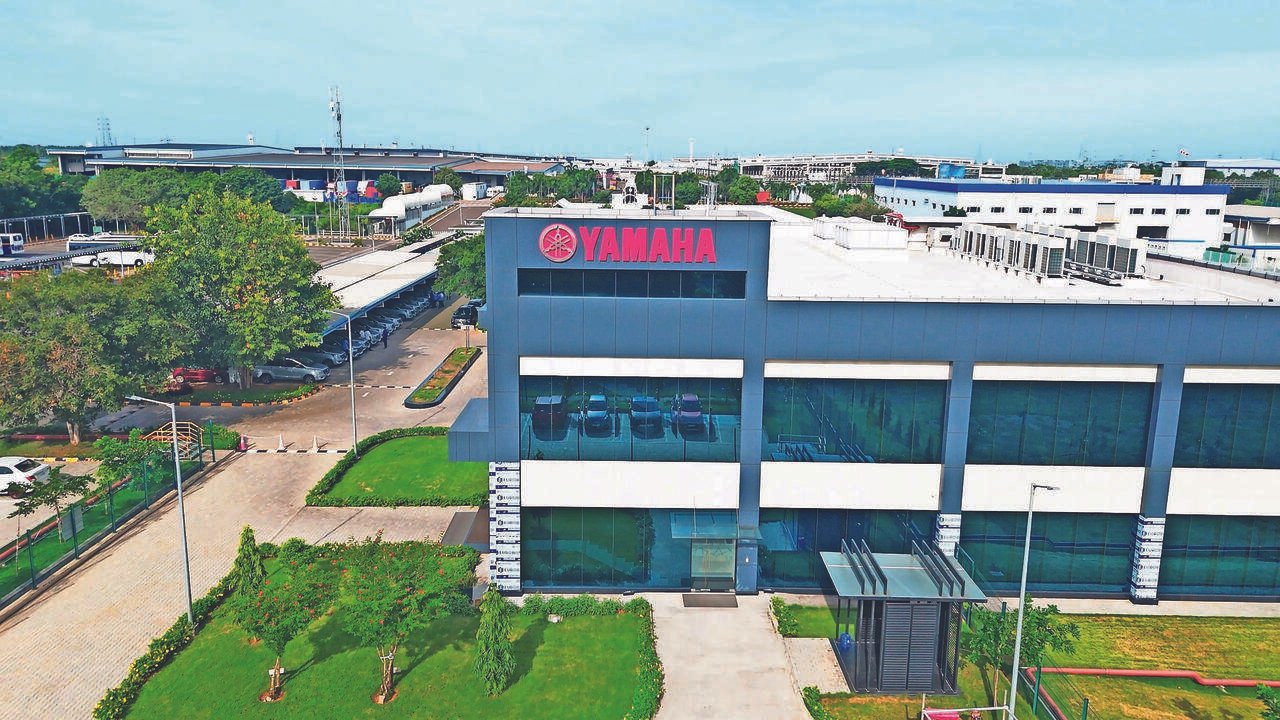
Chennai has long been home to India’s two-wheeler manufacturing heavyweights. Alongside TVS Motor and Royal Enfield, Japanese motorcycle maker Yamaha is now giving the city a bigger role in its global ambitions—not merely as a production base but as the company’s major export hub. More than a decade after opening its factory at Vallam Vadagal near Chennai, Yamaha is repositioning the facility from a domestic manufacturing plant into a global production centre that will manufacture both internal combustion engine (ICE) and electric vehicles (EVs), while expanding its role in serving export markets.The company has proposed an additional investment of Rs 58 crore for the Chennai plant, just a year after completing a Rs 180-crore expansion programme. The factory, inaugurated by former Tamil Nadu chief minister J Jayalalithaa (late) during the Global Investors Meet in Sept 2015, is already Yamaha’s largest manufacturing facility in India. With an annual capacity of 900,000 units—around 60% of Yamaha India’s total manufacturing capacity of 1.5 million units—the Chennai plant has become the company’s production backbone. It employs around 7,000 people, builds more than 350,000 motorcycles annually for the domestic market and exports over 250,000 units each year. In June 2025, it rolled out its five-millionth vehicle. Yamaha is targeting sales of more than 1.1 million units, including exports, in 2026.While India’s two-wheeler market remains large, global manufacturers are increasingly using the country as a cost-competitive production base for overseas markets. Yamaha, too, is doubling down on India as a manufacturing base for global markets. “When the Chennai plant was established, exports were already part of the long-term vision. More than a decade later, I believe we need to place even greater emphasis on export growth,” Hajime Aota, chairman of Yamaha Motor India Group, told TOI.The plant’s location gives it a natural advantage. “Southern India provides easier access to ports and sea routes, which is a significant advantage when serving overseas markets,” Aota said.“As domestic market growth eventually moderates and electrification changes industry dynamics, export-oriented manufacturing from Chennai could become one of the key pillars supporting Yamaha India’s long-term growth. My ambition is not just to export larger volumes from India, but to make Indian-made Yamaha products globally recognised for quality, competitiveness and reliability. That is the direction in which I would like to take the business,” he said. The company is also reviewing how production is divided across its two factories. “One possibility is increasing motorcycle production in Chennai,” Aota said, suggesting that the southern plant could take on a larger manufacturing role. Beyond expanding capacity, Yamaha plans to increase the localisation of components and strengthen its supplier ecosystem in India to improve cost competitiveness for export markets. The objective is to make India not only a large consumer market but also a manufacturing base serving global demand.That ambition comes despite Yamaha remaining a relatively small player in India’s two-wheeler market, with a share of just over 5%. Yet the company sees considerable room for expansion, particularly in southern India, which accounts for nearly 30% of the country’s two-wheeler demand but contributes roughly half of Yamaha India’s sales.The company’s broader objective is to become faster and more responsive to Indian consumers, strengthen local product development, improve export competitiveness, and prepare the organisation for the transition to new mobility. The region also offers another strategic advantage. Chennai has emerged as one of India’s largest automotive and EV manufacturing clusters, with a deep supplier ecosystem that could support Yamaha’s transition to electric mobility alongside its export ambitions.


