



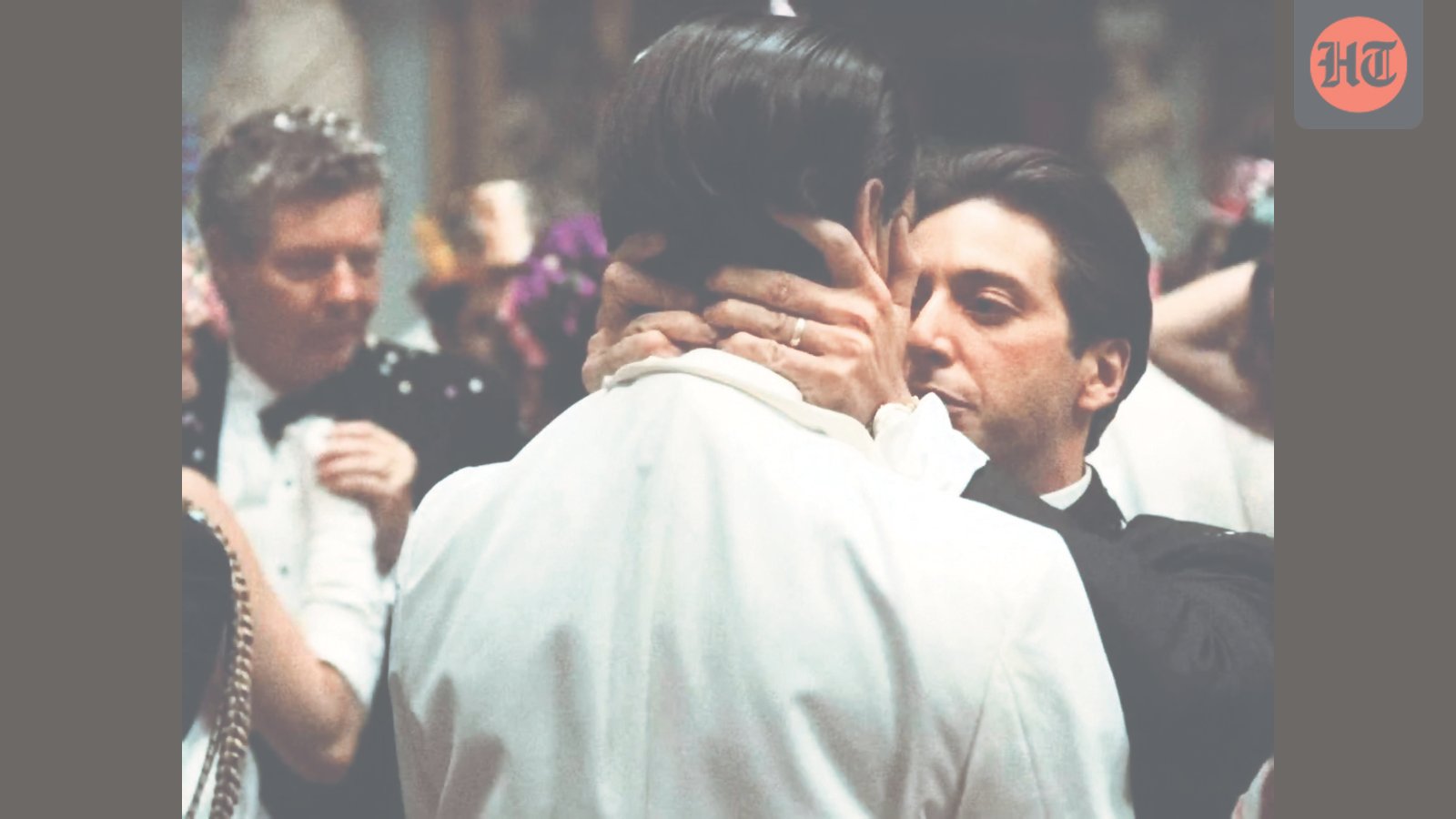
A quick peck on the lips or cheek could start a romance, end a feud, humiliate an enemy, prove one’s loyalty, expose a traitor, even be a death sentence…
The many ways in which the kiss was used, in fact, made for a whole host of scenarios that would seem extraordinarily strange today.
In the 11th century, for instance, the kiss of peace or osculum pacis, typically a kiss on the lips between men, was considered a valid way to signal the end of a property dispute.
In the 14th century, a gesture of fealty between a ruler and his subjects also involved a kiss on the mouth. It’s how Richard II was greeted by his uncles, and then by all his counts and lords, when he turned 21 and came of age as a ruler.
Why the lips? Because the mouth was viewed as a gateway to the soul, making this gesture a sort of unbreakable pact.
The kiss of death has a long history, of course. It’s how Judas betrayed Jesus; he kissed him on the cheek to indicate to Roman soldiers whom to capture. Farewell kisses on the cheek also confirmed a hit among members of the Italian-American mafia. (This was a gesture considered so violent that some recipients angrily kissed their rivals back, in defiance if nothing else).
People through history have kissed each other in all sorts of contexts, says historian Katie Barclay, professor at Macquarie University in Australia. Her new book, The Kiss: A History of Passion and Power (2026), traces this intriguing story.
PACT, PASSION
The oldest written reference to a kiss appears on a cuneiform clay artifact from about 4,500 years ago, in a story about two Mesopotamian deities.
The Rig Veda, dated to at least 1500 BCE, describes the meeting of the lips too. By the 1st century CE, it had become such a rampant act that the Roman Emperor Tiberius (14-37 CE) tried to ban it at public functions, to control the spread of infections such as herpes.
By the 3rd century CE, the Kama Sutra was dedicating entire chapters to the art of kissing (between people actually in a romantic tryst).
Among Christians, Barclay says, status and gender determined who could kiss whom. Those of higher status had to make the first move. To keep the sin of lust from rearing its head, it was thought best to exchange such tokens only with members of the same sex.
The elite disliked the idea of kissing members of lower social rungs, though, and asked for alternatives. So churches introduced the pax, a ritual object that could be kissed in place of the person. These could be highly ornate wooden or brass items bearing an image of Mary or Jesus. In some cultures, and some films, it remains customary to kiss the ring.
In contract law, meanwhile, people began to hire proxies, to avoid kissing those they didn’t want to kiss.
It was only in the 16th century that the use of kisses to seal contracts began to decline, Barclay says. Kissing a relic or the Bible was often used instead. As Europe suffered waves of infectious diseases and an understanding grew that physical contact played a role, kissing found its new place, restricted to one’s inner circle: a spouse, a child, a parent.
LIP SERVICE
By the 18th century, however, a kiss could win a vote.
The willingness to kiss a voter was thought to prove a politician was connected to his people. It created these moments of “shared vulnerability that seemed to allow access to the inner man,” Barclay writes.
In Britain, same-sex male kissing was frowned upon, so politicians kissed the wives and daughters of voters instead. Today, such kisses are focused on babies, but remain rather key, particularly in optics-driven campaigns such as those for the office of US President.
Charles Dickens, a former parliamentary journalist, wrote hilariously of the importance of the politician’s kiss, in his debut novel The Pickwick Papers (1836). Here, the candidate, Sir Samuel Slumkey, is reluctant to kiss the babies of plebians. His adviser, Mr Perker, pleads, argues, explains, and eventually prevails:
“He has patted the babes on the head,” said Mr Perker, trembling with anxiety.
A roar of applause rent the air.
“He has kissed one of ’em!” exclaimed the delighted little man.
A second roar . . . “He’s kissing them all”, screamed the enthusiastic little gentleman… hailed by the deafening shouts of the multitude.”
PUCKER UP?
The development of germ theory from the mid-19th century on led to a decline in casual kissing.
Women were still kissing each other on the lips in greeting and soon this would wane too.
In 1910, American activist Imogene Rechtin began distributing Kiss Not badges, signalling that the wearer did not wish for anyone’s lips to touch her. She began her campaign, she said, after she noticed that a host at a social function had kissed over 30 women on the cheek or lips before getting to her.
By 1930, bibs embroidered with “Do not kiss me” were being recommended to parents for their infants.
Today, even within family and between friends, it is the hug that does the rounds; rarely the kiss. Even in the world of emojis, a heart of hug seems easier to share than the intimacy of a cartoon kiss.
An easy substitution is xx (for two kisses) or xoxo (for hugs and kisses). And you’d never guess how that custom began.
It dates to the late 1800s, when a cross or X was used as a signature by people who couldn’t write their names. After they’d signed off with a big X, Barclay says, they kissed the page as a pledge of good faith. And from those beginnings, the x became associated with a kiss (and with the place on the form where a signature is needed; lawyers and bankers will still mark those with a little x).
As for the casual kiss, it doesn’t seem to have come back into fashion, says Barclay.
The historian admits she wasn’t a fan herself; it could feel a bit intrusive.
But she doesn’t judge all kisses the same way anymore, she laughs. “I think exploring how important this gesture was to social, political and familial relationships has given me a new appreciation of what is possible with a kiss.”
