



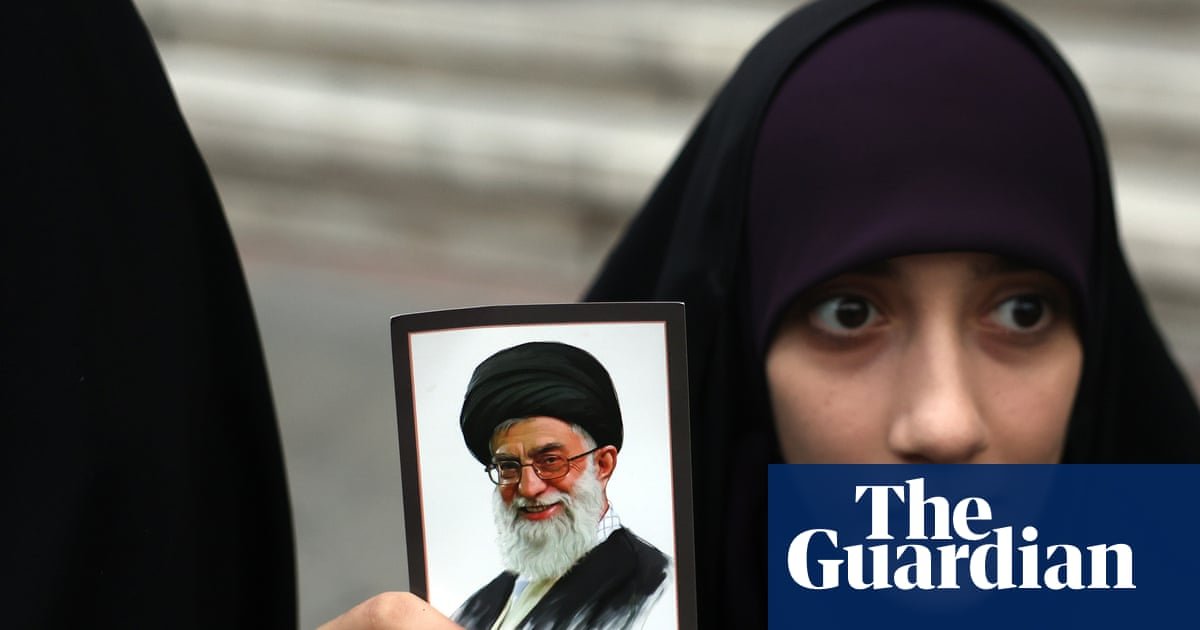
Two Irans are in view now. By night, there is the Iran that danced, celebrated and cried tears of joy at the death of the Ayatollah Ali Khamenei, hoping it marks the end of clerical rule and isolation from the west. By day, there are the mourning crowds gathering in the squares in Tehran and Isfahan demanding retribution and bewailing the loss of their sacred leader.
There is no need to guess which force has the greater domestic military power and retains the upper hand, but discerning whether the regime realises that the continued, inflexible pursuit of its current path will probably end in the regime’s chaotic collapse is harder to know.
As yet, there are no signs of fissure in the security apparatus. The instinct to resistance and to battle on is notoriously deep in Shia Islam and Iranian regime ideology.
On the surface, it seems implausible the regime can survive this weight of attrition. The roll call of the dead leadership is extraordinary and growing. Apart from the supreme leader, the dead include Maj Gen Shahid Rezaian, the head of the intelligence organisation of Iran’s police command; Lt Gen Seyyed Abdolrahim Mousavi, the chief of staff of the armed forces; Maj Gen Mohammad Pakpour, the commander of the Islamic Revolutionary Guard Corps (IRGC); Adm Ali Shamkhani, the adviser to the supreme commander, and Lt Gen Nasirzadeh, the defence minister. Some of these had only been in office for months having being elevated after the previous wave of assassinations during the Israeli assault on Iran in June last year.
At the same time, Iran’s stockpiles of weaponry and missile launchers will soon be under strain. Despite Iranian justifications, the damage being inflicted on Iran’s relations with its Gulf partners seems worse than the physical damage being inflicted on the US bases it is targeting.
Iran’s Strategic Council on Foreign Relations pleaded with the Gulf states to understand Iran’s dilemma. It complained: “The countries in the region which made every effort to persuade Trump to pursue diplomacy and avoid starting a war should now be convinced that no promise from Trump can be trusted. The way forward is for the regional countries to come to their senses and unite against the aggressive regime.”
The United Arab Emirates senior diplomat, Anwar Gargash, retorted that Iran’s actions were playing into the US’s hands. He wrote: “Iran’s aggression against the Gulf states missed its target and isolated Iran at its critical moment. Your war is not with your neighbours, and through this escalation, you confirm the narrative of those who see Iran as the region’s primary source of danger, and its missile programme as a perpetual title for instability. Return to your senses, to your surroundings, and deal with your neighbours with reason and responsibility before the circle of isolation and escalation widens.”
Dr Ebtesam al-Ketbi, the president of the UAE-based Emirates Policy Center thinktank, noted that the number of Iranian missiles directed at Gulf countries exceeded those launched at Israel. If the declared confrontation is with Israel, then why is the Gulf paying the heaviest price, she asked. The UAE alone had been attacked by 165 ballistic missiles, two cruise missiles and 541 drones.
But there is no sign yet that Iran’s surviving leadership is listening to these complaints. Indeed Oman, spared from attacks on the first day, was even hit despite acting as a mediator in the now abandoned talks on Iran’s nuclear programme. It serves to make the political landscape in which Iran operates much harder and the possibility of a Gulf military response grows ever closer, isolating Iran ever further.
But for the moment, the surviving leadership such as Ali Larijani, the secretary of the supreme national council, are focusing on their domestic audience, pulling every available patriotic string to rally and reassure the nation.
Morale may be sky high among those Iranians who called for death to the dictator at huge personal risk during the recent protests against the regime, but judging by the crowds that flooded the streets on Sunday to mourn the death of Khamenei, there is no immediate prospect of the son of the last shah, Reza Pahlavi, returning to Iran to be greeted with universal acclaim.
Although even mainstream reformist leaders such as Azar Mansouri admit there was a debate inside Iran about the validity of a foreign intervention in the wake of the January crackdown and the mass jailing of critics, hostility to Iran’s future being settled by the US is rife. One reformist group opposed to the regime on Sunday warned against “a humanitarian intervention”, saying “foreign bombs and missiles are not messengers of democracy but seeds of destruction and dependence”.
If Pahlavi returned prematurely he would very likely be returning to join a civil war, in which the stakes were well spelled out on Sunday by Reza Nasri, a lawyer closer to the foreign ministry.
“The scene is clear,” he wrote. “On one side, there stands a grand geopolitical project whose ultimate aim is to undermine all elements of Iran’s power and reduce the country to a half-dead, collapsed, submissive entity under the command of Israel and America – with a puppet coup-installed government. On the other side, a long-standing national movement stands firm to – despite all internal problems – resist the surrender of the country’s fate to foreign hands … for the sake of preserving independence and national dignity. Every free Iranian who holds this land dear in their heart will undoubtedly choose the second path.”
The leadership, in a bid to give off an aura of stability, has moved quickly to appoint the three-strong interim leadership, in which the chief of the judiciary, Gholamhossein Mohseni-Ejei, and Ayatollah Alireza Arafi, representing the Guardian council, will ensure the current anti-western bias endures.
Whoever Iran’s current system tries to select as Khamenei’s successor, the instinct will be to double down by choosing an IRGC-oriented authoritarian, sending a message to the protesters not to dare try their luck again. Iran has been preparing and discussing the Khamenei succession for decades, and the directly elected 88-strong Assembly of Experts, the body that choose the supreme leader, is packed with conservatives.
In the last assembly election in 2024, three relative moderates, including the former president Hassan Rouhani, were disqualified from standing. Rouhani was given no reason, but blamed the ruling minority for wanting to stifle competition and voter turnout. Now there are rumours that the regime knows it has been so weakened that it must at least broaden its leadership base to include not just Rouhani, but Mohammad Javad Zarif, a former foreign minister.
Yet if the war continues, conducted without limits, or boundaries, in the words of the foreign minister, Abbas Araghchi, and the strait of Hormuz gets closed, then there is a possibility that Iranian society simply implodes with a breakdown of civil order. Cash does not come out of the machines, bread does not get made, the revolutionary courts are destroyed, the prisons are sprung open and ethnic groups stake their claim.
Efforts are being made primarily by the Turks to see if some road back to de-escalation can be found, but what seems at stake now is more than stockpiles of highly enriched uranium and instead a geopolitical order across the Middle East.
Trump and Benjamin Netanyahu have a broad vision of what that may entail, but it is less clear they have a detailed route map to get there. Yet the US president, sensing he is on a roll, exudes confidence that IRGC members, offered immunity from prosecution, will weigh the personal odds and defect.
Asked in a phone interview with CBS who he thought would be the key decision maker after Khamenei’s death, Trump said: “I know exactly who but I cannot tell you.”
When asked if there was a certain person in Iran that he would like to lead the country, he replied: “Yes I think so, there are good options.” Whether others will agree, the next fateful days will determine.


