



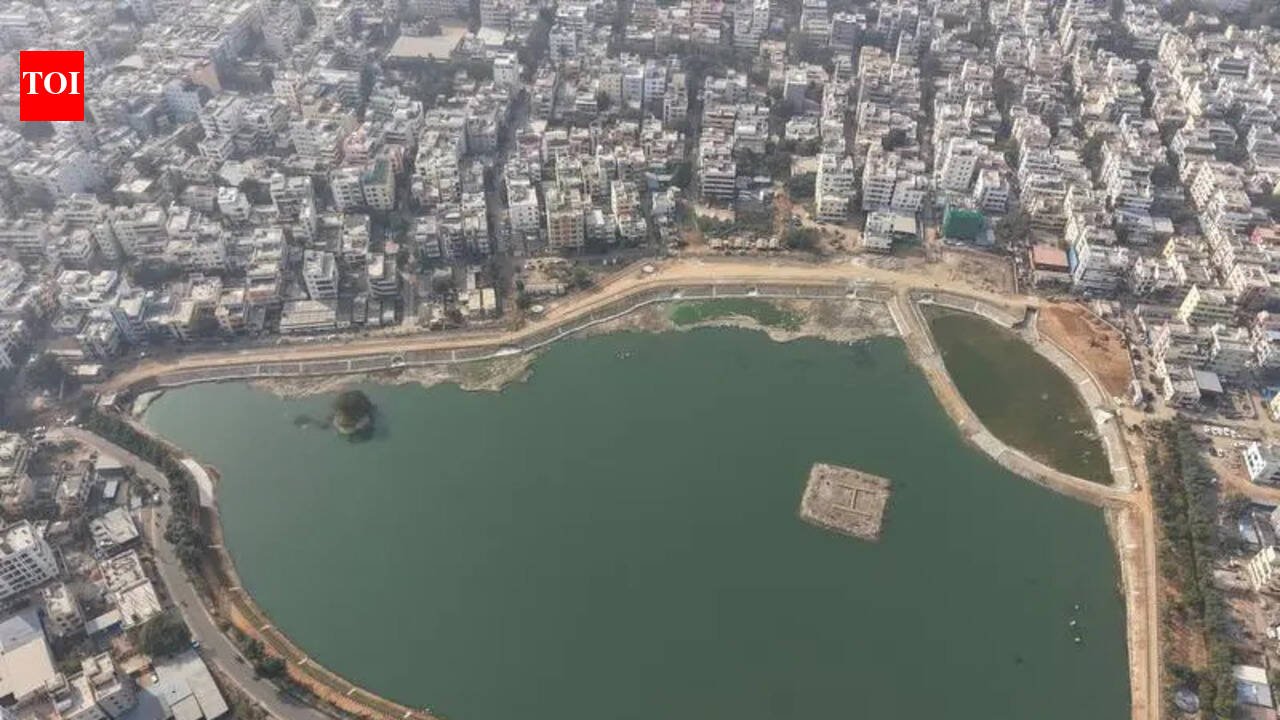
Hyderabad: As the city faces water scarcity as early as March, the spotlight has once again turned to lake rejuvenation as a potential solution to declining groundwater levels.The Hyderabad Disaster Response and Asset Protection Agency (HYDRAA) has recently restored three major water bodies—Bum-Rukn-ud-Dowla Lake, Bathukamma Kunta, and Kukatpally Nalla Cheruvu. However, the impact on groundwater has so far been limited. Groundwater levels in surrounding areas continue to hover between eight and 10 metres below ground level (mbgl).Officials caution that the benefits of lake rejuvenation take time to materialise. Decades of neglect, debris accumulation, and widespread encroachments, they say, require sustained efforts to reverse.Recent restoration work has significantly expanded the physical extent of these lakes. Kukatpally Nalla Cheruvu, which had shrunk to around 14 acres, has now been restored to nearly 30 acres. Bum-Rukn-ud-Dowla Lake has been expanded from four acres to around 18 acres, while Bathukamma Kunta, which had nearly vanished, has been revived to cover about five acres.Environmentalists acknowledge that these efforts are a step in the right direction, but emphasise that restoring ecological functionality is crucial for effective groundwater recharge. A major concern, they point out, remains the continued inflow of untreated sewage into these lakes, even after restoration.‘Inadequate STPs’“Stopping sewage inflow is critical,” said environmentalist B V Subba Rao, who has worked on lake restoration projects across India for over three decades. He noted that despite crores of rupees being spent on lake rejuvenation over the years, results have often fallen short due to the neglect of basic ecological principles.“The foundation of successful lake restoration lies in identifying and securing inlets, preventing further contamination, and ensuring adequate sewage treatment infrastructure,” he added.Currently, both Kukatpally Nalla Cheruvu and Bum-Rukn-ud-Dowla Lake lack sewage treatment plants (STPs), which remains a significant gap in their restoration. For Bathukamma Kunta, authorities plan to divert wastewater to a treatment plant under construction in Amberpet. Estimates suggest that Bum-Rukn-ud-Dowla Lake requires an STP with a capacity of 10–15 million litres per day (MLD), while Kukatpally Nalla Cheruvu would need a facility of more than 10 MLD.“Setting up an STP is one thing, but maintaining it over the long term is another challenge,” said Madhulika Chaudhary, known for her work on reviving lakes such as Pedda Cheruvu and Neknampur Lake in the city.Experts call for holistic approachShe cited the example of Durgam Cheruvu, where despite the installation of two STPs with capacities of 7.5 MLD and 5 MLD, nearly 20 MLD of untreated sewage continues to flow into the lake daily. “The lake was recently covered with hyacinth, which thrives in polluted water. This shows that infrastructure alone is not enough unless inflows are effectively controlled,” she said.Beyond infrastructure, experts also stress the need for a more holistic, nature-based approach to lake restoration. Environmental scientist K Babu Rao, who has worked on various not-for-profit projects related to water and air pollution in the city in the last four decades, highlighted the importance of integrating natural treatment systems with conventional methods.“Floating treatment wetlands can significantly improve water quality, while aerators help break down organic waste. We also need proper stormwater treatment systems, diffusers, and fully functional STPs at all outflow points,” he said.A V Ranganath, commissioner, HYDRAA, said that: “Aquifer recharge is a gradual process. It would take at least two monsoon cycles for the restored lakes to begin showing measurable improvements in groundwater levels. The agency is exploring the possibility of setting up STPs on govt land reclaimed from encroachments along the Full Tank Level (FTL) areas of these lakes. We are in discussions to utilise one to two acres of adjoining govt land for establishing STPs for the revived lakes.“


