



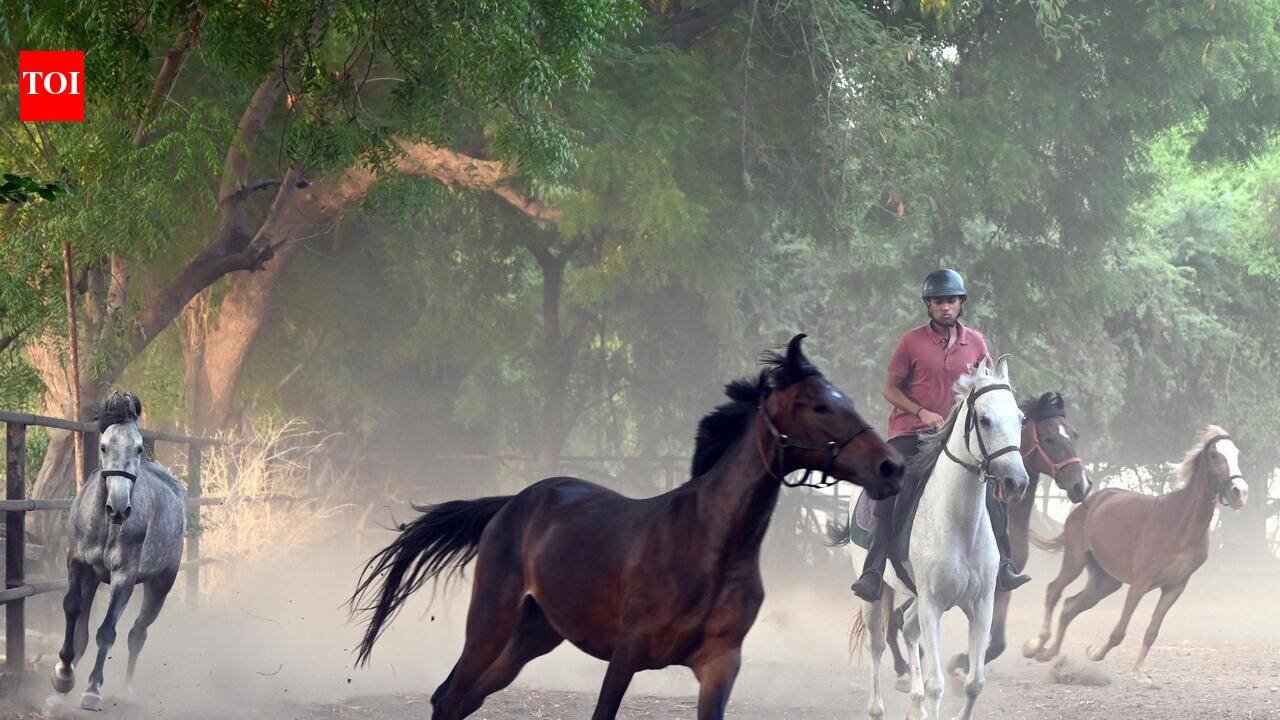
There was a time when owning a horse in Gujarat marked you out as royalty or an enthusiast. Today, it increasingly marks you out as an investor. Landowners on the outskirts of Ahmedabad are buying stallions and offering them for breeding while many others are setting up weekend farms. Even farmers in Banaskantha are diversifying from crops to colts, having realised that a well-bred horse pays as handsomely as a good harvest.Ronak Patel is a second-generation owner who runs a stud farm in Vadaj area of Ahmedabad. He keeps two stallions and three mares, and during the mating season, breeders trailer their mares to him from Rajasthan and Punjab. The season peaks around March and April. With a mare carrying for about 11 months, breeding then means the foal arrives in milder weather, away from the worst of the heat.Patel has watched the trade change around him. “You can buy a horse, but maintaining one is a different game altogether,” he says. “A cow gives you milk, a steady income. A horse gives you nothing like that.”So owners look for returns elsewhere, and one of the surest earners is stud farming — charging a fee each time a prized stallion covers a visiting mare. Until the 2000s, there were just a handful of farms in and around the city, Patel says. “After Covid, anyone with land started buying stallions and offering covering services. The growth of stud farms has been extraordinary in the past six years.”Gujarat bucks the trendAccording to the last livestock census, in 2019, Gujarat had 22,000 horses and ponies, the fifth-largest tally in the country, behind Uttar Pradesh, Jammu and Kashmir, Rajasthan, and Bihar. The surprise was that Gujarat’s count had risen 20% from the previous census in 2012, when the state had 18,000, even as the national population fell by 45% over the same stretch. Gujarat was the only state in the top five to record growth.The returns on investment are what draw people in. A sub-adult horse can sell for Rs 1 crore to Rs 1.5 crore. For eachcovering, the mating of a mare with a stallion, the stallion’s owner charges between Rs 50,000 and Rs 2.5 lakh. A stallion with a record of good offspring commands a premium, and for an owner with the right animal, the returns can cover the cost of purchase within a few years.Vishnu Chaudhary, who runs a stud farm in Mehsana, has 10 stallions and mares and fields inquiries from Rajasthan, Maharashtra, Karnataka and Tamil Nadu. Gujarat, he says, has become a destination for covering. “Ahmedabad and Mehsana together have around 300 farms now, double what they were six to seven years ago.”For Chaudhary, bloodline decides everything. “Genealogy matters for a horse the way it does for people. A stallion with a record of good offspring is in demand from breeders across states.”Why Marwari rulesAround 90% of the horses on Gujarat’s stud farms are Marwari, a breed recognisable by its dramatically inward-curved ears. “Marwari has the height, the stamina and strong limbs, and it suits Indian conditions,” says Chaudhary. “It is versatile, useful for hard work and for sport alike. A long, familiar history makes the breed easy to identify. Its temperament is steady, and it holds up well in Indian conditions, which is why most stud farms keep a Marwari stallion,” he adds.
Interest in keeping horses has climbed sharply since Covid, and the market has since split across distinct types of buyers. Some buy for sport, some for breeding, and others for shows and ceremonies
Horses must be registered with the All-India Marwari Horse Society for the breed’s authenticity to be recognised, and the market has reinforced that requirement. Documentation and a traceable bloodline feed directly into price. In this close-knit world, ownership is rarely a secret. As a breeder from Ahmedabad puts it: “You can drive aRs 1 crore car, and nobody knows. Own a Rs 1 crore horse, and breeders across states would know by the weekend.”Beyond the covering feeThe boom has built its own ecosystem. Weekend farms, where horses are stabled through the week and ridden on Saturdays and Sundays by owners and their families, have become a fixture around Ahmedabad.Almost every stud farm has a tie-up with a veterinarian. And owners, after years of handling their animals, learn to manage the common problems themselves. “You spot colic early, and you know how to give an injection or set up a saline drip,” says Patel.In Saurashtra, the Kathiawadi horse has a following of its own, especially among erstwhile royals for whom ownership goes well beyond status. Some of the larger royal stables keep 20 to 30 horses, used for riding, polo and patrolling their estates.Rich rewards, high maintenanceDharmendra Patel runs one of Ahmedabad’s leading stud and breeding centres. He moved to the city’s Shilaj area from Mehsana in 1991 with six horses and now owns 17.“A few years ago, the breeds we have in the state — Marwari, Kathiawadi and Arabian — were under threat,” he says. What turned it around, he says, was a mix of state support and private effort. Special breeding centres were set up and conservation programmes were launched. “Gujarat govt provides a grant of Rs 25 lakh for a horse show. That amount must be increased now,” he says.The turnaround owes as much to demand as to policy. Competitive sport, above all, has fuelled it. Interest has climbed sharply since Covid, and the market has since split across distinct types of buyers. Some buy for sport, some for breeding, and others for shows and ceremonies. What was once a pursuit for the wealthy has become, for many, an investment.A well-bred animal with good conformation and no behavioural faults can fetch up to Rs 1.5 crore. Even young horses command serious sums, with a good colt selling for Rs 25 lakh to Rs 50 lakh. Ownership patterns are changing too. Not every horse owner has land. A growing number keep their animals at boarding facilities, where monthly upkeep runs to about Rs 15,000.What it takes to keep a horseBut upkeep is about far more than money. Like humans, horses undergo regular vaccination, primarily against tetanus and rabies, says Dr Vipul Kavechiya, a veterinarian from Ahmedabad.“Our local conditions carry some risk factors, such as babesiosis and anaplasmosis, against which care must be taken. Leeches and ticks are common carriers of equine diseases. We also see cases of Theiler’s disease, also known as equine serum hepatitis.”
Not every horse owner has land. A growing number keep their animals at boarding facilities, where monthly upkeep runs to about Rs 15,000
Dental hygiene matters too, mainly to prevent gastrointestinal problems, says Dr Chirag Javiya, a veterinarian who works with several stud farms in and around the city. “The hooves must be checked every three months. Horses spend most of their lives standing, so the strain on their legs is considerable. Owners must ensure the animal is comfortable and watch for any change in its walk or gait.”Regular grooming, including massage and coat polish, is partly about appearance, but it also helps catch ticks early, experts say. Apart from the regular feed, horses, and stallions in particular, need more protein and a nutrient-rich diet during the mating season, along with higher levels of vitamins, antioxidants and omega-3. Regular exercise keeps a horse in good shape, mentally and physically.“Colic remains a major problem and one must watch for early signs such as a stop in motions and general unrest,” says Kavechiya. “If it is not addressed in time, it can turn dangerous.” Stables, says Javiya, must be airy, clean and free of irritants. “Regular disinfection is essential, along with enough space. Horses are herd animals, and socialising is a must.”The Kathiawadi fights for its placeThe Marwari may be the breed of choice for many, but the state’s own Kathiawadi is staging a recovery. Rajendrasinh Jadeja, secretary of the Kathiawadi Horse Breeders Association (KHBA) at Gondal, says the body now has 2,700 members, almost all in Saurashtra, the region that gives the horse breed its name. “Our goal is to conserve the breed, and the numbers give us reason for optimism,” he says. “There are around 15,000 known Kathiawadi horses today. Three decades ago, the figure had fallen to about 250.” TheKHBA is a govt-backed body with close links to the animal husbandry department. In Saurashtra alone, around 85 stud farms breed Kathiawadi horses under expert supervision. Jadeja owns one of the largest such farms, at Ashwatara in Porbandar, which has 45 horses, and points to Visaman Bapu Ashram in Paliyad, with 25, as another important centre. For all its pedigree as one of the oldest breeds in the country, and a regular winner in endurance races, the Kathiawadi has struggled to find takers beyond Saurashtra. KHBA officials are blunt about the reason. The aggressive promotion of the Marwari breed, with its wider national appeal, has pushed the Kathiawadi into second place even within Gujarat. A more organised effort to promote the breed is overdue, they say.


