



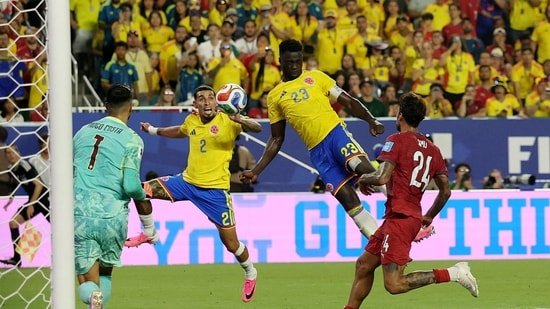
Colombia thought they had found the moment that would give their Group K dominance a perfect finish. Deep into the closing stages against Portugal in Miami, Davinson Sánchez rose inside the box, met a cross from the right phase of a set-piece move and headed the ball down into the net. For a second, the Colombian end exploded. Then came the flag. Then came VAR. Then came the image that explained everything: Sánchez was offside by the smallest possible footballing margin – a toe.


The decision was brutal, but it was not mysterious. Colombia had taken the corner out towards the edge of the penalty area, meaning the protection normally attached to a direct corner no longer applied. From the next cross, the usual offside law came back into play. Sánchez was fractionally ahead of the second-last Portugal defender when the ball was delivered, and because he then directly played the ball by heading it into the net, the offence was complete. It was not about intent. It was not about whether he gained a visible running advantage. It was simply about position at the moment of the teammate’s touch and involvement after that touch.
Why the offside call stood
Football’s offside law allows no special sympathy for tiny margins. A player is in an offside position if any part of the head, body or feet that can legally score is nearer to the opponents’ goal line than both the ball and the second-last defender. Hands and arms are ignored, but a foot counts. In Sánchez’s case, that was decisive. His toe had gone beyond the line.
That is why the argument that “he was only just offside” does not save the goal. In the law, “only just” is still offside. Once VAR established that Sánchez was ahead by that tiny fraction, the next question was whether he became involved in active play. He clearly did. He attacked the cross, made contact with the header and put the ball in the net. That made it a straightforward offside offence, however painful it looked in real time.
The corner detail is important too. There is no offside directly from a corner kick. But Colombia did not score directly from the initial corner delivery. They recycled the ball and crossed from the next phase. At that moment, the offside line reset. Sánchez had to be level with or behind the second-last Portugal defender when the cross was played. He was not.
Also Read: Colombia top Group K after stalemate with Portugal as DR Congo storm into Round of 32
The controversy came because the margin was so absurdly small. To the naked eye, it looked like a legitimate late winner. Even on replay, it felt harsh because Sánchez did not appear to have stolen a meaningful advantage. But modern semi-automated/VAR-assisted offside decisions are not judged on whether the advantage feels meaningful. They are judged on the body-part line. If a scoring part of the body is ahead, the goal is disallowed.
For Colombia, the frustration was sharpened by the flow of the match. They had pushed Portugal hard, created repeatedly, and looked the more dangerous side for long stretches. A Sánchez winner would have turned a strong group-stage statement into a dramatic one. Instead, the game finished 0-0, with Colombia still topping Group K on seven points and Portugal advancing second with five.
So the simplest explanation is also the correct one: Sánchez’s goal did not stand because his toe was offside when the cross was delivered. Cruel? Absolutely. Controversial? Naturally. Wrong in law? No.


