



True art, in its most profound sense, is always a reflection of the human condition, and the human condition is, by its very nature, political
ANUSHAH RIYAZ
This question has been the topic of discussion for many years now, where we analyse and look towards the inherent meaning of an artistic piece. Art is not just art any more. It is the collection of one’s thoughts, opinions, privileges and abilities. It is how a person expresses themselves and makes a statement through their work.
Art is political, and it has always been. Even when it doesn’t visually scream protest or activism, it has always had an inherent meaning. The art may be a painting of a serene landscape, a domestic setting or an abstract painting. But there are always questions associated with it. Who gets to see it? Who gets to show it? Who gets to own it? These are all political questions. But this idea isn’t new.
George Orwell famously said that “All art is propaganda”, meaning that every creative work has an underlying purpose, value, or ideological weight. He viewed art not as an isolated aesthetic pursuit, but as a deeply political tool. He has asserted this point in many of his essays. In his essay, Frontiers of Art and Propaganda, Orwell stated that writing honestly required acknowledging the political realities of the time.
The social and political purpose of art is undeniable. In his other essay, Why I Write, he says that “When I sit down to write a book, I do not say to myself, ‘I am going to produce a work of art.’ I write it because there is some lie that I want to expose, some fact to which I want to draw attention, and my initial concern is to get a hearing.” This reinforces the idea that art is not just “art for art’s sake”, but it has a deeper meaning behind it.
Art is never just about aesthetics. It reflects power, identity and control, whether the artist intends it or not. Even art that seems decorative or apolitical upholds certain values. It reflects what is considered important, who is erased and what a culture deems worthy of attention.
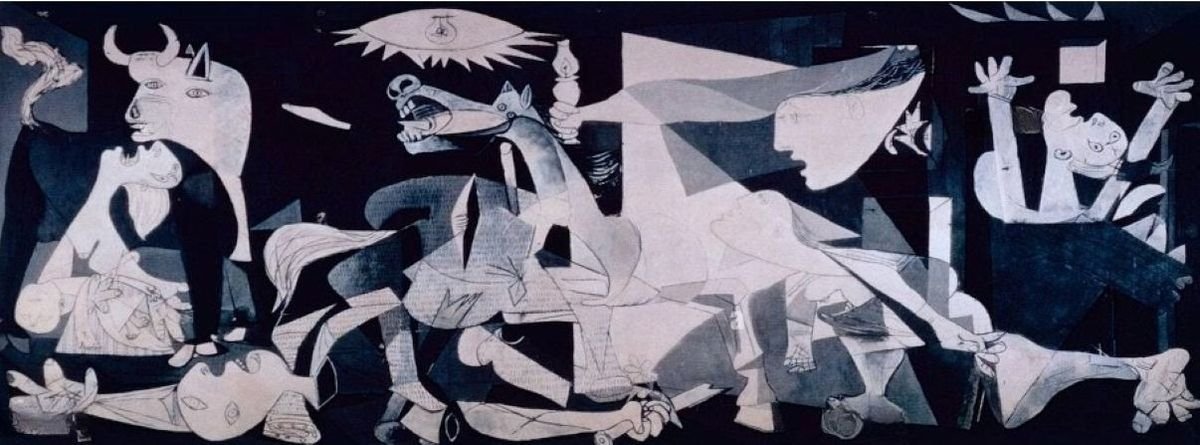
Some of the most powerful artworks in history have been seen as dangerous threats to the status quo. Pablo Picasso’s masterpiece, Guernica, was a large 1937 oil painting that depicted the aerial bombing of the Basque town of Guernica during the Spanish Civil War. It is one of the most powerful anti-war paintings in history.
A tapestry version of the painting is hung outside the Security Chamber at the UN. It was covered up by the U.S. government when Colin Powell argued for the Iraq War in 2003. Sixty-six years after the original was made, the painting was still seen as a threat and an interruption in destroying thousands of innocent lives. The painting threatened to speak to historical parallels that the Bush administration and UN officials were determined the media or the public should not draw.
Ai Weiwei is one of the world’s most famous living examples of an artist whose work proves that art is political. In fact, his famous personal motto is, “Everything is art. Everything is politics.” In 2008, a massive earthquake in Sichuan, China, killed thousands of children because of the poorly built schools in the area.
The government tried to cover up how many children died, but Ai Weiwei collected the names of victims and displayed a giant wall of 9000 brightly coloured school backpacks on the side of a museum. The project, Remembering, was a direct and public attack on government corruption in China. It was a powerful statement against Chinese authority and challenged the current government.
Trace is another one of his artworks. In 2014, when the Chinese government took away his passport so he could not leave the country, Ai Weiwei designed an art show for Alcatraz. Alcatraz is a famous former island prison in the United States. He used 1.2 million LEGO bricks to create portraits of 176 people from around the world who were jailed or exiled because of their political beliefs.
Although he was under house arrest in Beijing during the time, he used digital blueprints, building layouts and internet data to plan the entire exhibition from his studio. The building process itself became a statement about bypassing government censorship through technology and international solidarity. The artwork features 176 distinct portraits of people who have spoken out against injustice.
So, all art is shaped by its political and social context, access to resources and the identity of the artist. The very choice of medium, who gets to exhibit it and who can afford it, involves power and privilege.
Governments, institutions and social media platforms continue to censor art even today when it crosses certain lines. Because art is powerful. It has the ability to influence people and persuade them to take action regarding things they care about. It makes people hope for a better world where people are no longer restricted by the constraints of class hierarchy, apartheid, racism and colonialism. They imagine a better world where people are free and able to express their opinions freely. They are no longer censored and forced to remain silent on certain issues. The act of free speech is inherently political and has always been. Art itself is an act of free speech.
Therefore, every brushstroke, every painting and every carefully chosen word is because of a very specific context, inspired by the artist’s lived reality and shared with a world shaped by power dynamics. To create is to choose. To choose is to stand somewhere. And standing somewhere casts a shadow, which is political, whether intended or not.
The very act of displaying one’s art has always been something political. In earlier times, certain communities, such as women, people of colour and working-class individuals, were not allowed to display their art in a public space. They always had low representation in artistic works. Even today, museums which are controlled by high-profile billionaires and people who know nothing about art control which art gets to be shown, whose stories are told and whose voices are amplified. It is a political reality, one which still needs a lot of work to be done for.
One question that is sometimes asked in this context is: Are a child’s scribbles political? And the answer is yes. The very act of a child having paper and a pencil is a political statement. It reflects economic privilege, access to resources and the leisure time afforded by a certain class position. In a world where thousands of children are engaged in child labour in fields and factories, a child’s scribbles are a reflection of a particular societal structure that allows for such “innocent” creativity.
Even art forms that seem mundane, such as cooking, especially in the context of Palestinian cuisine, are deeply embedded with politics. For Palestinians, in times of displacement, occupation and blockade, the act of preparing food and sharing it was not just for nourishment. It became a profound act of resistance, of remembering one’s history, culture, and heritage through these traditional recipes. The continuity of these traditions is a powerful political statement, asserting existence and belonging to their homeland.
When an artist remains silent in times of genocide, war or systemic oppression, they do not escape politics but rather become complicit in it. The question is not whether art should be political, it’s whether we are willing to acknowledge the politics already embedded in it. True art, in its most profound sense, is always a reflection of the human condition, and the human condition is, by its very nature, political.
(The author is an undergraduate student and literature enthusiast)


