



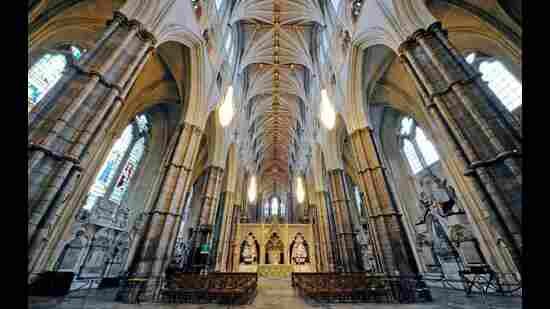
London never ceases to surprise. No matter how often I return, the city has a way of revealing something new — sometimes loudly, making a statement, and sometimes quietly, like an overlooked footnote. On my most recent visit, that discovery, by happenstance, was in the most unexpected place: Westminster Abbey.


One of the most visited historic sites in the city, Westminster Abbey lures people in droves, most of them gravitating towards the nave, the Gothic stonework, and the famed Coronation Chair. On a recent visit though, I found myself wandering down a side aisle. And then, just past the marble effigies of kings and statesmen in the south transept, I landed upon a quiet literary landmark. Poets’ Corner.


For book lovers, this small area is one of the most meaningful literary destinations in the world. More than 100 writers are buried or memorialised here, including Geoffrey Chaucer, Charles Dickens, Thomas Hardy, Alfred Tennyson and Rudyard Kipling; there are also memorials to Jane Austen and the Brontë sisters. The space is both a national archive of literary achievement and a reminder of how deeply writing has shaped Britain’s cultural history.
A serendipitous tradition
Westminster Abbey itself predates most of the literature represented here. A church has existed on this site since the 10th century, and the present Gothic structure dates largely from the 13th century. It has hosted coronations since 1066 and is home to the graves of monarchs, statesmen, scientists, and national figures.
Poets’ Corner, however, did not begin as part of any formal plan. Geoffrey Chaucer was buried here in 1400 — not because he wrote The Canterbury Tales, but because he worked for the crown and lived near the Abbey. His presence later took on symbolic meaning as English literature evolved. When the poet Edmund Spenser was buried beside him in 1599, mourners reportedly placed verses and quills in his grave. That moment marked the reimagining of the space as a literary memorial.
Over the following centuries, the area gradually filled with burials, monuments, busts, and plaques. There was no official rule, but a pattern emerged: when a writer’s work had significantly shaped the English language or national culture, they were remembered here.
A walk through the canon
Visiting Poets’ Corner feels like walking through a condensed history of English literature.
The central monument to William Shakespeare, erected in 1740, remains one of the most recognisable. Although Shakespeare is buried in Stratford-upon-Avon, his presence here reflects his status in national identity. His words continue to define the space: “The poet’s eye, in fine frenzy rolling, doth glance from heaven to earth, from earth to heaven.”


Nearby lies Charles Dickens, buried here in 1870. Dickens had reportedly wished for a quieter resting place, writing in his will “that my name be inscribed in plain English letters on my tomb… I rest my claims to the remembrance of my country upon my published works…” However, public opinion insisted his work deserved national recognition, and he was buried here. His simple inscription, just his name, date of birth, and death date contrasts with the scale of the legacy he left behind.
Other graves and memorials trace the evolution of British writing. These include Alfred, Lord Tennyson, Poet Laureate during Queen Victoria’s reign, Rudyard Kipling, whose ashes rest close to Tennyson’s, Thomas Hardy, whose ashes were interred here after his death, Samuel Johnson, lexicographer and essayist, and Ben Jonson, the only person buried vertically beneath the floor.
Not all writers here are interred. Some, such as Jane Austen, the Brontë sisters, and DH Lawrence, are commemorated through plaques installed long after their deaths. Their inclusion reflects changing views about literary value and the expanding canon.
Austen’s memorial, a small tablet unveiled in December 1967, is made of polished Roman stone that simply bears her name and year of birth and death. A line from her writing, from Mansfield Park, comes to mind: “Let other pens dwell on guilt and misery. I quit such odious subjects as soon as I can, impatient to restore everybody, not greatly in fault themselves, to tolerable comfort, and to have done with all the rest.”
The meaning and purpose of the space
Poets’ Corner remains one of the few places where a cultural tradition is still evolving. Memorials continue to be added, though rarely and only after careful consideration. The decision is based not on popularity, but on enduring influence and national significance.


The atmosphere in this space differs from the rest of the Abbey. Although thousands walk through it each week, it remains unexpectedly quiet. Visitors often end up pausing here, taking more than a moment — not because the monuments are grander (many are simple slabs underfoot), but because the connection feels personal. For many people, these writers were part of childhood reading, formal education, or private imagination long before they became names in stone.
A line from Chaucer, inscribed near his resting place, encapsulates the sentiment many feel when standing here: “The lyf so short, the craft so longe to lerne.”
London’s wider literary landscape
While Poets’ Corner is a highlight for literary travellers, it sits within a city full of literary heritage. Many visitors combine a stop here with other landmarks, including the British Library, home to original manuscripts by Austen, the Brontës, Shakespeare, and others; the Charles Dickens Museum in Bloomsbury; Shakespeare’s Globe Theatre on the South Bank; Keats House in Hampstead; and Dr Johnson’s House near Fleet Street.
Historic pubs are also part of the city’s literary fabric. Ye Olde Cheshire Cheese near Fleet Street hosted writers including Johnson, Dickens, and later Arthur Conan Doyle. The Fitzroy Tavern and The George Inn also feature in literary history.
Walking through London, it’s possible to recognise many of the familiar street names, squares, and alleyways that appear in novels, poems, and essays written across centuries.
A place worth seeking out
Poets’ Corner is easy to miss if you enter Westminster Abbey with a checklist of major attractions. Yet, it remains one of the most meaningful cultural spaces in London. It is a reminder of how language shapes national identity and how writing can endure long after the world that produced it has changed.
Not every city gives its writers a memorial. Fewer still place them alongside monarchs and political leaders. In that sense, Poets’ Corner isn’t just a tribute to literature; it is an acknowledgement of the power of words.
As Shakespeare reminds us, “We are such stuff as dreams are made on,” and Poets’ Corner feels built precisely from that substance – from memory, imagination, and words. It’s more than a stop on a London itinerary for lovers of literature; it is a quiet reminder that across the world stories outlive their makers.
Teja Lele is an independent editor and writes on books, travel and lifestyle.


