



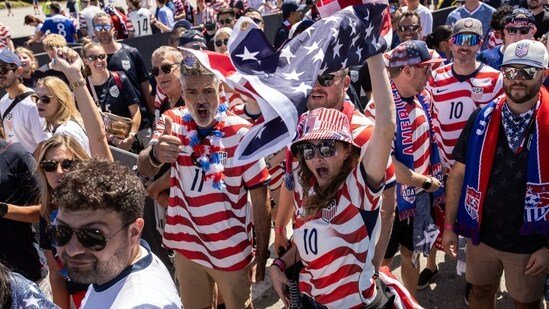
Andrea Rojas and Carlos Ramon saved for more than a year for their trip to see the World Cup.
But the married Virginia couple weren’t prepared for the bill: nearly $10,000 to travel to and see games in Boston, New Jersey and Miami. That was more than double what they paid for a similar trip to the 2014 World Cup in Brazil.
Tickets? $800 apiece on FIFA’s official resale site before the team schedules were announced. Forget trying to see their favorite squads. Game day parking? $175 at Gillette Stadium outside Boston and $150 outside Miami. Car rental, hotel, $98 commuter-train tickets in New York and air fare further drove up their bill.
If she and her husband weren’t such big fans, Rojas said, “I would boycott FIFA because of what they’re doing” with ticket prices. “It’s basically turning into a Super Bowl – for people who have the means or are willing to get into crazy debt.”
But so it goes in the modern era of high-end live entertainment, where people are willing to spend vast pools of money and go into debt to attend once-in-a-lifetime events. Those at the top of the economic ladder spend lavishly without breaking a sweat. But such events are also drawing the working and middle classes, who bust open savings and borrow money to afford spiraling prices.
From the World Cup, to the NBA Finals, to concerts by chart-topping artists such as Olivia Rodrigo and Harry Styles, to boomer-friendly megatours by Rush and AC/DC, there seems to be no limit to what some are willing to pay.
For ardent fans, budgetary concerns are no match for the fear of missing out in a you-only-live-once economy.
“Worth every penny,” said Kenzie Doctor, an Edinburgh gym worker who withdrew 3,000 pounds (nearly $4,000) from a government savings program to offset the nearly $9,000 it cost him to see Scotland play in the World Cup. “When you had the national anthem at the game, it was so sentimental, there were tears running down my face.”
A FIFA official said it has offered a range of ticket prices and that World Cup proceeds help run the nonprofit’s global development projects.
Resale tickets on SeatGeek for World Cup matches have averaged about $1,084 each, with later-round matches going for more. Tickets to the NBA Finals between the New York Knicks and San Antonio Spurs fetched an average of $4,100, while seats at Madison Square Garden were going for as much as $9,000 on average.
A constellation of entertainment companies, leagues, payments companies and hospitality groups are enjoying the bounty.
The frothy ticketing environment has been a boon to “buy now, pay later” companies like Affirm and Klarna that help fans pay for pricier seats than they otherwise might not buy.
Knicks owner Madison Square Garden Sports stock is up roughly 88% over the last year, while shares in Ticketmaster parent Live Nation are up more than 20%.
Those who are flush have no problem shelling out. For the working and middle classes, changing economic realities such as stubbornly high mortgage rates have led to a new calculus. If the typical status symbols of buying a single-family house is out of reach, maybe spending hundreds of dollars to see Metallica at Las Vegas’ Sphere doesn’t sound so outrageous.
To understand how we got here, go back to the pandemic.
The economic phenomenon known as “funflation” bloomed as venues reopened following months of closures driven by fear of the virus, which canceled tours, forced sports leagues to play games in front of empty seats and hammered restaurants and movie theaters. Once live music, theater and sports returned, vaccines proliferated and public health restrictions eased, people rushed back to be entertained in big crowds.
A public tired of hoarding toilet paper in isolation lived it up. Enter megatours by artists such as Taylor Swift and Beyonce, whose multigenerational appeal helped break sales records.
They contributed to a new standard of elaborate, hours-long concerts with more emphasis on choreography, pyrotechnics, costume changes and technology to wow audiences.
That wave of concerts also normalized the idea of concert tourism — traveling across state or international borders for a unique experience. Bank accounts were flush from the Covid era of staying home and families and friends were ready to party.
Since the transition of the recorded music industry from album sales to subscription-based streaming services, artists have relied much more heavily on touring for their income in recent decades. Decades-old bands playing on nostalgia and newly minted podcasting stars added to the craze.
Years of stock-market gains have supercharged the spending power of older households—especially Baby Boomers. The No. 4 touring act for the first half of this year is AC/DC, according to Pollstar, coming in behind Bad Bunny, Lady Gaga and BTS in worldwide ticket sales.
“The affluent are spending and spending with abandon,” said Diane Swonk, chief economist for KPMG. “That’s bidding up the cost of things for the bottom 80%, where wages and incomes haven’t kept up with inflation.”
But the costs of touring have increased with inflation, driving up base ticket prices. Increasingly sophisticated bots are quick to snap up blocks of seats and flip them for a profit.
And the concert industry deploys tactics to maximize revenue such as releasing blocks of tickets in waves to increase scarcity and implementing so-called dynamic pricing, raising prices in response to high demand.
The cost burdens for consumers are causing some people to get choosier about how they spend their money, often splurging on a show or two rather than going to many events throughout the year.
Tiffanie Williams, a 42-year-old who lives in Sebring, Florida, used to get out to live music and comedy shows weekly, pinging between Los Angeles, San Diego and Ontario, Calif. In the past year, she’s been to one concert—Post Malone, for which she paid $178.
“If you’re wanting to get out, it’s too expensive,” she said.
For Veterans Day weekend she gave her fiance a choice between taking a cruise or seeing his favorite band, Rush. He chose the prog rock heroes. After searching for tickets at three different locations—and passing on $500 for nosebleeds—this week she landed on a pair for a Tampa show for $978. She signed up for Afterpay and is on a payment plan for $93 a month.
Public outrage over the costs of concertgoing helped lead to a blockbuster Justice Department antitrust lawsuit against Live Nation, the world’s largest concert promoter, accusing it of overcharging fans and pressuring venues to use its Ticketmaster platform. Though the federal government settled its case, a collection of state attorneys general carried on and won a jury verdict against Live Nation.
Live Nation has denied that it is an illegal monopoly and said claims about its power in the market are overblown, saying that artists set the prices, not venues or promoters. The states are seeking to have Live Nation and Ticketmaster broken up. The remedial portion of the case is pending.
There are signs that the high costs might be putting pressure on demand for shows that don’t quite hit the bucket-list threshold. Music fans online in recent months discussed what became known as “blue dot fever” referring to the blue circles showing unsold, face-value seats available for a show at a concert venue. Some artists have canceled shows due to softer than expected sales.
Live Nation says less than 1% of shows on the books this year have been canceled.
Shows for the top 100 tours in North America grossed a total of $1.9 billion, the same as last year, according to Pollstar. SeatGeek’s average resale price has remained essentially flat at $203 in the year ending June 23, compared to $206 the same period a year earlier, while sales volume was up 20%.
“As long as you’re somebody’s favorite artist, the touring market is really good,” said Nathan Hubbard, chief executive of music management firm Firebird Music Holdings. “If there aren’t fans that are putting tattoos of your lyrics on their body, you might be having a problem.”
Executives say the post-pandemic demand hasn’t waned, though some acknowledge a pullback in spending from lower-income households for shows in smaller venues. Overall, people are waiting until closer to the concert date to buy tickets while considering how to spend their money.
Music fans want an experience, fueling demand for upgraded and VIP options such as skip-the-line entry or access to more exclusive viewing areas, said Bryan Perez, chief executive of AXS, the ticketing service owned by sports and live music giant Anschutz Entertainment Group.
“People are deciding how they want to spend their entertainment dollars,” Perez said.
Earlier this year, Karen Datangel and a friend logged onto Ticketmaster, hoping to score tickets to a Olivia Rodrigo concert in December at the Oakland Arena.
Datangel, a 37-year-old government communications employee and devoted pop music fan who has seen stars like Taylor Swift and Sabrina Carpenter, got stuck in the online queue. Her friend, though, found two seats, far from the stage, at $261 each.
The friend opted out, but Datangel didn’t give up: She ultimately decided to pay $400 for a spot in a suite reserved by another friend.
She said the price is worth it: “Concerts have made up some of the greatest experiences and memories that I’ve had in my life.”


