



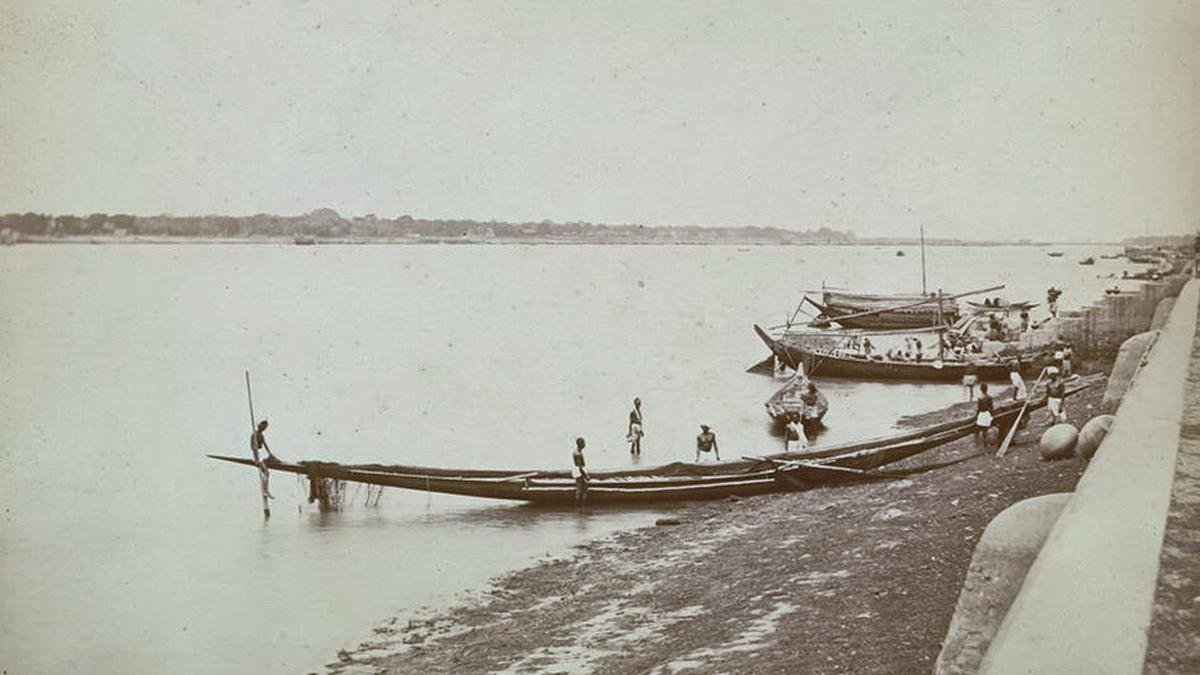
Boats on the Padma river in 1860.
| Photo Credit: Public domain
Bangladesh has approved a large river engineering project called the Padma barrage, on the Padma river, which is Bangladesh’s stretch of the Ganga, in Rajbari district. It is Bangladesh’s attempt to partially re-engineer the hydrology of its southwest region, which has become prone to drought after decades of reduced seasonal flows linked to the Farakka barrage upstream in India.
The barrage will be 2.1-km-long and have 78 spillway gates, undersluices, navigation locks, fish passages, and associated embankments. It will impound roughly 2.9 billion cubic metres of water and includes 113 MW of hydropower generation. According to Bangladesh, the project will affect roughly 37% of the country’s land area and irrigate around 2.88 million ha of farmland.
While the barrage’s supporters see a long-delayed national water security project in the Padma barrage, critics have said mega-barrages often underperform, alter sediment flows in unpredictable ways, and can create new ecological problems, such as water-logging and damage to fisheries. Some environmental groups have also criticised the speed of approval and called for greater public scrutiny.
As Mehebub Sahana at the University of Manchester and Bayes Ahmed at University College London have argued, the project highlights how South Asian countries are building more barriers to rivers rather than removing them. The regional turn towards unilateral river engineering is at odds with Europe and North America tearing down obsolete dams and culverts to restore rivers’ free flow. In 2025 alone, 21 European countries removed a record 603 barriers.
Published – June 01, 2026 06:30 am IST


