






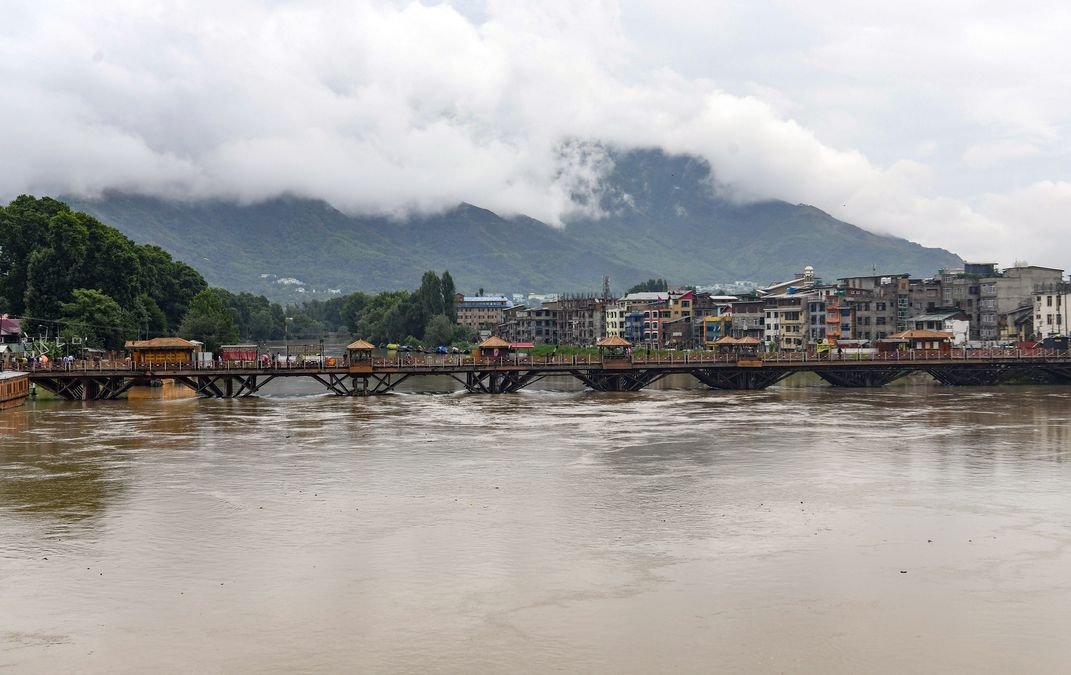
Srinagar, Aug 23: The Jhelum River could be heading towards a dramatically different future as climate change reshapes temperatures, precipitation and the seasonal rhythm of its flows, according to a new research study that projects major changes in the river basin through the end of this century.The study, authored by Mustafa Javed, Jurgen Bohner and Shabeh ul Hasson, assessed future changes in the mean and extreme streamflow of the Jhelum under three Shared Socioeconomic Pathways (SSPs)—SSP1-2.6, SSP3-7.0 and SSP5-8.5.The researchers followed the Inter-Sectoral Impact Model Intercomparison Project (ISIMIP) 3b protocol and used the eco-hydrological Soil and Water Integrated Model (SWIM) to assess the river’s response to projected climate conditions. The model was calibrated and validated against observed Jhelum streamflow before being forced with bias-adjusted historical climate data for 1985–2014 and future datasets covering 2016–2100.The findings point towards a warmer and substantially wetter Jhelum basin.“Under SSP1-2.6, SSP3-7.0 and SSP5-8.5, the study projects warming of 0.9°C, 5.7°C and 7.5°C per century, respectively, compared with the historical period,” the study reads. “Precipitation is also projected to increase substantially, by 329 mm, 665 mm and 1,258 mm per century, respectively, under the three scenarios.”It states that the most pronounced seasonal changes are projected under the high-end SSP5-8.5 scenario. “In the far-future period, monsoon temperatures could rise by 5.78°C, while monsoon precipitation could increase by 20.84 per cent,” the research reads.However, the study highlights a striking contradiction in the Jhelum’s projected future: more precipitation does not necessarily translate into higher river flows during the high-flow season.The mean ensemble projections indicate that low flows could increase significantly, with February flows rising by 89 per cent, while high flows could decrease by 37 per cent in June across the scenarios, according to the study. It states that the changes are projected to become more pronounced under the high-end warming scenario, suggesting that climate change could alter the timing and distribution of water in the Jhelum rather than simply increasing or decreasing its overall volume.The researchers also examined extreme river flows through the 30-year return level for the near-future period of 2016–2043, mid-future period of 2044–2071 and far-future period of 2072–2100.Under SSP1-2.6, the 30-year return level is projected to decline by 7.01 to 9.87 per cent; under SSP3-7.0, by 7.22 to 13.35 per cent; and under SSP5-8.5, by 9.41 to 26.60 per cent.The researchers said these projections imply a reduction in the likelihood or magnitude of extreme river-flow events. The findings assume particular importance for Kashmir, where the Jhelum is closely linked to agriculture, hydropower, wetlands, settlements and the region’s overall water security.The study also underlines the vulnerability of High Asian mountain water resources, which serve as a lifeline for downstream communities but face growing pressure from warmer future climates.By mapping possible changes in the river’s discharge dynamics, the researchers said the findings could contribute to better management of the Jhelum’s precious water resources. The projections offer a glimpse of a Jhelum that could behave very differently by the end of the century—warmer skies, wetter conditions, higher winter low flows and lower summer high flows.For Kashmir, where the Jhelum has shaped settlements, agriculture and life for centuries, the research suggests that climate change may not simply bring more or less water—it could fundamentally change when the river rises, when it recedes and how the valley depends on its lifeline.


