






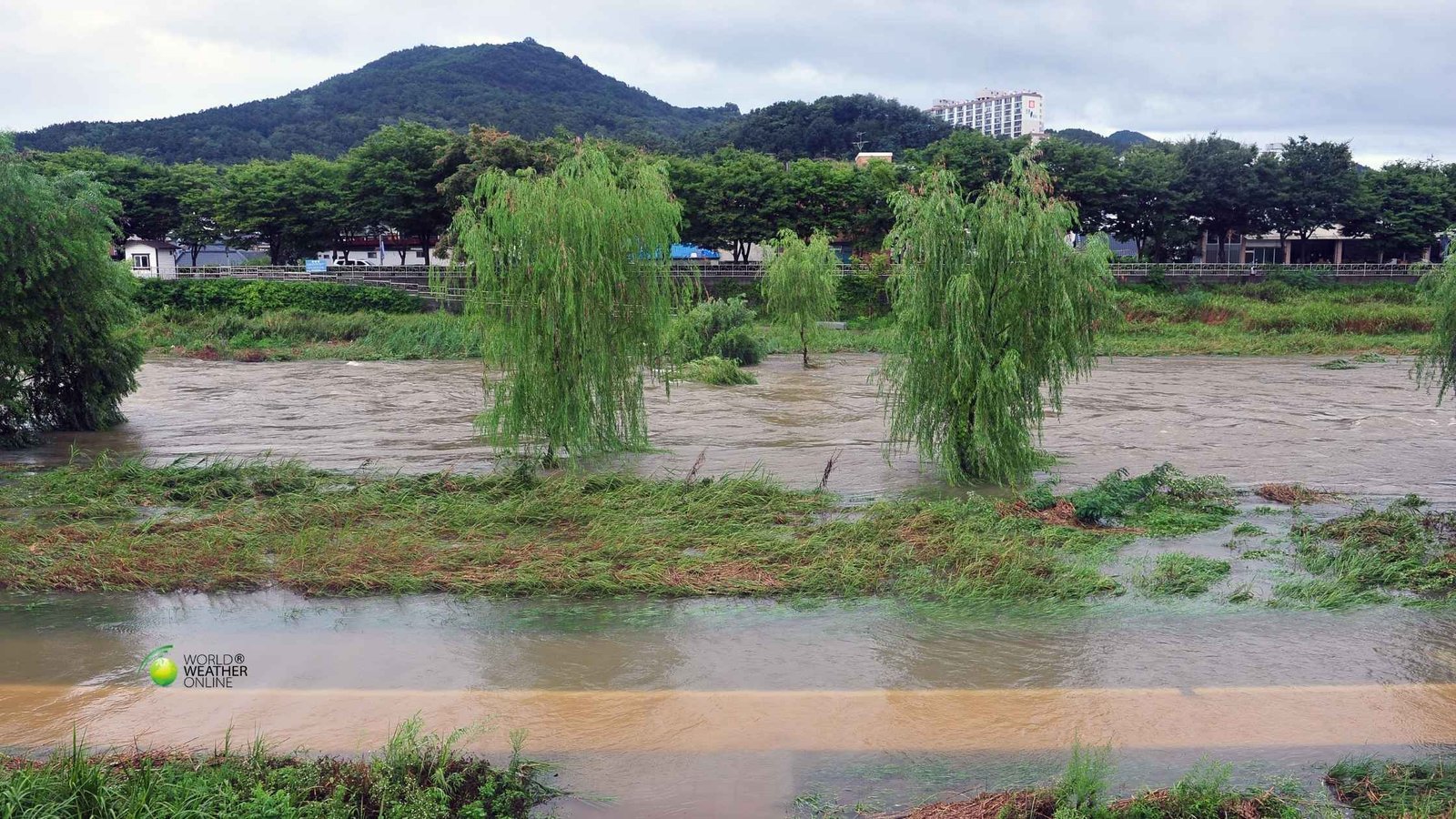
A journey through Chiba or Geoje should not usually involve escaping a submerged vehicle. Yet roads became rivers in both places as exceptional rain fell faster than the landscape could carry it away.
Japan and South Korea’s record rainfall arrived only four days apart. Though the storms were separate, they exposed the same danger: modern cities remain vulnerable when several weeks of rain are compressed into a few hours.
Chiba’s Records Collapsed Within Hours
The deluge struck Japan’s Chiba Prefecture, east of Tokyo, during mid-August. Warm, moisture-filled air produced rainfall that the Japan Meteorological Agency described as unprecedented.
Consequently, Chiba City measured 115 mm in one hour, easily surpassing its previous one-hour record of 71 mm. Moreover, Sakura received 97 mm during the same length of time. The intensity continued rather than fading after a single cloudburst.
Official observations showed the following rainfall statistics:
- Around 189.5 mm in three hours at Sakura
- 293 mm in six hours at Chiba
- Around 341.5 mm in 12 hours at Chiba
- Around 406.5 mm over 72 hours at Chiba
Several monitoring stations broke long-standing rainfall records. Chiba’s six-hour total exceeded its previous record by 82 mm, while its 12-hour accumulation was almost 74 mm higher than the earlier benchmark.
The figures soon became a human disaster, and Japan issued its highest heavy-rain warning across affected municipalities. More than 100,000 households were advised to evacuate, while over 20,000 lost electricity. Flooding and suspended transport left thousands of travellers stranded around Narita Airport during the busy Bon holiday period.
One week later, the confirmed death toll stood at 13, with another person missing. Some victims were found inside vehicles overtaken by rapidly rising water.
Geoje Received a Season’s Rain in Days
Four days after the Chiba deluge, extreme rain struck South Korea’s southern coast. Geoje, an island city in South Gyeongsang province, recorded 124.5 mm in one hour early on 17 August. Shockingly, more than 400 mm fell through the night.
From Saturday to Monday morning, Geoje accumulated 805.7 mm of rain. The continuing downpour pushed the broader total to approximately 912 mm by Monday evening. Nearby Tongyeong also received 671.9 mm during the initial period.
In fact, this was comparable to an entire summer’s rainfall arriving in a few days.
Rivers spilled across roads, homes flooded, and electricity failed in approximately 3,580 properties. Around 390 people were evacuated, while 12 schools and kindergartens were damaged. A rain-triggered landslide struck the lower floor of an apartment building in Geoje. Resultantly, one resident died, and four people were injured.
Why Did the Clouds Release So Much Water?
Japan frequently experiences heavy summer rain because warm, humid air from the North Pacific meets cooler air. The contrast forces moisture upwards. As the rising air cools, water vapour condenses and feeds powerful rain clouds.
While in the Chiba event, this moisture supply persisted over a densely populated area. Instead of a brief shower passing through, heavy rain continued long enough to break records across several timescales.
Southern South Korea had a similar abundance of warm maritime moisture. Geoje’s coastal position left it exposed, while the region’s hills helped lift the air further. Rain also saturated the ground over successive days. Once soil pores filled, additional water flowed rapidly downhill and weakened slopes, creating the conditions for landslides.
When Streets Become Part of the Drainage System
Scientifically, concrete and asphalt prevent rain from sinking naturally into the ground. Water is directed towards drains, channels and low points instead. If rainfall exceeds the system’s capacity, streets themselves become temporary waterways.
Underpasses remains especially dangerous. They sit below the surrounding road network and can collect water from several directions. A driver may enter while the surface appears manageable, only to find deeper water ahead or behind.
Chiba’s floods also demonstrated how disruption travels beyond the submerged neighbourhood. Flooded railway lines and access roads stranded passengers at Narita Airport even when terminals remained functional. Ultimately, one blocked transport corridor can affect thousands of people far from the deepest water.
A Warmer Atmosphere Raises the Possible Maximum
A warmer atmosphere can generally hold about 7% more water vapour for every 1°C of warming. This does not mean every rainy day becomes extreme. It means that when conditions are already favourable for heavy rain, clouds may have access to more moisture.
Additionally, warm seas can strengthen that supply. The result is a higher ceiling for short, concentrated downpours.
Climate change should not be presented as the sole explanation for these particular floods without a dedicated attribution study. Local air patterns, terrain, and storm movement remain essential. However, the wider rise in atmospheric moisture is making extreme rainfall an increasingly serious planning problem.


