






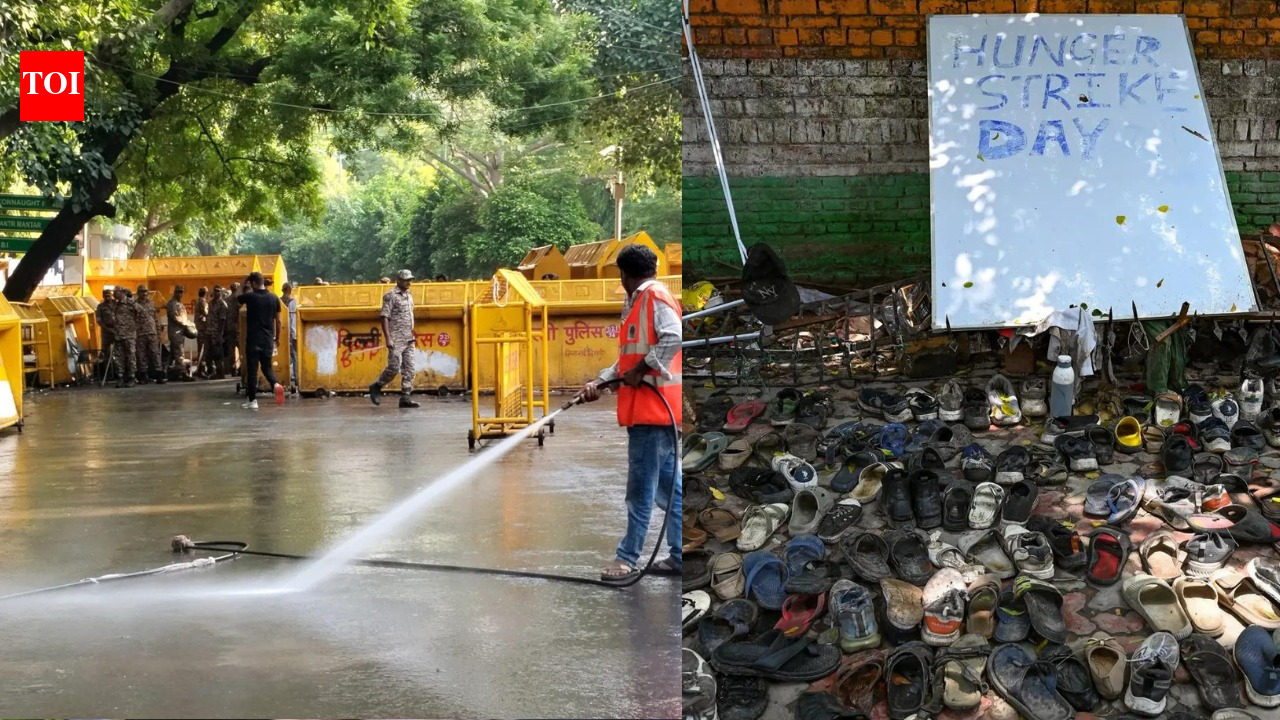
NEW DELHI: The stage where activist Sonam Wangchuk sat on hunger strike was gone. The tents, temporary kitchens and crowds that had occupied the road for weeks had disappeared. Yet Jantar Mantar was far from silent.Two days after the 36-day student agitation came to an end, a group of students gathered outside the barricades, taking selfies at the spot where the Cockroach Janata Party (CJP) had held its sit-in, according to news agency PTI.They were not there to protest. Some had arrived out of curiosity, while others wanted a photograph from a place they had repeatedly seen on social media.“Everyone was talking about this place. We watched the videos, saw the police action, saw the crowds. I wanted to see what it looked like when there was no protest,” said Rohan, 19, a CAT aspirant from Jaipur who is studying in Delhi.His friend, a student from Lucknow, was less interested in the empty road.“We came late. We knew the protest was over, but we still wanted to come once. It feels strange seeing this place so empty after watching thousands of people here,” he said.The students were not allowed inside the protest area. Barricades remained on both sides of the road, leaving visitors to look into the space where thousands of protesters had gathered until Saturday to demand accountability over paper leaks.The signs of the agitation were slowly disappearing, but the process was incomplete.On Monday, a painter was repairing barricades damaged during the protest. He repainted them yellow and used a red brush to write “Delhi Police” across them. Road dividers were also being repaired with fresh cement and painted in the familiar yellow-and-black pattern.Near the men’s washroom, remnants of the protest remained scattered. Mosquito nets, plastic chairs, posters, food storage vessels, dusty portraits of Jesus and a statue of BR Ambedkar were still lying around.The road was being cleaned, but traces of the protest lingered. Outside a row of South Indian restaurants, sewage was being cleared as the smell remained in the air.At Janpath market and nearby shops, traders were slowly reopening their establishments. Tea sellers returned to their stalls, and office-goers began coming back to the area.For shopkeepers who had witnessed the protest grow around them, however, normalcy was not returning as quickly as expected.Bava, who has operated his shop for four decades, said the barricades and road restrictions had badly affected his business.“Office-goers stopped coming. In the last week, even the internet was blocked, and the Metro and roads were affected. We were left with almost no business,” he said.The protesters themselves, he said, were not enough to make up for the loss.“Food was being distributed free to protesters, so there was very little business from them. And the police were not allowing people to enter from many sides. Even now, the area is barricaded. It will take some time for things to become normal again,” he said.Dinesh Sharma, who has sold tea near Jantar Mantar for nearly two decades, has witnessed several movements in the area, including the Anna Hazare agitation. However, he said the student protest brought a different kind of crowd.“Earlier, people came to listen. These youngsters came with their phones. They were jumping, shouting, recording everything. Every person seemed to be making a video,” he said.According to news agency PTI, during the protest, the road became a place where almost every moment was recorded and shared. By Monday, the crowd at his tea stall had changed. Around 20-30 Rapid Action Force (RAF) personnel stood nearby, checking their phones while waiting for their duties to end.“We will be here tonight as well,” one officer said, adding that they were on their regular duty.The security arrangements remained even after the protest ended. Barricades continued to block parts of the road, while the detention bus near the site appeared worn and damaged.Before the area could fully return to its usual routine, another protest had already begun.Around 50-60 people sat on a red carpet along the footpath, raising slogans demanding a separate Gorkhaland under the banner of the Gorkhaland Rashtriya Manch. The group had permission to protest for two days and planned to continue their demonstration on Sunday and Monday.Their protest took place at a location with recent political significance — the same spot where the CJP had placed its first poster after its founder Abhijeet Dipke arrived from Boston.Unlike the CJP agitation, which attracted thousands and dominated Jantar Mantar for weeks, the Gorkhaland protesters were attempting to build support around a demand that has existed for decades.Nearby, members of the All India Democratic Women’s Association were concluding their protest demanding 33 per cent reservation for women in Parliament. Their agitation, which began on July 20 and also supported the student movement, will continue until August 13, the final day of the Monsoon Session of Parliament.“We supported the students because their fight was also about the future of young people. By standing with them, we were also making our own voice heard,” said Babli Lamba, who had come from Hisar.Although the crowds had changed, Jantar Mantar continued to attract people who were not part of the original agitation.A group of journalists from Telangana also arrived in Delhi to raise demands including pensions for senior journalists and a national protection law for journalists.Srinivas, editor of a local Telugu daily, said the group travelled from Hyderabad because some issues needed to be raised beyond state boundaries.“We have held protests in Telangana. We came here because some demands cannot remain limited to one state,” he said.For many visitors, however, the location had become more than just a protest site. It had become a reminder of a recent movement they had followed online.Students from Haryana, Uttar Pradesh and nearby regions visited Jantar Mantar to see the place they had watched on their phones. A first-year college student from Rohini said she told her parents she was going nearby before taking the Metro to Jantar Mantar.“They would not have allowed me to come if we had told them the truth,” the 19-year-old said.A student from Sonipat said watching videos online had made the protest feel familiar, but visiting the location offered a different experience.“You can watch everything on your phone. But after a point, you want to know what it feels like to actually stand there,” he said.


