



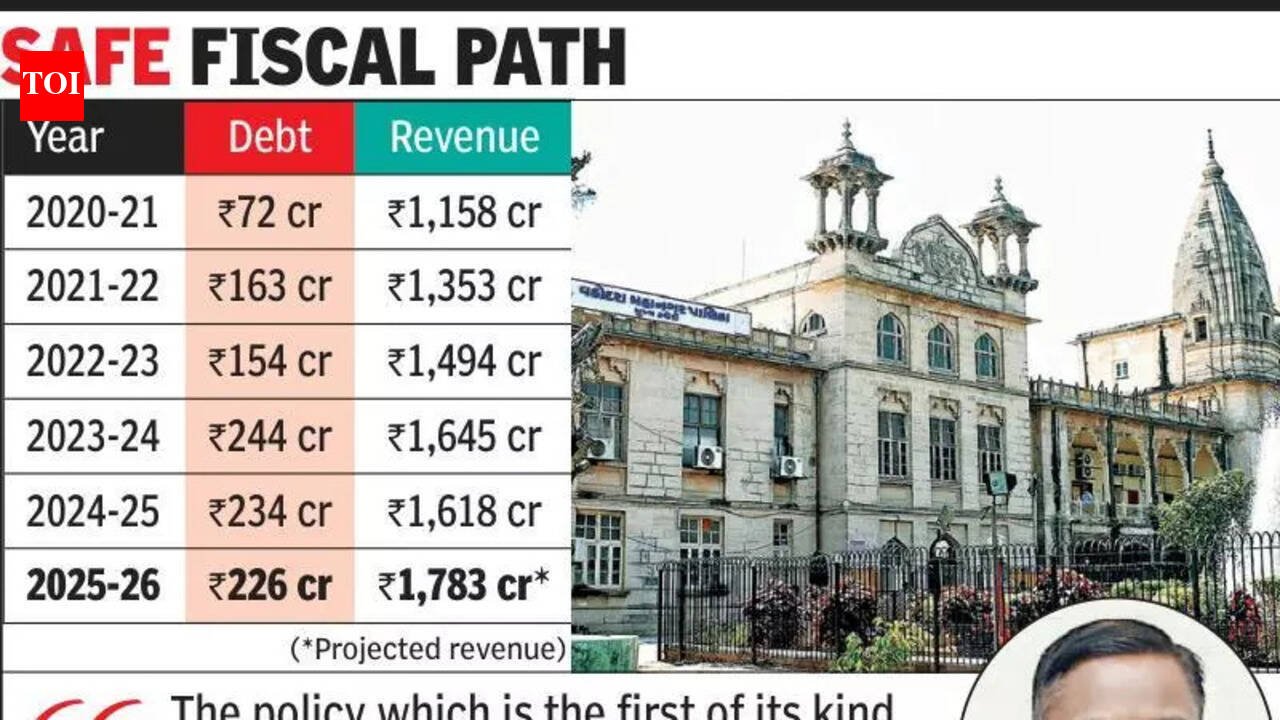
Vadodara: The Vadodara Municipal Corporation (VMC) says it has become the first civic body in the country to instate a debt management policy (DMP). The policy, drawn up with guidance from the US treasury department, outlines the conditions under which VMC can issue debt instruments or take advances.The policy was introduced as VMC’s capital expenditure has risen with a growing number of projects, including those requiring the civic body’s contribution under government schemes. To meet these obligations, VMC has increasingly relied on bonds and advances. Under the Smart Cities Mission, the Union ministry of housing and urban affairs has an arrangement with the US treasury department to support six Indian cities in issuing municipal bonds. Through this arrangement, VMC and the municipal corporations of Rajkot, Pimpri Chinchwad, Faridabad, Mysore and Mangaluru received technical assistance. VMC’s current borrowings stand at Rs 226 crore — Rs 200 crore through bonds and Rs 26 crore in advances. Officials said that against the balance sheet size of Rs 16,817 crore, this exposure remains low. Debt has declined over the last three fiscal years, with a projected revenue of Rs 1,783 crore for the current fiscal and a surplus of Rs 430 crore in Feb. The civic body plans to raise Rs 200 crore through Blue Bonds for water supply schemes in FY 2026-27 and has Rs 120 crore in an escrow account for debt servicing. “The policy will ensure debt is not taken recklessly. It is a framework within which we can take debt and draws limits that we cannot cross,” said VMC chief account officer Santosh Tiwari. He added that 4% of revenue currently goes towards debt servicing. The policy mandates maintaining adequate operating surplus, sufficient cash reserves and low leverage against resources such as property tax. It also requires that the corporation avoid actions that could trigger a ratings downgrade. According to the policy, long-term debt should be used only for capital assets, infrastructure projects and equipment where costs can be spread across multiple budget years. It cannot be used for annual operations. Bond issues must be tied to clearly defined and approved projects. The policy further states that debt must not exceed limits set by the debt capacity analysis template. This analysis must be completed at least annually, upon release of new financial results, and before issuing fresh debt. The policy itself will be reviewed and updated annually. A debt service reserve fund (DSRF) should generally be funded using bond proceeds but may also be supported by municipal accounts or freed-up sinking fund deposits. The DSRF must be invested in safe, liquid assets, and may be used to make the final debt service payment in the last year of a bond’s tenure. VMC standing committee chairman Sheetal Mistry said the policy strengthens fiscal discipline. “The policy was ratified with the budget and was cleared by the elected wing,” he said.


