



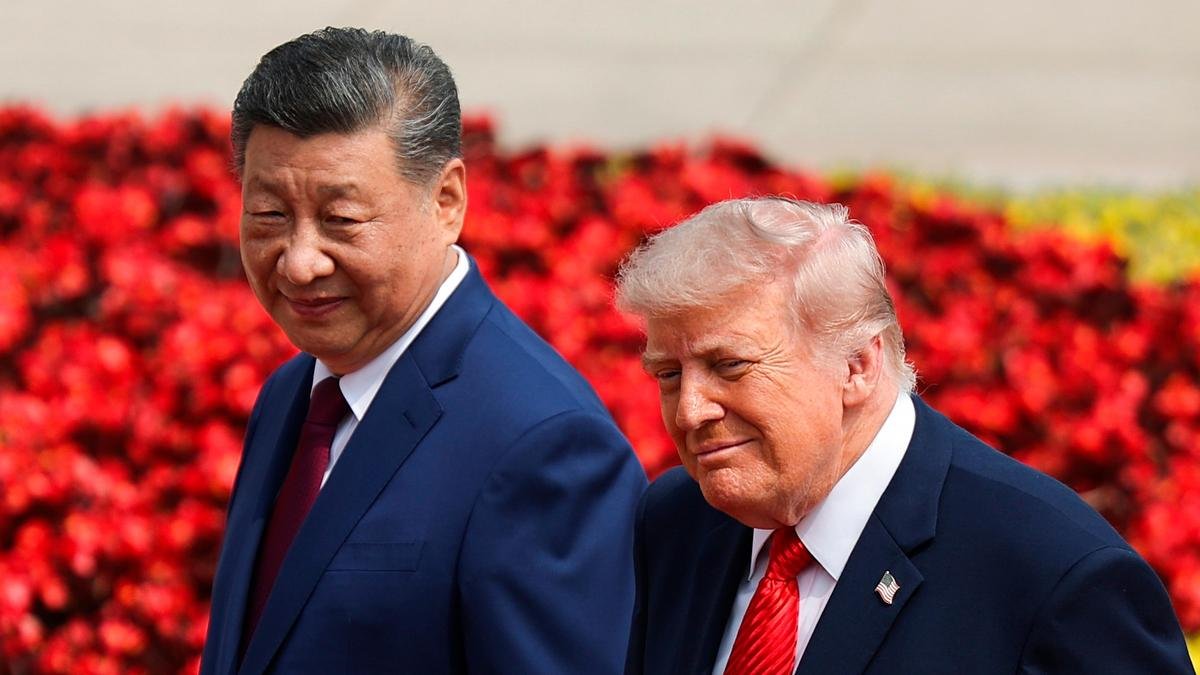
The United States and China appeared to come to an uneasy truce — at least for now — on trade, Taiwan, and the future of an increasingly contested relationship, as their leaders met for talks in Beijing on Thursday (May 14, 2026).
Chinese President Xi Jinping told visiting U.S. President Donald Trump that relations could descend to “clashes and conflicts” if the Taiwan question, which he described as “the most important issue in China-U.S. relations”, was not managed properly, according to the Chinese readout of the talks. “If it is handled properly, the bilateral relationship will enjoy overall stability. Otherwise, the two countries will have clashes and even conflicts, putting the entire relationship in great jeopardy,” he said. China also conveyed its opposition to U.S. arms sales to Taiwan.
Also Read | U.S. to persuade China to play ‘more active role’ in resolving Iran war crisis, says Marco Rubio
The U.S. readout, for its part, made no mention of Taiwan, although Secretary of State Marco Rubio later told reporters the U.S. position remained unchanged. The readouts suggested both sides had merely underlined their respective positions on an issue that remains a flashpoint.
The White House statement said both agreed on the need to keep the Strait of Hormuz open and to support the free flow of energy, and that Mr. Xi had “made clear China’s opposition to the militarisation of the strait”. However, there appeared to be no broader agreement on addressing the Iran crisis.
The ceremony in Beijing trumped the substance. Mr. Trump’s visit began with a grand welcome on Thursday (May 14, 2026) morning, as he was greeted by marching PLA troops and cheering schoolchildren at the Great Hall of the People. “It really was a magnificent welcome like none other,” Mr. Trump said.
The two leaders spent several hours in each other’s company, with the two-hour-long delegation talks followed by Mr. Xi taking the U.S. President on a tour of the Temple of Heaven. A state banquet followed in the evening, with further talks over tea set for Friday (May 15, 2026) in the Chinese leadership’s Zhongnanhai compound.
Also Read | Key events in ties among United States, China and Taiwan
New vision for ties
At the formal talks, Mr. Xi called for “a new vision” for ties, which he labelled “a constructive relationship of strategic stability” for “the next three years and beyond”.
The two leaders may meet three more times this year alone, officials said. Mr. Trump invited Mr. Xi to visit the U.S. on September 24, which he provisionally accepted. The two leaders could also meet at an APEC (Asia-Pacific Economic Cooperation) summit that China is set to host later this year, and at the G-20 meet in Miami.
The broader challenge facing the two leaders as they navigate a fractious relationship is a changed dynamic. “The U.S. still thinks it is dealing with the China of 10 years ago, but the power dynamic has shifted”, said Cameron Johnson, formerly Professor at New York University Shanghai and senior partner at a supply chain consulting firm that advises U.S. and Chinese companies.
Both countries have traded blows in an ongoing trade and technology war. For U.S. businesses, restricted access to rare earths was a major worry, while for China, American export controls remain a concern, especially on semiconductors.
The visit could yield a temporary truce. Mr. Johnson said there could be some relaxation by China on rare earths for commercial use, but even that would depend on whether the U.S. eases up on tariffs and export controls. Reports on Thursday (May 14, 2026) said the U.S. cleared 10 Chinese firms to purchase advanced H200 chips from Nvidia, whose CEO Jensen Huang accompanied Mr. Trump to Beijing.
U.S. Treasury Secretary Scott Bessent said on Thursday (May 14, 2026), both sides were also discussing setting up a Board of Trade for trade issues and a Board of Investment to allow Chinese investment in non-sensitive sectors.
The U.S.-China trade tango offered lessons for India, Mr. Johnson said. “There are thousands of choke points in the supply chain,” he said. “The first thing to do is to map your supply chain, and only then can you have a consideration of both your needs and your vulnerabilities.” In both the U.S. and India, he noted, measures to curb Chinese investment eventually resulted in an even greater reliance on imports from China.
Published – May 14, 2026 10:32 am IST


