



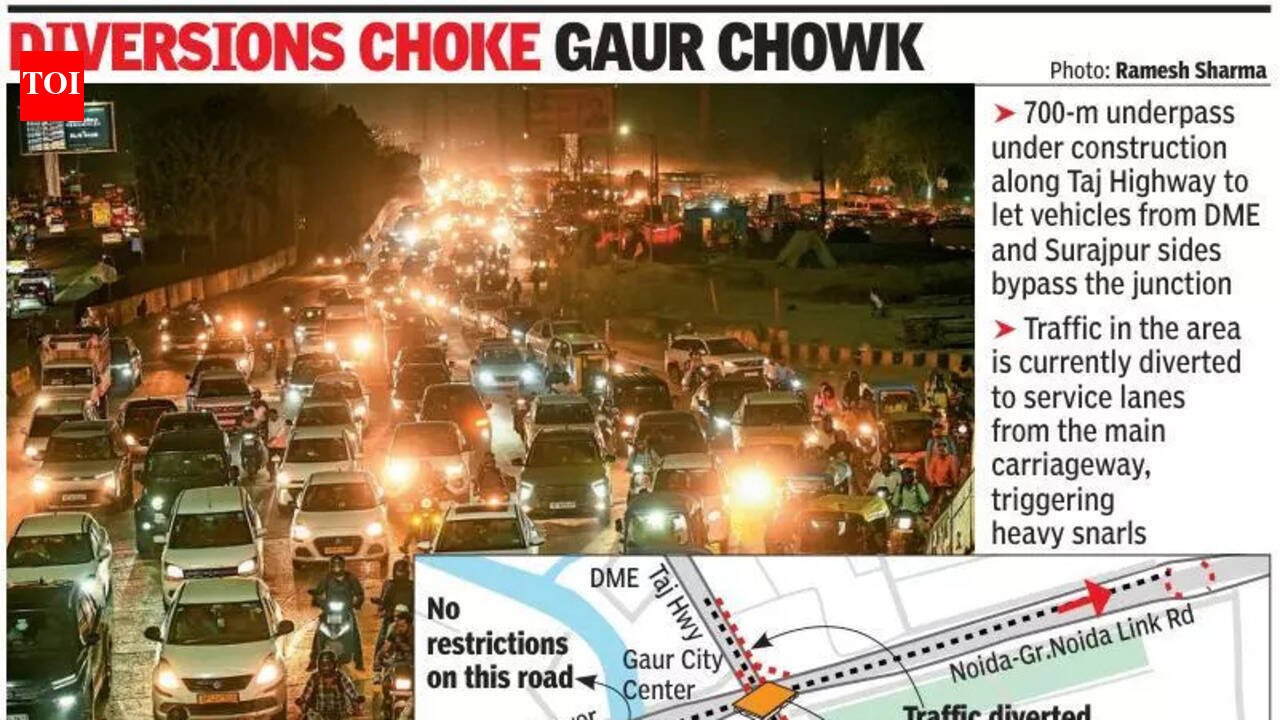
Noida: The 700-metre underpass running parallel to Taj Highway that is expected to decongest Gaur Chowk, among Greater Noida West’s busiest stretches, is likely to open by June. Greater Noida Industrial Development Authority (GNIDA) chief executive officer Sumit Yadav said about 65% of the work has been completed.“In Sept last year, the slab of the underpass was completed, and traffic movement was allowed without restrictions for vehicles travelling from Parthala Chowk to Gaur Chowk and further towards Ek Murti Chowk,” Yadav said. “We expect to complete the remaining work in the next three to four months and aim to open it before the monsoon. This will significantly improve traffic movement at Gaur Chowk.”Dotted with several housing societies and malls, Gaur Chowk remains knotted with snarls as traffic from Noida, Surajpur, Crossings Republik, and Delhi-Meerut Expressway converges at the intersection. During peak office hours, tailbacks extend up to Parthala flyover. Once ready, the Rs 92-crore six-lane underpass will allow vehicles coming from or headed to Surajpur to bypass the daily bottlenecks at Gaur Chowk by connecting Greater Noida directly with Gaur City and DME ahead.Currently, traffic has been diverted from the main carriageway to service lanes on both sides of the Taj Highway, leading to heavy congestion during peak hours. There are no curbs on Vikas Marg, which intersects the highway at the intersection. Commuters claimed the ongoing construction has made the junction difficult to navigate. Rakesh Kumar said traffic from the three-lane carriageway is abruptly diverted into a service lane near Gaur Chowk. “It can take nearly half an hour to cross the area during rush hour,” he said.Amit Kumar, a resident of Noida’s Sector 121, who frequently travels between Noida and Greater Noida West, said the narrowed lanes cannot handle the volume of traffic. “Vehicles remain stuck for long stretches. Even two-wheelers find it hard to move. Autos, e-rickshaws and food carts also occupy the roadside,” he said.Work on the project began in June 2024 with an initial completion timeline of 18 months.


