






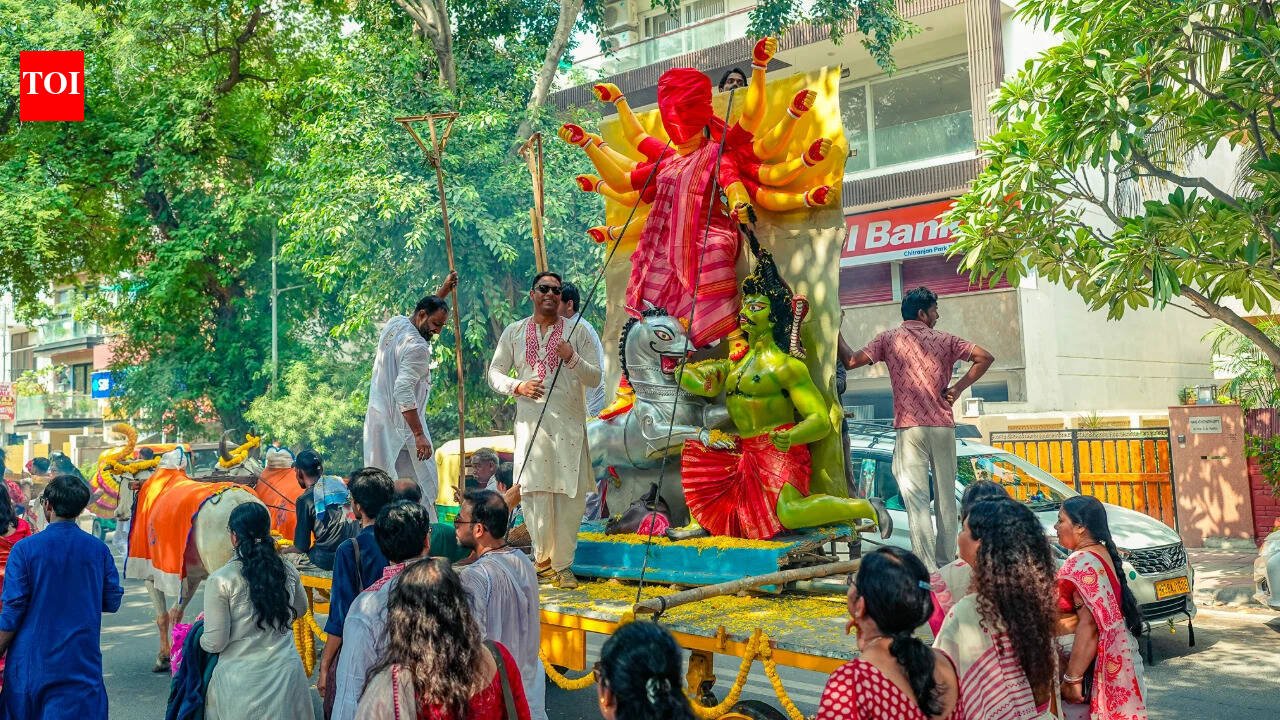
From a ritual honouring the murtikar to spontaneous dances at crossroads, the Mahalaya procession celebrated the goddess’s journey home in CR Park on Saturday morning. Members of the Durgotsab GK2 community, dressed in red and white, gathered to bring Uma home. The first beats of the dhaak marked the start of her journey from the workshop, where artisans from Krishnanagar had been shaping the pratima, to the pandal in Greater Kailash 2.
Before the pratima was taken out of the workshop, a traditional ritual called Taam thanda was observed
Before the pratima left the workshop, the community observed a ritual called taam thanda, presenting the murtikar with a basket of clothes, fish, and other essentials. “The offering carried a message of abundance and prosperity – a wish that the artisan’s household would always be well provided for, with rice in the fields, fish in the rivers and oil in plenty,” said key organiser Samrat Banerjee.
Samrat Banerjee, who leads the Durgotsab GK2 celebrations, during the Mahalaya Shobha Yatra from the murtikar workshop in CR Park to the pandal in GK2
Dressed in red and white, members of the Durgotsab GK2 community welcomed Maa with gusto
As the procession moved through CR Park towards Greater Kailash II, the sound of the dhaak accompanied the community.
As the procession made its way through CR Park towards GK2, the beats of the dhaak and the fragrant smoke of the dhuno accompanied the community. At crossroads, including near Market One, members would briefly form a circle and perform kikli, breaking into spontaneous bursts of dance before moving ahead without disrupting traffic.
The idol’s arrival by bullock cart revived an old tradition
Anandloke and Vande Mataram mark the arrivalOnce the idols were installed on the bedi at the pandal, the community sang Rabindranath Tagore’s Anandloke, followed by Vande Mataram. The latter held particular significance this year, as the national song’s 150th anniversary formed the theme of the Durgotsab GK2 pandal.
Members of the community danced to the festive beats during Durgotsab GK2’s Mahalaya Shobha Yatra.
The theme draws on the spirit of Vande Mataram as an expression of the country’s cultural diversity and shared identity. Through art, music, textiles, food and community participation, the organisers seek to explore how the song’s spirit can bring people together across regional, cultural and social differences.
Once the idols reached the pandal and were placed on the bedi, the gathering sang Anandloke, composed by Rabindranath Tagore, followed by Vande Mataram.
This inclusive approach also informs the larger philosophy of Durgotsab GK2, rooted in the invocation Ya Devi Sarva Bhuteshu — the goddess who resides in all beings. The organisers have sought to extend this idea beyond the visual design of the pandal through accessibility initiatives, including Braille interpretations for visually impaired visitors and sign-language explanations of the puja for devotees with hearing or speech impairments.
A quick round of kikli at a crossroads:
An artistic agaazThe Shobha Yatra marked the beginning of the celebrations in the 35th year of Durgotsab GK2. The celebrations continued on Sunday with Gandharvika, an evening of classical music featuring musicians and singers presenting raag and raaginis to celebrate Maa Durga’s homecoming. Curated and produced by the Roots and Wings community, the programme was held at the Naat Mondir.
Curated and produced by the Roots and Wings community, the programme was held at the Naat Mondir.
The evening also saw the unveiling of Matrika: The Cosmic Warp and Weft, a series of five monumental diptychs by Spanish-born artist Javier Artacho. Drawing on the cultural and spiritual dimensions of Vande Mataram and Navaratri, the paintings depict scenes of devotion, rural life, sacred rituals and the feminine divine. Combining classical European traditions with the dramatic chiaroscuro of Andalusian masters, Artacho’s work offered an artistic interpretation of the ideas underpinning this year’s celebrations at Durgotsab GK2.
The evening also saw the unveiling of Matrika: The Cosmic Warp and Weft, a series of five monumental diptychs by Spanish-born artist Javier Artacho.


