






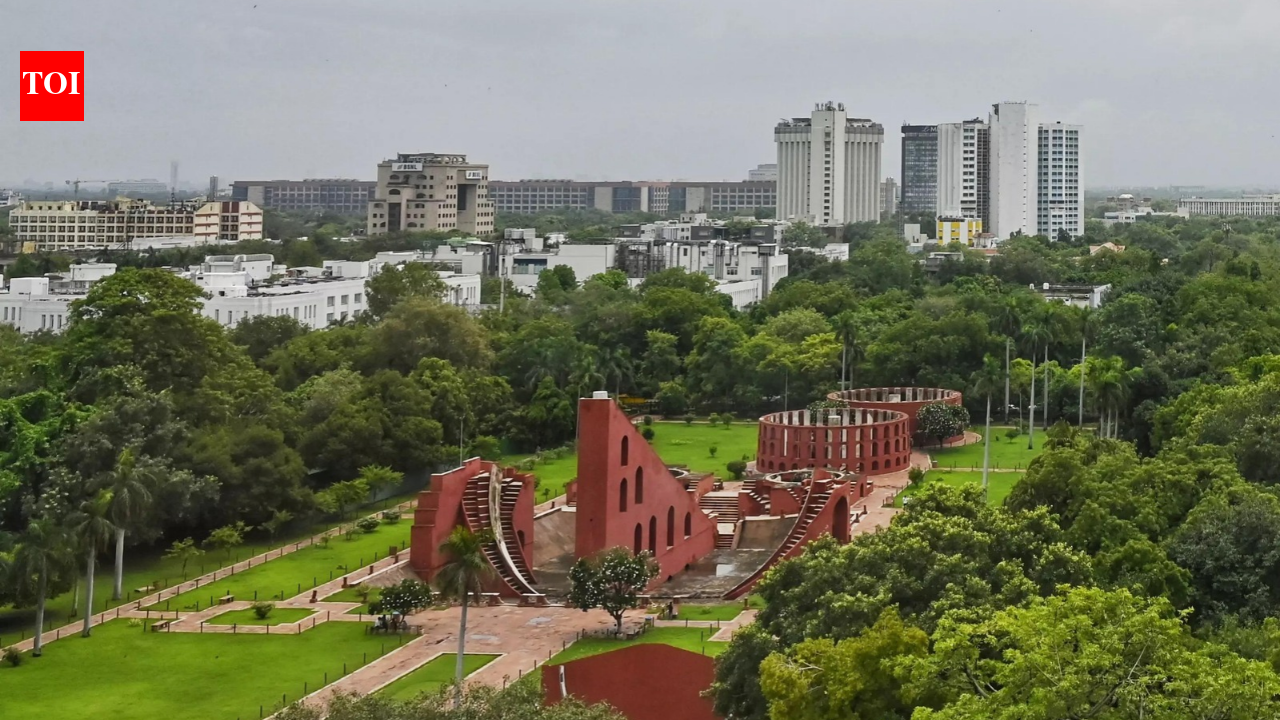
NEW DELHI: The Cockroach Janata Party (CJP) on Monday wrote to the Delhi Police asking for permission and a fixed date to hold a peaceful demonstration at Jantar Mantar. The party gave authorities 24 hours to respond.The letter comes as the 18th-century observatory has been de-notified as a designated protest venue in Delhi. According to an official notice, the Delhi police have named three new sites: Ramlila Ground, Burari Ground and CBD Ground. The decision follows heightened security arrangements after calls for protests in the capital.
A maharaja’s eye on the heavens
Jantar Mantar was built in 1731 by Jaipur ruler Maharaja Sawai Jai Singh II, during the reign of Mughal emperor Muhammad Shah. A PTI report notes that it was one of five observatories he raised across India to study celestial bodies and refine astronomical calculations.Historian Rana Safvi, in her book Shahjahanabad: The Living City of Old Delhi, describes its towering masonry instruments, among them the Samrat Yantra, Jai Prakash, Ram Yantra and Misra Yantra. They were used to measure time, follow the sun and planets, and compute astronomical positions.Its location in the heart of the capital, close to Parliament, government offices and Connaught Place, would later give the adjoining road a very different identity.
From Boat Club lawns to Jantar Mantar Road
Jantar Mantar was not always the city’s main protest ground. For decades after Independence, some of Delhi’s biggest demonstrations were held on the Boat Club lawns near India Gate. Other groups camped behind the Red Fort for days or weeks, hoping to meet ministers and press their demands.Historian Sohail Hashmi told PTI that Delhi had a long tradition of public protest, with large demonstrations filling the stretch between Boat Club and India Gate in the 1960s.
Jantar Mantar was built in 1731 by Jaipur ruler Maharaja Sawai Jai Singh II. (File Photo)
That changed after the massive farmers’ agitation led by Mahendra Singh Tikait in the late 1980s. Citing security and public order concerns, authorities gradually restricted protests at Boat Club. By 1993, Jantar Mantar Road had become the designated venue for dharnas and demonstrations in central Delhi.Trade unions, farmers, students, pensioners, ex-servicemen, displaced communities, activists and families seeking justice gathered there in growing numbers, making their grievances visible close to the seat of power.
When dissent met the right to peace
The arrangement lasted nearly 25 years. In 2017, residents of Jantar Mantar Road approached the National Green Tribunal. They argued that their neighbourhood had effectively become a permanent protest site, with demonstrations running for weeks or months and bringing tents, temporary structures, loudspeakers, garbage and disruption to daily life.In October 2017, the tribunal ordered that protests at Jantar Mantar be stopped and moved to Ramlila Maidan.The Mazdoor Kisan Shakti Sangathan, farmers’ organisations, the Indian Ex-Servicemen Movement and others challenged the order in the Supreme Court. They argued that a blanket ban would violate the fundamental right to peaceful assembly. They also said it would push protests farther from Parliament and the seat of government, making them less visible and harder to reach, especially for poorer protesters.On July 23, 2018, the Supreme Court tried to balance the competing interests. It recognised residents’ rights to peace and a clean environment alongside citizens’ fundamental right to protest peacefully. It directed authorities to regulate demonstrations through guidelines rather than prohibit them outright.The framework required prior police permission and set conditions on crowd size, duration, sanitation, noise, traffic management, public order and organisers’ responsibilities. Jantar Mantar Road was designated for protests of up to 1,000 people, while larger gatherings were to be held at Ramlila Maidan.
A symbol at a crossroads
Hashmi told PTI that Jantar Mantar had become a symbol of democratic dissent, with protests there often involving small groups or individuals raising different issues.Referring to the ongoing CJP agitation, he said the scale and duration of the mobilisation stood out. He described such large gatherings, sustained over a long period at the site, as something not seen in recent decades.The Delhi Police’s decision to de-notify Jantar Mantar as a protest venue marks another turn in its story. The observatory remains a monument to scientific inquiry, while the road beside it carries the legacy of generations who gathered there to seek justice, press for change and demand to be heard.The two histories have long shared one name. One was built to understand the movements of the heavens, the other shaped by citizens trying to influence events on the ground.(With agency inputs)


