


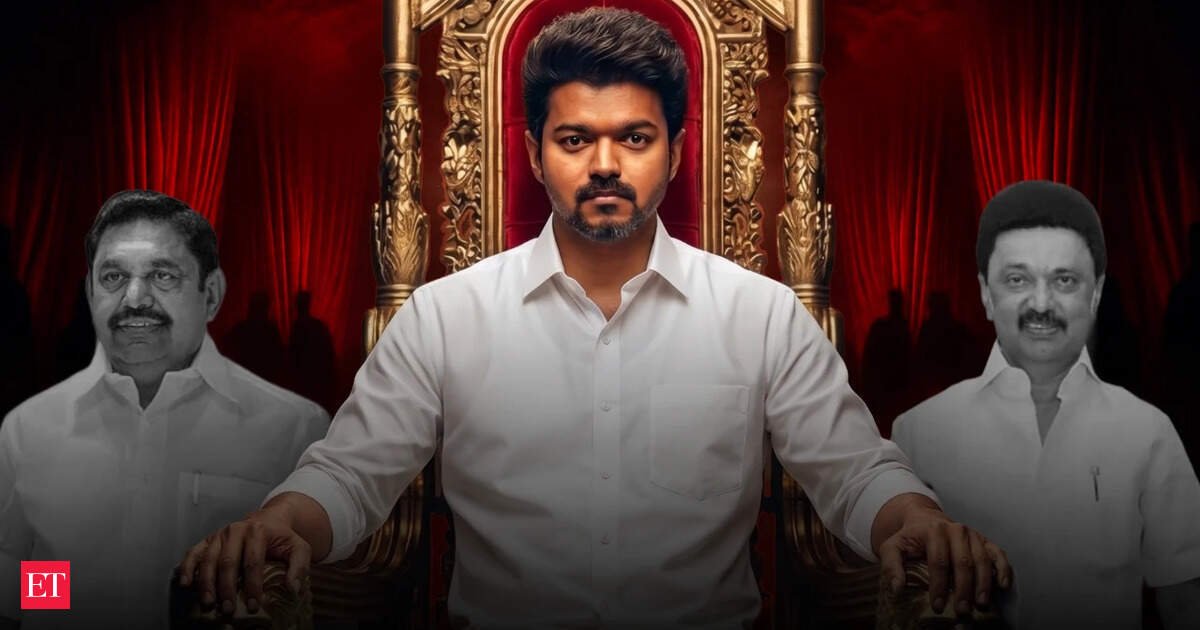
The swearing-in ceremony at Nehru Stadium in Chennai came after the TVK, led by Vijay, formed a coalition with Congress, Viduthalai Chiruthaigal Katchi (VCK), Communist Party of India (CPI), Communist Party of India (Marxist) and the Indian Union Muslim League Legislature Party (IUML) to cross the majority mark of 118 seats in the 234-member Assembly.
Vijay’s swearing in as Tamil Nadu CM ends the decades-long dominance of the DMK-AIADMK political axis in the state.
The development follows a tense post-poll deadlock in which Governor Rajendra Vishwanath Arlekar had initially sought clarity on TVK’s majority support before inviting Vijay to form the government, triggering sharp criticism from opposition leaders and allies.
With Congress extending support to TVK and Left parties, along with smaller regional outfits eventually backing the alliance, Vijay is now set to lead what one may call Tamil Nadu’s first major post-Dravidian coalition-era government.
Vijay’s Cabinet Ministers list
Vijay, the new Tamil Nadu CM has recommended a list of nine persons to be appointed as Ministers for the state, making his cabinet a mixture of both youth and experience. The following ministers have been approved by Governor Arlekar to join Vijay’s cabinet:
- N. Anand
- Aadhav Arjuna
- Dr. K.G. Arunraj
- K.A. Sengottaiyan
- P. Venkataramanan
- R. Nirmalkumar
- Rajmohan
- Dr. TK. Prabhu
- S. Keerthana
Also read: Tamil Nadu cabinet ministers list
A fractured mandate that reshaped Tamil Nadu politics
The 2026 Assembly election was expected to be a high-stakes contest with Vijay’s debut polls. TVK emerged as the single largest party with 108 seats, leaving both the ruling Dravida Munnetra Kazhagam (DMK) and the opposition All India Anna Dravida Munnetra Kazhagam (AIADMK) stunned.
Congress, which secured five seats, later extended support to TVK despite its long-standing alliance history with the DMK, triggering sharp accusations of “betrayal” from DMK leaders.
The AIADMK declined to support TVK, forcing Vijay to rely on negotiations with smaller parties, including VCK, CPI and CPI(M) to secure the majority mark required for Tamil Nadu government formation.
Track live developments of Vijay’s oath-taking ceremony
Governor row fuelled political tensions
Congress leaders, including Kapil Sibal, accused Governor Rajendra Vishwanath Arlekar of ‘buying time’ to facilitate political manoeuvring in favour of the BJP, while other opposition leaders alleged that he was acting under pressure from the Centre.
Sibal publicly criticised the delay, while Tamil Nadu Congress chief K Selvaperunthagai organised statewide protests, accusing the Governor of undermining constitutional norms.
Who was in the race?
2026 Tamil Nadu elections represented the first triangular political battle in the state
Forner Chief Minister MK Stalin’s DMK campaigned on governance continuity and the legacy of Dravidian welfare politics, while Edappadi K. Palaniswami’s AIADMK party attempted to regain lost political ground amid leadership challenges.
Vijay’s TVK, meanwhile, positioned itself as a generational alternative promising political disruption, administrative reform and anti-establishment governance.
Smaller parties such as VCK and the Left parties ultimately emerged as key players in determining the formation of the next government.
Also read: Big ‘Vijay’ for TVK as VCK promises ‘unconditional support’ to form govt in Tamil Nadu
What drove TVK’s rise?
TVK’s breakthrough was driven by a combination of anti-incumbency, youth mobilisation and Vijay’s long-cultivated cinematic image as a “common man’s hero”.
For over two decades, Vijay’s films repeatedly portrayed him as a figure confronting corruption, defending farmers, challenging exploitative systems and standing up for ordinary citizens.
Films such as Kaththi, Mersal and Sarkar helped shape a political persona that blurred the line between cinema and governance.
His popularity among Gen Z voters also played a decisive role. Viral film dialogues and politically interpreted songs transformed Vijay’s cinematic universe into a digitally amplified political movement.
Unlike traditional politicians who rose through party structures, Vijay entered politics with a ready-made emotional connection with millions of voters.
A new political era begins
Vijay now assumes office at a time of enormous expectations and equally significant scrutiny.
Questions remain over how TVK will transition from a personality-driven movement into a governing institution, how coalition management will shape policy decisions and whether Vijay can sustain the anti-establishment appeal that powered his rise.
His elevation to the Chief Minister’s office marks a defining moment in Tamil Nadu politics.
For the first time in decades, the state’s political front is no longer centred solely around the DMK-AIADMK axis. Instead, it has entered a new phase shaped by cinematic populism, digital-age mobilisation and a generational demand for political reinvention.
