



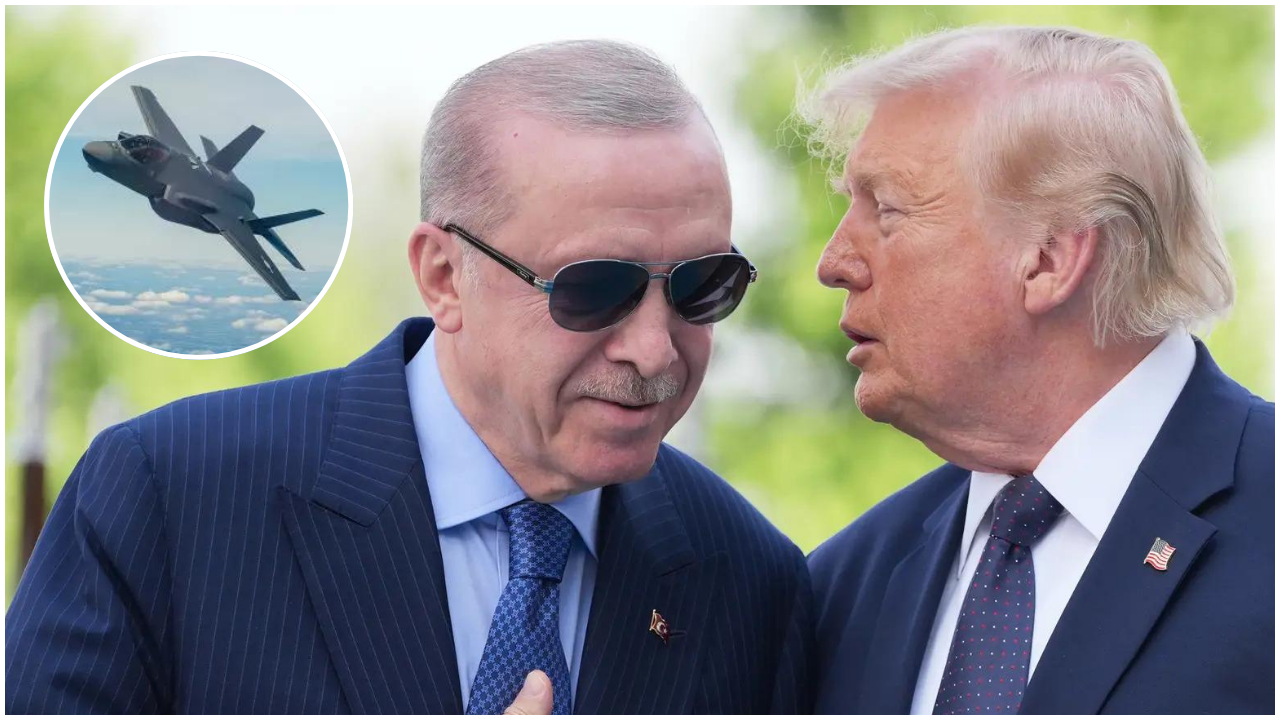
The future of Turkey’s access to the US-made F-35 stealth fighter has once again come under the spotlight after reports suggested that US President Donald Trump is considering allowing Ankara back into the programme.Washington reportedly discussed the issue with Turkish President Recep Tayyip Erdogan on the sidelines of the Nato summit in Turkey, signalling a possible thaw in defence ties that have remained frozen since 2019.The development has also triggered opposition from Israel. Israeli Prime Minister Benjamin Netanyahu has publicly urged Washington not to sell the fifth-generation fighter to Turkey, arguing that doing so would alter the military balance in the Middle East.According to CNN, Netanyahu warned that supplying F-35s to Ankara would “destroy the power balance in the Middle East” and described Turkey under President Recep Tayyip Erdogan as “not exactly a model ally of the United States.”
Why did Turkey lose access to the F-35?
Turkey was one of the original international partners in the F-35 Joint Strike Fighter programme. It had planned to purchase more than 100 aircraft and was also manufacturing several components for the jet.However, relations deteriorated sharply in 2019 after Ankara purchased Russia’s S-400 air defence system despite repeated warnings from Washington.The United States argued that operating the Russian-made S-400 alongside the F-35 could expose sensitive stealth and electronic warfare technologies to Moscow.As a result, Turkey was removed from the F-35 programme and sanctioned under the Countering America’s Adversaries Through Sanctions Act (CAATSA).Congress also passed legislation prohibiting the transfer of F-35 aircraft to Turkey as long as it retained the S-400 system.Trump is now exploring ways to restore Turkey’s participation, although any move would have to navigate congressional and legal restrictions.
Which countries currently operate the F-35?
The F-35 is not exported like a conventional fighter aircraft. It remains one of America’s most closely guarded military technologies, combining stealth capabilities, advanced sensors, electronic warfare systems and secure battlefield networking.Washington generally sells the aircraft only to trusted allies and long-term strategic partners that can integrate with US military operations.As of 2026, the F-35 is operated by 11 countries, while the wider programme includes the United States and 19 allied nations.In Europe, the United Kingdom uses the carrier-capable F-35B to strengthen Nato expeditionary operations.Italy serves as both an operator and home to Europe’s only Final Assembly and Check-Out (FACO) facility, making it a major production and maintenance hub.The Netherlands supports Nato air policing and logistics, while Norway deploys the aircraft to monitor Russian activity in the Arctic. Denmark contributes to Baltic security, and Belgium supports Nato’s nuclear-sharing mission.In the Indo-Pacific, Australia uses the F-35 as a cornerstone of its defence partnership with the United States. Japan and South Korea operate the aircraft to deter both China and North Korea while integrating closely with US forces stationed in the region.Israel is the only Middle Eastern country operating the F-35. Unlike other operators, it flies the customised F-35I Adir, fitted with Israeli-developed electronic warfare systems, mission software and indigenous weapons integration.Several additional US allies have placed orders but are awaiting deliveries. These include Germany, Finland, Poland, Switzerland, the Czech Republic, Greece, Romania, Canada and Singapore, all of which are acquiring the aircraft to modernise their air forces and strengthen regional deterrence.For Washington, the F-35 serves not only as a military platform but also as a strategic tool to deepen alliances, improve interoperability and reinforce regional security architectures across Europe, the Middle East and the Indo-Pacific.
Why is Israel opposed to selling the F-35 to Turkey?
Israel’s opposition stems from its long-standing Qualitative Military Edge (QME) — a US policy that ensures Israel maintains superior military capabilities over potential regional adversaries.The F-35I Adir has become central to that advantage. Its Israeli-specific upgrades allow the country’s air force to conduct deep-strike missions with capabilities unavailable to most other operators.If Turkey were to acquire the aircraft, it would become another regional power with fifth-generation stealth capability, significantly narrowing Israel’s technological lead.Speaking to CNN, Netanyahu said Turkey under Erdogan was “not exactly a model ally of the United States” and warned that providing Ankara with America’s most advanced fighter would fuel further regional instability.Relations between Israel and Turkey have deteriorated sharply since the Gaza war, with Erdogan repeatedly accusing Israel of genocide and Netanyahu criticising Ankara’s support for groups linked to the Muslim Brotherhood.
What happens next?
As per Reuters, Trump’s administration is exploring ways to bring Turkey back into the programme, although officials remain divided over how to overcome existing legal and congressional restrictions.The issue has become one of the most contentious defence questions facing Washington as it balances its strategic relationship with Nato ally Turkey against Israel’s security concerns and long-standing US commitments to preserving Israel’s military superiority in the Middle East.


