


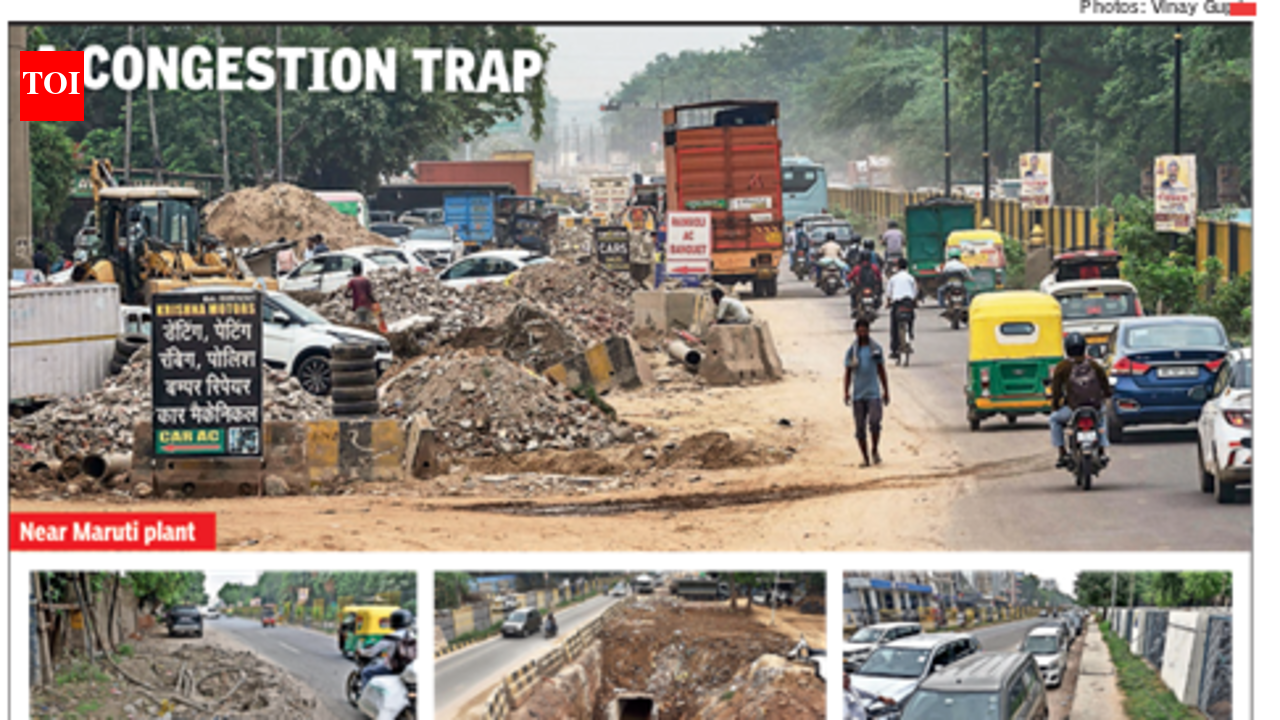
Gurgaon: It’s a daily ordeal for thousands of commuters on Old Delhi-Gurgaon road.Encroachments, unfinished civic works, waterlogging, overflowing sewers and poor traffic management — traffic on one of the city’s key arterial roads crawls, besides posing a serious safety hazard.“Old Delhi-Gurgaon road was once part of the Delhi-Jaipur highway and should have the infrastructure of a major arterial road,” says Sector 23 RWA vice-president Bhawani Shankar Tripathy, adding, “Instead, the carriageway is uneven and the drainage system has virtually collapsed. Pavements are either missing or unusable, signages are inadequate and encroachments have narrowed the road at several places. The road has suffered from years of neglect despite being one of the city’s oldest and busiest corridors.”A five-km stretch from Atul Kataria Chowk to Dundahera, which connects several residential sectors with industrial hubs, corporate offices and the Delhi border, witnesses heavy traffic throughout the day.Residents say the traffic volume has increased significantly over the past few years, but the condition of the road has steadily deteriorated, with little visible action from the authorities despite repeated complaints.A major concern is the ongoing construction of the master stormwater drain, for which nearly half of the 30-metre-wide road has been barricaded. While the project is aimed at addressing flooding, commuters say the execution has only worsened congestion.Saket Singh, a resident of Gurgaon One, told TOI, “The biggest problem is wrong-side driving by e-rickshaws and other vehicles, with hardly any enforcement. There are also dug-up stretches where drainage work is underway. Even after temporary repairs, the recent rains have led to fresh waterlogging because there is no proper outlet for the accumulated water.”A section of the road near the Sector 17/18 dividing road was dug up last year for laying the drain. Though part of the dug-up stretch has since been filled back, several portions remain open, with loose debris scattered on the carriageway. During the monsoon, these dug-up sections become difficult to navigate, increasing the risk of accidents.Residents allege that poor planning and delayed restoration of the road have left motorists negotiating uneven surfaces, bottlenecks and diversions on an already congested corridor.“My commute now takes almost twice as long during peak hours. The stretch near Atul Kataria Chowk and the Sector 17/18 junction remains heavily congested because of the ongoing stormwater drain work. Considering that this is one of the busiest roads, such large-scale construction should ideally have been completed before the monsoon. Traffic police personnel try to manage the situation, but poor road infrastructure and encroachments, especially near the Maruti gate where the road effectively narrows to a single lane, make congestion unavoidable,” Saket added.Adding to the chaos are encroachments along both sides of the road. Makeshift huts, scrap dealers, old furniture and car shops, and unauthorised vendors have occupied portions of the roadside, while shopkeepers have extended their businesses onto public land.Unabated roadside parking of cars, trucks and cranes further narrows the available carriageway, leaving little room for smooth traffic movement.The situation is particularly chaotic near the Maruti gate, where commuters say e-rickshaws and auto-rickshaws frequently stop in the middle of the road to pick up and drop passengers. A similar situation prevails near Kapashera border, Hanuman Chowk and Jwala Mill Road due to the presence of offices and industrial hubs.With pedestrians crossing indiscriminately and vehicles making sudden turns, the junctions have become a major traffic bottleneck during peak hours.Unregulated movement of e-rickshaws has emerged as another major concern. According to commuters, many e-rickshaws drive on the wrong side, cut across lanes without warning and operate with little enforcement from the traffic police, creating dangerous situations for motorists and pedestrians alike.Meanwhile, a senior official of GMDA said that two major works are currently underway on Old Delhi-Gurgaon Road.“The master stormwater drain project is in progress and we have also awarded the tender to strengthen and complete the existing surface drainage network by covering the missing links. Our immediate priority is to ensure the entire drainage system becomes functional and addresses the recurring waterlogging on the road. Once these drainage works are completed, we will take up the comprehensive redevelopment of the road. Encroachments will also be removed as part of the redevelopment exercise. Removing them in isolation serves little purpose as they tend to reappear,” the official added.Civic issues further compound the problem. Garbage is routinely dumped near Jwala Mill Road, while recurring sewer overflows and waterlogging near Dundahera leave a section of the road submerged after rains. Auto-rickshaws parked along the waterlogged stretch reduce the usable road width, worsening traffic congestion.“Garbage is routinely dumped along the roadside, drain covers are missing and civic agencies have spent years digging and repairing drains without creating a reliable drainage network. The corridor has also suffered due to repeated announcements of infrastructure projects that never materialised, leaving its redevelopment as is. This road requires a complete end-to-end redesign with proper drainage, pedestrian facilities, traffic management and strict enforcement,” Tripathy added.Pedestrians, too, face unsafe conditions. A foot overbridge near Dundahera, constructed to facilitate safe road crossing, is poorly maintained, forcing many people to cross the busy carriageway instead. Open drain covers at several locations pose a serious risk, particularly at night and during rainfall when they are difficult to spot.Residents also pointed to exposed electrical wires hanging dangerously low and transformers installed without adequate fencing or warning signs, calling them potential safety hazards in a high-footfall area.Commuters say the road reflects years of uncoordinated civic planning, where multiple agencies have undertaken works without ensuring timely restoration or effective traffic management.Satyendra Jha, a resident of Palam Vihar who commutes daily from Udyog Vihar 3, said, “The biggest problem is the complete lack of traffic discipline. E-rickshaws drive against the traffic, stop anywhere to pick up passengers and create traffic jams. There is hardly any enforcement. During the peak hours, it takes more than 30 minutes to cross this stretch.”
