



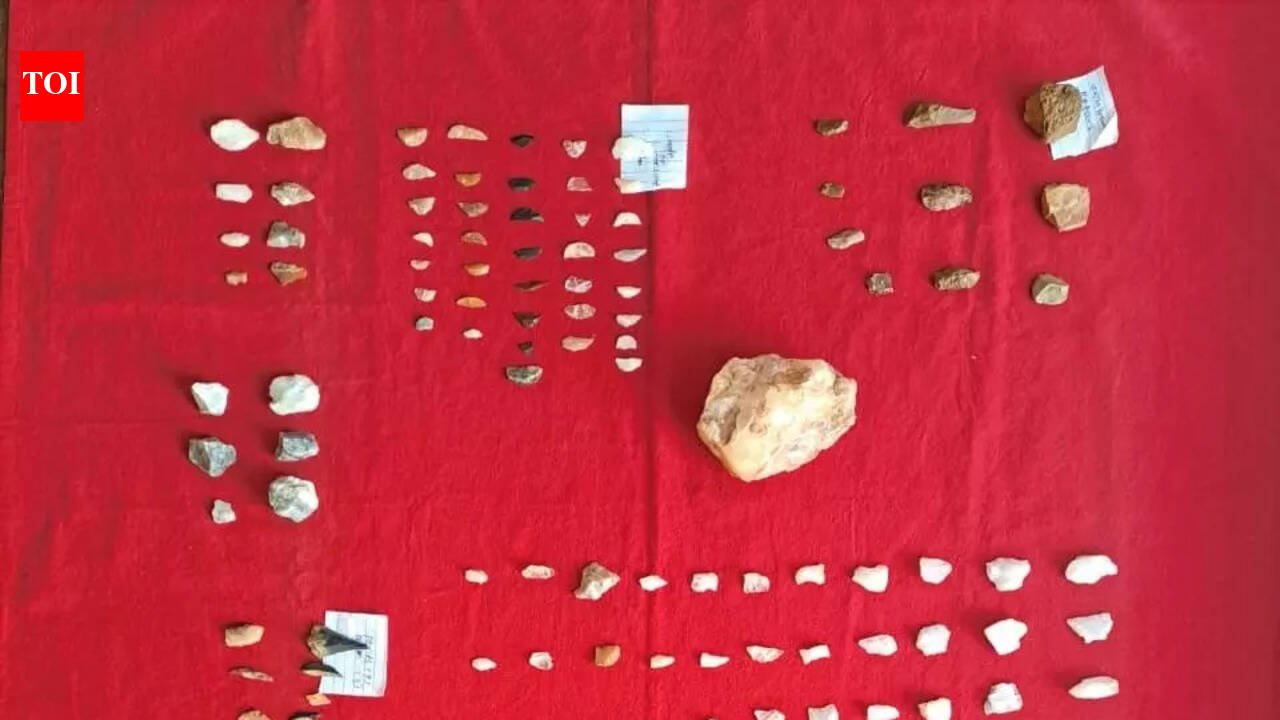
Rourkela: Researchers from the history department of Govt Autonomous College, Sundargarh, have found stone tools in the Ib river valley supposedly belonging to the Middle and Upper Palaeolithic period, which indicated human habitation existed in the region 40,000 to 60,000 years ago.The discovery was made during a two-year field survey led by assistant professor Sakir Hussain, along with PG students. With Sundargarh already known for pre-historic rock paintings, the team initiated an archaeological survey in the Ib valley region, focusing on Balijori and Baladmal under Sadar block.
During the survey, researchers found stone tools believed to have been used for hunting and daily life by early humans. “As the stone assemblages collected during field surveys from Baladmal and Balijori are surface finds, and radiometric dates are absent, the cultural attribution of the sites is based primarily on material remains, especially the characteristics of lithic assemblages,” said Hussain.“Typological and techno-morphological analysis of the stone tools like small-sized hand axes suggests an association with the Middle Palaeolithic period. Similarly, the occurrence of blades and bladelets, along with tool types such as burins and end scrapers, indicates characteristic of the Upper Palaeolithic period,” he added.Hussain said aspects such as raw material selection, core reduction strategies, retouch patterns and degrees of tool standardisation are closely examined and compared with well-dated reference assemblages from other regions to strengthen the cultural interpretation at prima facie level. “Considering the significance of the site, we have requested the Archaeological Survey of India to undertake large-scale excavation,” said Hussain.In 2023, Geological Survey of India identified a unique geo-heritage site at Chengapahad near Kanika Brahmani village under Sundargarh’s Hemgir block, listing it among 90 rare geo-heritage sites in the country, believed to date back to the Jurassic period.


