



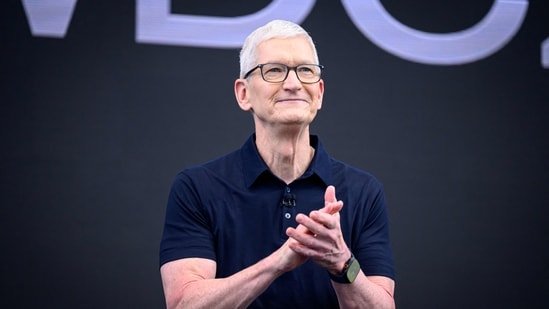
In what is Tim Cook’s last keynote as CEO, before he hands over the reigns of Apple Inc. to John Ternus, the tech giant has underlined a refreshed artificial intelligence (AI) strategy for the long term, at the Worldwide Developer Conference (WWDC). Alongside, next iterations of all product operating systems are being readied to evolve individuality as well as a collective ecosystem play for iPhone, iPad, Mac, as well as Apple Watch, and Apple TV.
“I’m deeply grateful to have been on this journey with you,” said an emotional Cook, thanking developers and Apple’s community. “The developers are building more apps than ever,” he notes the momentum defining app experiences for users. There are now 1000 new app submissions by developers to the App Store, every hour.
Also Read:
Focus areas are platform improvements, trust and safety, and what Craig Federighi, Apple’s senior vice president of Software Engineering, calls a big leap forward for Siri. The macOS Golden Gate for instance, he says, is built on the premise of “attention to details”.
Following last year’s introduction of the transparency inspired Liquid Glass interface across the board, Apple is making further refinements, such as diffusing content better for legibility and depth effect. There is now a slider option for transparency and tint settings. There are interface tweaks across apps, including controls, and how text renders.
Apple insists parts of all operating systems have been reworked to improve responsiveness, which means iPhone and iPad apps can now launch up to 30% faster. Content is also quicker to process, as well as data transfer between devices. The CPU scheduler has been reworked on the iPhone to improve compute allocation. This will support iPhones as far back as the iPhone 11, marking a fresh performance boost for older iPhones.
Apple is adding a suite of child safety features. Once a child account is set up on an Apple device, parents will be able to control what children can see, who they can talk to, and a broader guidance for their digital content consumption. Parents will be able to unlock content and apps at any time—this includes which apps children will be able to download from the App Store, and now which websites they can access on Safari on iPhone, iPad or Mac.
Parents will still need to approve an all download, or approve conversations with new contacts. Daily Child Allowance recommendations for different app categories will also be available to parents. Apple is offering a full suite of tools to developers.
Writing a new AI chapter
For Apple’s AI jigsaw, completion has been long overdue. The smarter Siri, which was expected to be at par with popular AI chatbots, was first shown off in 2024 but the release didn’t culminate thus far. It may well be a case that with Gemini providing a foundation for the Apple Foundation Models that now underline Siri AI companion capabilities, Apple feels more confident of Siri being able to executive a variety of tasks beyond conversations.
“Some seem to be racing forward, seemingly pursuing AI for the sake of AI, without clear regard to the people,” Federighi says, not mincing words while describing the current AI landscape.
Apple Intelligence is evolving with Apple Foundation models which will now infuse Google’s Gemini models. These will compute on device as well as online, depending on task. Reasoning, visual understanding and generation are some key elements. Utility remains key to AI integration for Apple, including a new system orchestrator for context.
Spotlight search and a powerful semantic index will find context and content, alongside finding the latest information on the web, before generating an answer.
It was earlier this year when Apple and Google announced a multi-year partnership, stating the latter’s Gemini models and cloud technology will provide a foundation for Apple Intelligence features. With a powerful AI assistant arriving as part of iOS 27 later this year, the need for separate subscriptions including OpenAI’s ChatGPT and Anthropic’s Claude, reduces significantly for many users.
There will be specific app actions across, integration across apps, and on-screen awareness will have context of what a user is watching or seeing, for particular tasks and queries. Siri AI will now integrate personal context understanding, app actions, broader state awareness, image understanding, and access to broad world knowledge.
Federighi notes that while most AI companies talk about privacy, but by default most retain a user’s conversations for model training. Apple will not store any user data and will only be used to execute a task or generation request. Apple calls on experts to verify this claim at any time.
For users, the ability to contextualise responses and tasks with information across Apple devices, will unlock deeper utility. You can start chatting with Siri AI on one device, and continue on another. Certain options will also be available on the Apple Watch.
While Apple’s AI pivot begins in earnest when iOS 27, iPadOS 27, macOS Golden Gate, watchOS 27 and tvOS 27 arrive later this year in time for the availability of the next generation iPhones, there is a clear intent towards refinement and improvements focusing on performance and battery frugality.
Last year’s operating systems, the iOS 26 and iPadOS 26 included has also ushered a naming scheme change.


