



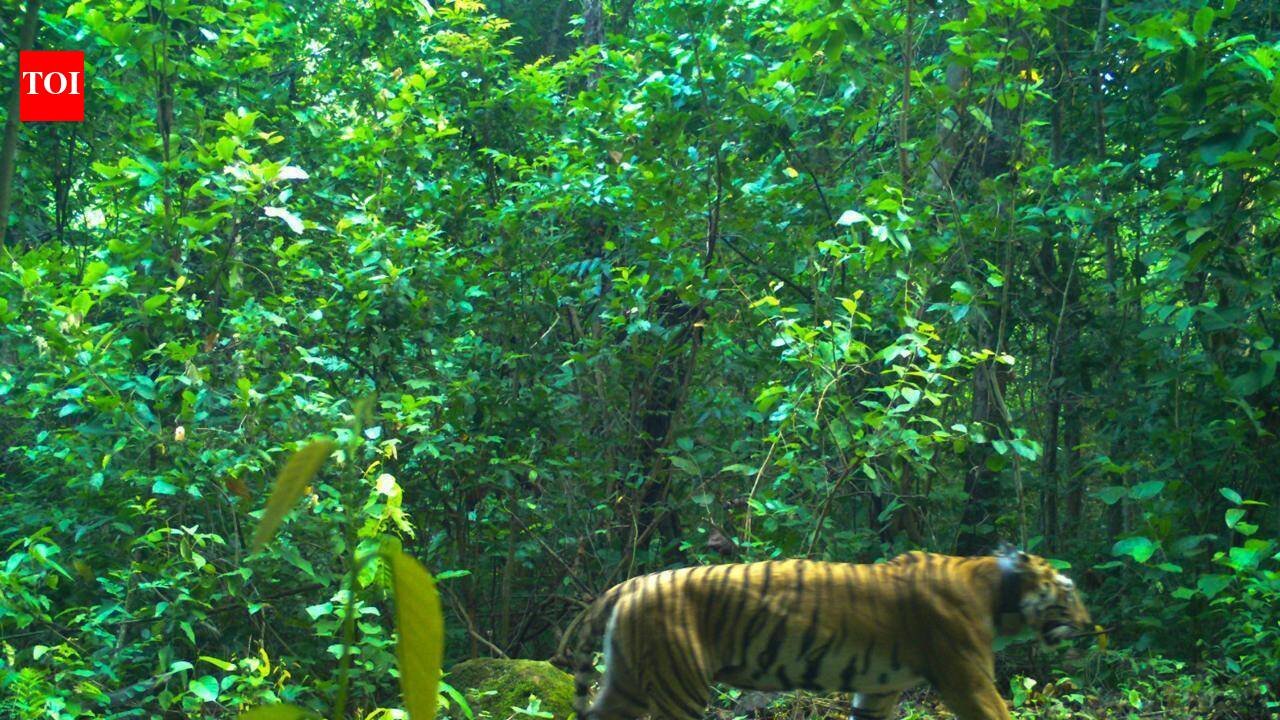
Bhubaneswar: Similipal Tiger Reserve is witnessing a quiet but significant shift in its ecological balance with tigress Zeenat, once a resident of the southern core, now moving with her four cubs to its northern region.This relocation is being hailed as a promising development, as the north historically has had fewer big cats despite being a designated core area with abundant meadows and prey.Wildlife officials confirm that Zeenat and her cubs have almost stabilised in the northern stretches. Although monsoon rain has thickened vegetation, making sightings rare and camera trap captures minimal, the family is reported to be thriving. Their presence signals the possibility of a more balanced distribution of tigers across Similipal’s vast landscape.Wildlife officials said for decades, the southern core — comprising Jenabil, UBK, national park and Bhanjabasa — has been the stronghold of Similipal’s tiger population. These deep forests, devoid of human settlements, have provided ideal breeding grounds. The 2014 and 2018 All India Tiger Estimations identified all tigers within this southern belt. However, as numbers grew, dispersal became inevitable. Young males began venturing into the northern core, which includes Nawna (south and north), Pithabata-south, and Chahala.The 2022 estimation marked a turning point, recording the first male tiger (T26) in north Similipal. Since then, the population has steadily risen. “Now six big cats have been identified in the northern core: tigresses T34, T24 and T40, alongside tigers T26, T44 and T46. Zeenat’s arrival with her cubs adds further momentum to this trend, strengthening hopes of a sustainable population in the region,” a wildlife officer said on condition of anonymity.Ecologically, the northern core is uniquely diverse. It hosts northern tropical mixed deciduous forests, semi-evergreen patches, high-level sal forests, dry deciduous sal, grasslands and savannahs. This mosaic of habitats offers ample prey and shelter, making it well suited for tiger habitation. Until recently, however, it lacked the breeding presence that the southern core enjoyed.Zeenat’s relocation may change that narrative. Her cubs, if they survive till adulthood, could establish territories in the north, ensuring long-term stability of tiger numbers across Similipal. Conservationists believe this natural dispersal is vital for the genetic diversity and resilience of the population.While sightings remain elusive due to dense monsoon foliage, the very presence of Zeenat and her cubs is being celebrated as a milestone. For the northern core of Similipal, long overshadowed by its southern counterpart, this could mark the beginning of a new chapter in tiger conservation, wildlife officials said.


