


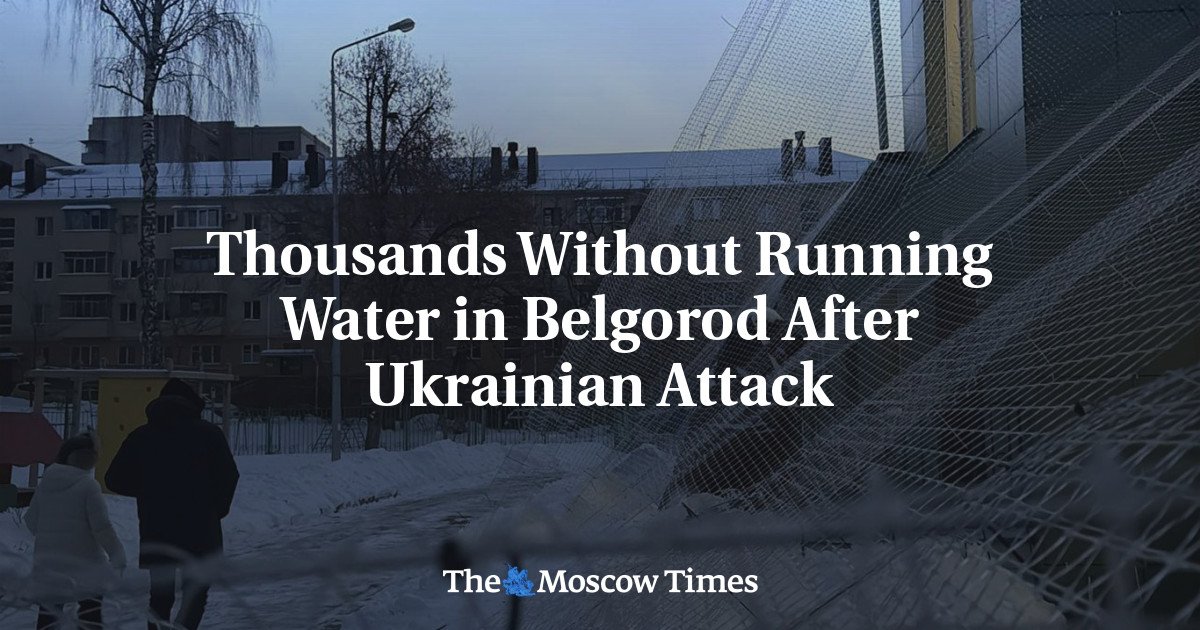
Around 100,000 customers in the city of Belgorod were without running water early Monday after power surges caused by Ukrainian airstrikes on the local power grid forced two pumping stations to go into emergency shutdown.
Repeated Ukrainian drone and missile attacks have caused major utility outages in the southwestern Belgorod region since the start of the year.
Belgorod region Governor Vyacheslav Gladkov said Sunday that around 84,000 people in the regional capital were still without heating, gas or electricity following multiple days of airstrikes.
On Monday, Belgorod Mayor Valentin Demidov said emergency crews were scrambling to restore water service to thousands of people after a Ukrainian attack caused power outages that forced part of the city’s water supply system into a temporary shutdown.
“About 100,000 customers were left without water in the central and northern parts of the city,” Demidov said. Service had already been restored to some homes, he said, and work was continuing elsewhere.
Governor Gladkov said freezing temperatures had complicated efforts to restore utilities. Hundreds of centrally heated buildings must have their entire heating systems drained before service can be safely resumed, he added.
“If we don’t do this, the damage or harm will be almost catastrophic for every resident living in this part of the city,” Gladkov said in a video message.
On Monday, the temperature in Belgorod is forecast to drop to minus 19 degrees Celsius (minus 2 degrees Fahrenheit) overnight.
The recent utility outages in the Belgorod region have coincided with the Russian military’s own targeted strikes on Ukraine’s power grid amid subzero temperatures.
Ukrainian President Volodymyr Zelensky has accused Moscow of “trying to use cold weather as a tool of terror.”
A Message from The Moscow Times:
Dear readers,
We are facing unprecedented challenges. Russia’s Prosecutor General’s Office has designated The Moscow Times as an “undesirable” organization, criminalizing our work and putting our staff at risk of prosecution. This follows our earlier unjust labeling as a “foreign agent.”
These actions are direct attempts to silence independent journalism in Russia. The authorities claim our work “discredits the decisions of the Russian leadership.” We see things differently: we strive to provide accurate, unbiased reporting on Russia.
We, the journalists of The Moscow Times, refuse to be silenced. But to continue our work, we need your help.
Your support, no matter how small, makes a world of difference. If you can, please support us monthly starting from just $2. It’s quick to set up, and every contribution makes a significant impact.
By supporting The Moscow Times, you’re defending open, independent journalism in the face of repression. Thank you for standing with us.
Continue
Not ready to support today?
Remind me later.
×
Remind me next month
Thank you! Your reminder is set.


