



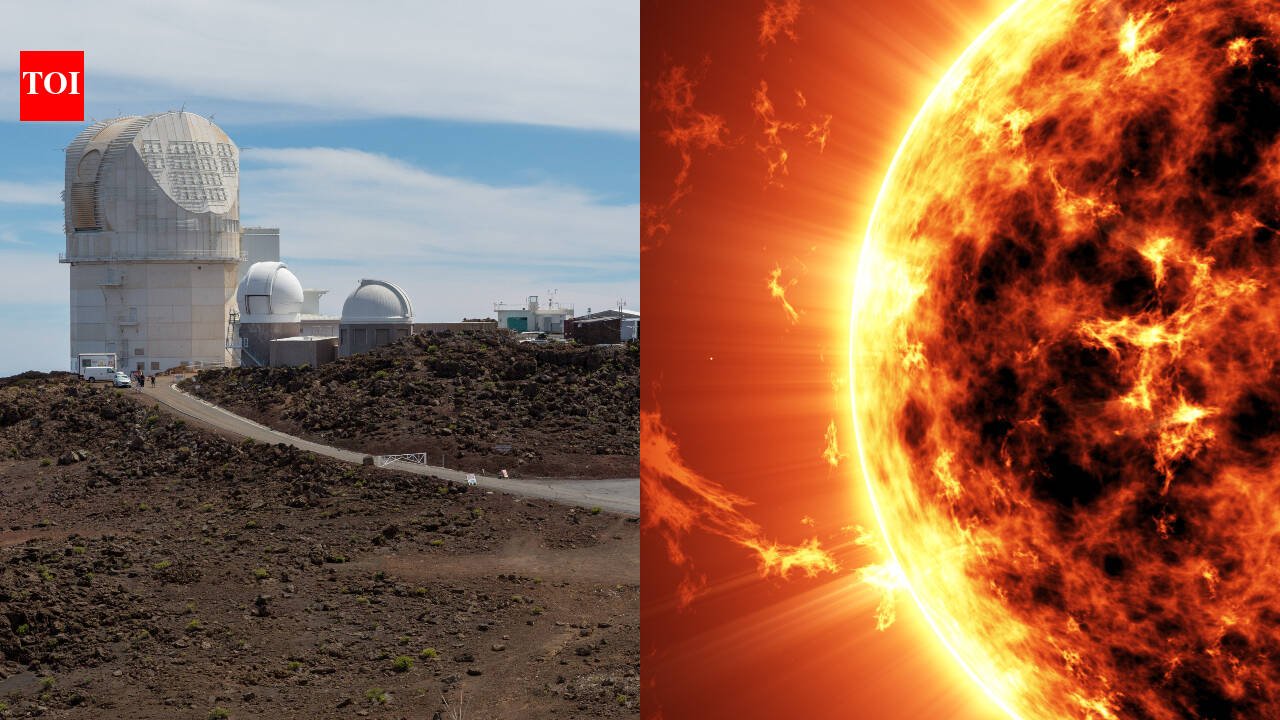
The Sun may appear to us on Earth as a glowing ball of plasma, but its surface is far more active and turbulent than it looks, which has been proven time and again through research. According to a latest report by Nature, observations from the world’s largest solar telescope have now provided an incredibly detailed view of the Sun’s surface, showing tiny swirling structures that could help scientists understand how energy and magnetic fields flow through the solar atmosphere. The article clearly mentions that the observations were made with the Daniel K. Inouye Solar Telescope (DKIST), a powerful 4-metre class solar telescope operated by the US National Science Foundation. It could examine parts of the Sun on the order of 19 kilometers, letting researchers see features that were too small for solar telescopes to detect before.
A closer look at the Sun
The photosphere – the visible surface of the Sun – is never still. It is proven to have hot plasma which rises, cools, and then sinks again in a process known as convection. These movements create patterns like boiling water. Magnetic fields are also present across the whole solar surface. They interact with these turbulent plasma flows creating an ever-changing environment. Some of the smallest details of this interaction had been hidden until now because existing telescopes could not see them clearly. But DKIST has changed that view. The high-resolution images show that the edges where magnetic regions meet the surrounding plasma are not smooth. Rather, they are filled with little vortices and swirls.
Miniature vortices on the Sun’s surface
When scientists looked at a series of images, they saw vortices forming and changing around magnetic areas. The smallest structures were near DKIST’s theoretical limit of resolution, about 19 kilometers. A study of 47 vortices showed they generally manifested at roughly 65 kilometers apart and individual vortices ranged from around 25 to 170 kilometers in size. They also seemed to move across the Sun at speeds between about 0.67 and 3 kilometers per second. According to scientists, these small swirls are important because they are associated with a physical process called the Kelvin–Helmholtz instability, or KHI.
What is Kelvin-Helmholtz instability?
The Kelvin–Helmholtz instability is an instability that occurs when two layers of fluid or plasma are moving past each other at different speeds.
The Kelvin–Helmholtz instability is an instability that occurs when two layers of fluid or plasma are moving past each other at different speeds. The difference in speed produces a strong shear. This shear can make the boundary between the layers unstable, developing waves and swirls. According to scientists, a familiar example is the wave-like pattern that sometimes occurs when wind blows across the surface of water. Scientists have predicted that similar instabilities may occur on the Sun. However, their very small size made it difficult to see them directly. The new observations from DKIST show these instabilities to be common around magnetic regions on the solar surface.
How magnetic fields create conditions
The researchers found that the Sun’s normal convective flows can drift toward locations with strong magnetic fields. The boundary between the flows can show a sharp velocity difference when the flows meet magnetic regions. This strong difference, or velocity shear, provides the conditions necessary for the growth of the Kelvin-Helmholtz instability. The magnetic field in the observed region is mainly vertical and the plasma flows are mainly horizontal, so the magnetic field does not completely suppress the instability. This leads to many small, fast-changing vortices around magnetic concentrations.
The discovery is confirmed by computer simulations
The scientists checked that what they saw on the telescope was indeed Kelvin-Helmholtz instabilities by comparing the images from the telescope with detailed computer simulations of the Sun’s atmosphere. The simulations resulted in vortices having a very similar shape and behavior to those observed by DKIST. The simulated vortices had similar sizes, growth rates and movement speeds. The good agreement between observations and simulations gives researchers more confidence that the swirling structures are indeed caused by Kelvin-Helmholtz instabilities.
Why this discovery matters
According to scientists involved in the process, the finding could help them understand how the Sun transports mass, energy, momentum and magnetic fields through its atmosphere. The processes are closely related to the behavior of active regions on the Sun and could eventually help them to better understand solar activity. The vortices can also twist and braid the magnetic field lines. Such processes can affect the storage and release of magnetic energy in the solar atmosphere. Most important, the pictures reveal that the surface of the Sun is much more dynamic and complex at small scales than previous images had suggested. DKIST is giving scientists a new view of the turbulent processes that power the Sun’s magnetic environment, resolving structures only tens of kilometers across.Images Courtesy: istock


