



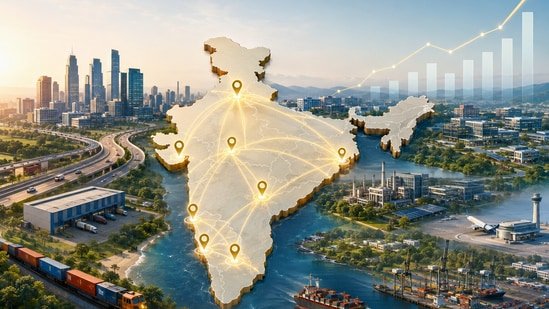
For a long time, India’s economic map was easy to read. The biggest companies went to Bengaluru, Mumbai, Delhi NCR, Hyderabad, Chennai and Pune. Jobs followed them. So did roads, offices, housing and investment. The more these cities grew, the more they attracted, and that cycle kept reinforcing their dominance.

It also influenced how people thought about opportunity. A city with multinational firms, modern infrastructure and a deep talent pool was naturally seen as a stronger bet for long-term growth. That view is no longer enough.
Across India, economic activity is beginning to spread in ways that were far less visible a decade ago. Better highways, new regional airports, industrial corridors, stronger digital networks and the rise of Global Capability Centres (GCCs) are opening up new possibilities outside the largest metros. Coimbatore, Kochi, Indore, Mangaluru and Bhubaneswar are now finding a place in conversations around manufacturing, technology, logistics and professional services.
This is not a story about the decline of India’s major cities. They remain the country’s most powerful economic centres and continue to receive the largest share of investment. But the next phase of growth could come from a broader group of regional hubs rather than from one or two dominant markets.
For investors, that matters because this is not simply a fashionable Tier-2 city narrative. It points to a deeper change in how India’s economy is being built.
Growth is no longer being planned around a few cities
India’s economy has expanded sharply over the past decade. At the same time, public policy has placed greater emphasis on creating jobs, industries and infrastructure beyond the country’s largest urban centres.
The National Industrial Corridor Development Programme is central to that effort. It is designed to build integrated industrial cities connected through roads, ports, airports and freight networks. The programme now spans 11 industrial corridors, including the Chennai-Bengaluru Industrial Corridor, the Bengaluru-Mumbai Industrial Corridor, the East Coast Industrial Corridor and the extension of the Chennai-Bengaluru corridor towards Kochi via Coimbatore. The objective is to create connected locations where factories, logistics providers and suppliers can operate more efficiently through stronger transport and freight infrastructure.
Regional air connectivity is moving in the same direction. In March 2026, the Union Cabinet approved the next phase of the modified UDAN regional connectivity scheme, with an outlay of ₹28,840 crore for FY2026-27 to FY2035-36. By March 2026, 663 routes had been operationalised across 95 airports, heliports and water aerodromes. More than 163 lakh passengers had used the network since the programme began.
Better connectivity can help smaller urban centres attract businesses, support tourism, strengthen trade links and become more closely integrated with the wider economy. Together, these policies point to a deliberate effort to connect more regional centres to national supply chains instead of concentrating growth in a handful of metros.
The corporate shift is already visible
Infrastructure creates the setting for growth. Companies decide whether that setting becomes economically meaningful. One of the strongest signs of change is the growth of Global Capability Centres.
GCCs are not back offices in the old sense. Multinational companies use them for technology, finance, research, engineering and core business operations, making them a major force in India’s office market. JLL reported that GCC leasing reached a record 31 million square feet in 2025. As per H1 2026 reports by Cushman & Wakefield, GCC leasing is at 16.5 MSF, up about 38% YoY. The numbers show how important India has become to the global operations of large corporations.
The traditional metros still dominate this market, but the search for new locations is widening. JLL’s India GCC Guide 2026 identifies Coimbatore, Kochi, Mysuru, Ahmedabad, Jaipur and Kolkata as increasingly attractive alternatives. These cities offer skilled talent and can be 10% to 35% cheaper to operate in than more established markets.
That cost advantage is only part of the story. Many of these cities also have strong universities, technical talent, improving transport links and a better quality of life than they were once given credit for. According to CBRE, India leased 45.5 million square feet of office space in the first half of 2026, the highest ever for that period. GCCs accounted for about 43% of total leasing, while the number of GCC transactions rose over 30% year-on-year, even as companies continued to navigate an uncertain global economy.
A new GCC brings more than office demand. It creates jobs, drives demand for housing, transport, schools, hospitals, restaurants and retail, setting off economic activity across the local economy. That is how a city starts to change.
The emerging cities are not all following the same script
It is tempting to treat Tier-2 growth as one broad theme. In reality, each city is building from a different base.
Coimbatore has spent years developing a strong manufacturing and engineering ecosystem. Its location along the extension of the Chennai-Bengaluru Industrial Corridor towards Kochi gives that existing industrial base another layer of support.
Kochi’s advantage is different. It already has a strong maritime and logistics identity, and it is also being considered as a future GCC destination because of its talent pool and improving business environment.
Indore has emerged as one of central India’s most important centres for manufacturing and services. Its industrial infrastructure, along with the Vikram Udyogpuri Industrial Township under the National Industrial Corridor Development Programme, has added to its appeal.
Odisha is taking a more regional approach. Its plans are centred on the Bhubaneswar-Cuttack-Paradip economic region, while the Odisha Economic Corridor is also being developed under the national industrial corridor programme.
Mangaluru brings together another set of advantages. It has a major seaport, an airport and a location that fits into Karnataka’s push to spread economic activity beyond Bengaluru. The state government has also spoken about encouraging GCC growth across other Tier-2 and Tier-3 cities as part of a more balanced development strategy.
None of these places needs to become the next Bengaluru or the next Mumbai. That comparison can be misleading because it assumes there is only one model for urban growth. Coimbatore may deepen its manufacturing strengths. Kochi may build on logistics and technology. Mangaluru may benefit from port-led development. Bhubaneswar may continue to grow across technology, electronics and public administration. Their appeal lies in what they already do well, not in how closely they can copy a metro.
Why investors should look beyond the headlines
Economic change is often easier to recognise in hindsight than while it is unfolding. By the time a city is widely seen as a new growth hub, the groundwork has usually been underway for years. Roads have been built, industrial parks developed, businesses have expanded and people have started moving in. The headlines often arrive much later.
That is why infrastructure should be seen as a starting point, not the destination. A highway, airport or freight corridor cannot transform a local economy on its own. Its real value lies in making it easier for businesses to invest, hire, transport goods and access new markets, creating jobs and demand for housing, healthcare, education and other services.
The World Bank has consistently highlighted the link between transport infrastructure, market access and regional productivity. Better connectivity can improve labour mobility, lower logistics costs and support more balanced economic development across regions.
India’s own infrastructure strategy reflects the same thinking. Under the PM Gati Shakti National Master Plan, multiple ministries are coordinating roads, railways, ports, airports and utility infrastructure through a unified planning platform to improve connectivity, reduce logistical bottlenecks and make project execution more efficient.
For investors, infrastructure alone is not an investment thesis. It becomes meaningful when it helps businesses expand, creates jobs and strengthens local economies over time. That is why the economic impact of infrastructure often takes far longer to emerge than the initial announcements.
Opportunity may not be spread evenly
The growing attention on India’s regional cities should not be mistaken for a guarantee that every Tier-2 market is about to become a major economic success story. History rarely works that way. Infrastructure is an important advantage, but it is only one piece of a much larger puzzle.
Whether a city develops into a lasting business hub depends on several other factors, including the quality of governance, availability of skilled talent, industrial policy, educational institutions, ease of doing business, private-sector participation and access to finance.
The Economic Survey 2025–26 makes a similar point. It notes that while urbanisation will play an increasingly important role in India’s long-term growth, productivity gains depend on the quality of urban planning, infrastructure and institutional capacity rather than urban expansion alone.
Companies take a similarly balanced approach when deciding where to invest. Lower costs may make a city attractive initially, but long-term decisions are also influenced by talent availability, transport connectivity, digital infrastructure, quality of life and the strength of the surrounding business ecosystem. That helps explain why certain cities continue to receive greater attention than others.
Coimbatore’s manufacturing and engineering capabilities have been built over decades. Kochi combines a well-established maritime economy with a growing technology ecosystem. Indore benefits from a diversified industrial base supported by strong educational institutions. Bhubaneswar has steadily expanded its strengths in information technology, electronics and public administration. These advantages have developed over many years and cannot be created through a single policy announcement.
For investors, understanding those underlying strengths is likely to be more valuable than assuming every emerging city will follow the same path.
A changing map of growth
For much of the past two decades, India’s growth story has centred on a handful of metropolitan cities. Those centres remain vital and continue to attract significant investment. What is changing is the number of places contributing to that growth. Manufacturing is expanding into new industrial corridors, technology companies are looking beyond traditional talent hubs, logistics networks are becoming more integrated and regional air connectivity continues to improve.
Together, these trends point to an economy that is becoming geographically broader. The metros are not becoming less important, but the opportunity set is becoming larger. For investors, that means looking beyond the obvious locations and understanding the structural forces shaping regional economies. Infrastructure, business investment, employment and industrial diversification reinforce one another over time to create sustainable growth.
As India’s economy becomes more connected, its next phase of growth may be driven by a wider network of regional centres rather than a handful of dominant metros. The key is not to chase the city making headlines today, but to identify where infrastructure, businesses and skilled talent are coming together to build tomorrow’s growth.
Note to the Reader: This article has been produced on behalf of the brand by HT Brand Studio and does not have journalistic/editorial involvement of Hindustan Times. The content is for information and awareness purposes and does not constitute any financial advice.


