



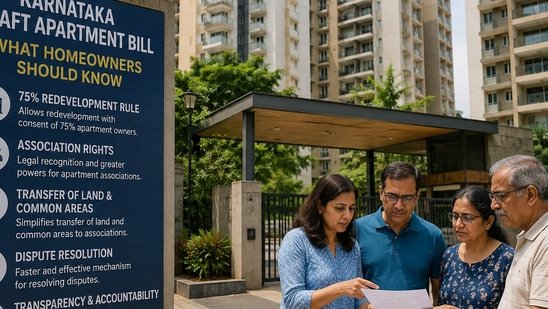
The Karnataka government on July 15 released the draft Karnataka Apartment (Ownership and Management) Bill, 2026 (KAOMA), proposing a comprehensive overhaul of apartment ownership and management in the state. The legislation seeks to replace over-five-decade-old laws with a unified legal framework to strengthen apartment owners’ rights, improve governance, and provide a clear mechanism for the redevelopment of ageing residential complexes.

Homebuyer groups say the Bill could resolve long-pending issues such as legal recognition of apartment associations, transfer of land and common areas, and grievance redressal, while real estate experts believe it could improve transparency and streamline the management and redevelopment of ageing apartment complexes, provided it is implemented effectively.
CREDAI Karnataka welcomed the proposed legislation, calling it a positive step towards strengthening the state’s apartment ownership framework.
Chief Minister D.K. Shivakumar said that the government is committed to passing the Bill during the upcoming Monsoon Session of the legislature and has invited feedback from citizens, resident welfare associations and other stakeholders until August 6 before finalising the legislation.
Speaking at a stakeholder consultation in Bengaluru on July 15, Shivakumar said the objective is to resolve long-pending apartment-related issues through administrative reforms rather than prolonged litigation. He noted that Bengaluru has more than 25,000 apartment buildings housing an estimated 2.5 to 3 million flats, while 60,000-75,000 apartments were registered with the Karnataka Real Estate Regulatory Authority (KRERA) in Bengaluru and surrounding urban areas over the past year.
According to the government, the existing Karnataka Apartment Ownership Act, 1972 and the Karnataka Ownership Flats (Regulation of the Promotion of Construction, Sale, Management and Transfer) Act, 1972, have become outdated following the enactment of the Real Estate (Regulation and Development) Act (RERA), 2016, resulting in overlapping and, at times, conflicting provisions.
Bengaluru Urban Development Minister Krishna Byre Gowda said there is currently no dedicated statutory authority to address apartment-related issues, with associations registered under various laws, including the Karnataka Societies Registration Act and KRERA.
What does the draft Karnataka Apartment (Ownership and Management) Bill, 2026 propose?
The draft legislation seeks to address several long-pending issues, including the transfer of land beneath apartment complexes, ownership of common areas, the formation and regulation of apartment owners’ associations, maintenance responsibilities, the redevelopment of ageing buildings, and dispute resolution.
Redevelopment of apartment complexes: Among its key provisions, the draft Bill proposes that redevelopment of apartment complexes can proceed with the consent of at least 75% of apartment owners. Owners unwilling to participate would be entitled to compensation of at least twice the prevailing market value of their property.
Structural safety measures for ageing buildings: The Bill also introduces mandatory structural safety measures for ageing buildings. Apartment complexes more than 30 years old must obtain a structural stability certificate and renew it every 5 years thereafter. It also lays down, for the first time, a detailed legal framework for the redevelopment of ageing apartment complexes, as many of Bengaluru’s earliest residential buildings approach the end of their design life.
Undivided share of project land and common areas: A key provision requires developers to transfer the project land and common areas to apartment owners, while apartment associations will be responsible only for management and maintenance. The Bill also clarifies the calculation of the undivided share of land attached to each apartment and introduces deemed conveyance provisions for older projects where common areas were never legally transferred to owners.
Developers will be required to hand over all original project documents, transfer any unspent maintenance funds, facilitate the formation of apartment owners’ associations and maintain common areas until residents formally assume control.
Dispute resolution: The bill applies to apartment projects with more than eight units, bring enforcement under the Urban Development Department through a designated competent authority.
For dispute resolution, the Bill proposes establishing a Competent Authority and an Appellate Authority, both vested with powers equivalent to those of a civil court. The Urban Development Department will oversee implementation, regulate apartment associations, approve bylaws, investigate complaints and enforce compliance. Existing apartment associations registered under current laws will automatically be recognised under the new framework.
Defines private and super built-up area: The Bill also defines private area and super built-up area.
Speaking at a stakeholder consultation in Bengaluru, Chief Minister M. DK Shivakumar said the government’s objective is to ensure homebuyers enjoy full ownership rights upon purchasing a property.
“We are very firm on one principle. When a property is handed over, owners must have full legal rights over it. After the sale agreement and registration are completed, builders should hand over all relevant documents. Apartment owners should not be forced into litigation to secure their basic rights,” he said.
The Chief Minister also raised concerns about developers delaying the transfer of title deeds and other ownership documents, alleging that some builders mortgage buyers’ properties and retain original documents until loans are repaid.
“These practices are unacceptable. The document handover process must be transparent, official and properly documented, with copies retained by both the builder and the owner,” he said.
What do homebuyers have to say?
Calling the draft rules an important step towards strengthening homebuyers’ rights, Dhananjaya Padmanabhachar, convenor of the Karnataka Homebuyers Forum, said they could address three long-standing issues faced by apartment owners in the state.
“First, there has never been a clear statutory mechanism for registering apartment associations under the Karnataka Apartment Ownership Act. Although many associations claim to be registered, there has been no designated authority or gazette notification implementing the Act effectively for nearly five decades. Apartment associations need a legal identity, and these draft rules could finally provide that,” he said.
Second, Padmanabhachar pointed out that Section 17 of the Real Estate (Regulation and Development) Act (RERA) requires developers to transfer the land and common areas to the association of allottees. “For this transfer to happen, the association itself must be legally registered. Without a recognised association, the transfer of land cannot be completed. These rules could help resolve that long-pending issue,” he said.
The third major concern is the absence of a dedicated grievance redressal mechanism. “At present, apartment owners often have to approach civil courts even for routine disputes within housing societies. The proposed competent authority under the draft rules would provide a specialised forum to handle such complaints, reducing the need for litigation and making dispute resolution faster and more accessible,” he added.
Important step towards strengthening consumer confidence: Credai Karnataka
As our cities evolve, the legal framework governing apartment ownership must evolve as well. The proposed Karnataka Apartment Ownership (Draft) Bill recognises that apartment ownership today extends beyond the purchase of a home and requires greater clarity on ownership rights, governance, and the long-term management of residential societies.
“This is an important step towards strengthening consumer confidence, improving transparency, and reducing avoidable disputes,” said Bhaskar T Nagendrappa, president, CREDAI Karnataka.
“Equally significant is the Draft Bill’s recognition of redevelopment as an emerging urban priority, which will become increasingly relevant as Karnataka’s cities mature and existing housing stock ages,” he said.
CREDAI Karnataka, representing the state’s developer fraternity, “welcomes this initiative by the Government. We are actively engaging with the Bangalore Apartment Federation (BAF) and other stakeholders to jointly deliberate on the provisions of the Draft Bill and provide constructive recommendations that address both the current and future needs of homebuyers while ensuring a practical, balanced, and forward-looking regulatory framework.”
“As the legislation is currently in the consultation stage, we encourage all stakeholders to actively participate in the process so that the final law effectively safeguards the interests of apartment owners while supporting the sustainable growth of Karnataka’s housing sector,” he said.
Real estate experts’ take on the draft Bill
The Bill is a timely intervention to modernise a regulatory framework that has not seen significant changes since 1972. A single legal framework will enhance transparency in governance for housing societies, minimise conflicts, and standardise maintenance and redevelopment procedures.
“These are crucial in cities like Bengaluru with a fast-ageing housing stock. The focus on redevelopment is especially relevant, as land scarcity and structural obsolescence are emerging challenges in mature micro-markets,” said Ashish Sharma, Executive Director and City Head – Bengaluru, ANAROCK Group.
“However, the Bill needs effective execution to succeed. Clear segregation of roles among RWAs, developers and authorities, mechanisms for dispute resolution and enforcement provisions will be crucial. Done right, it could be a model for other states facing similar urban housing problems,” he added.


