



What does it mean for a region to run out of water?
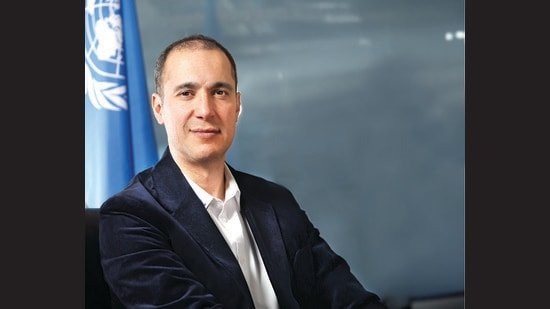
It’s a bit like financial bankruptcy, says Kaveh Madani, director of the United Nations thinktank on water, the UN University Institute for Water, Environment and Health (UNU-INWEH).
At first, it feels manageable, with cutbacks, delayed instalments, a little borrowing, and moving things around. But the interest piles up.
Once-full rivers become seasonal, aquifers turn saline; as groundwater levels sink, the ground itself may begin to subside. Pretty soon, one is staring at the bottom of the barrel.
“This is not a water crisis anymore. This is water bankruptcy,” Madani says.
Once things reach this point, the familiar remedies of water cuts and water trains make little difference. It will take new approaches to craft a way forward.
The first step is acknowledging the irreversible nature of the damage. The second is an overhaul of systems, to adapt to new constraints and prevent further damage, Madani says.
For his work in helping create modelling systems for such a world — and using interesting approaches such as game theory to change how governments act and communicate amid such a situation (more on the game theory in a bit) — the Iranian scientist was recently announced as the winner of the 1 million Swedish krona (about $100,000) Stockholm Water Prize, often called the Nobel for water (it is presented in collaboration with the Royal Swedish Academy of Sciences, which administers some of the Nobel Prizes; he will receive the award in August).
At 44, Madani is the youngest recipient of the Stockholm Water Foundation’s prize since its inception in 1991, and the first UN official and former politician to receive the award. He was chosen, the jury citation says, for his “unique combination of groundbreaking research on water resources management with policy, diplomacy and global outreach, often under personal risk and political complexity”.
That personal risk refers to his last stint in Iran.
After studying in Iran, Sweden and the US, and teaching at Imperial College London, where he built an international reputation modelling water systems, Madani was invited home to play a similar role within the government.
He returned in 2017 and started to break down the problems that would need to be addressed. Working within the environment ministry, he built a young, diverse team, many of them women, and led it for about a year, only to then be interrogated on charges of being a saboteur.
When he realised he was in real danger, he fled, in 2018. After months of hiding, he resurfaced in the US, and began teaching at Yale. He now lives in Toronto, and was appointed head of UNU-INWEH in 2023.
“I’ve had a pretty bumpy life, but having friends, family and colleagues who support me so I can continue to investigate, research and challenge dominant ideas is something that energises me,” he says. “I am honoured to receive this award. I didn’t think in my wildest dreams that I would achieve this.”
***
The Stockholm award comes weeks after Madani sounded an alarm in January, through a report titled Global Water Bankruptcy: Living Beyond Our Hydrological Means in the Post-Crisis Era. (Post-crisis era is a term generally used in the economic context. It indicates the period after an event such as a downturn or depression, when the focus must shift from sustaining the pre-event normal to finding ways to navigate a new reality.)
When it comes to water, here is where we stand, according to Madani’s UNU-INWEH report.
About 50% of global domestic water supply is now derived from groundwater, about 70% of major aquifers are in long-term decline, 4.1 million sq km of natural wetlands have been erased, 2 billion people live on ground that is either subsiding or at high risk of subsiding, and 4 billion people face a severe water scarcity for at least one month a year.
***
Madani’s argument, amid this reality, is a hopeful one: The water situation around the world cannot be attributed to climate change alone. Gross mismanagement in planning and executing water policies has played a significant role — and that means we can undo a large part of this.
Changes can be made today.
It is well-acknowledged, after all, that about 50% of the water supplied to India’s biggest urban guzzlers, Delhi and Mumbai, is wasted as a result of broken pipelines, leakages and theft. But there is little political will or public pressure to fix this. Because people assume the monsoon will come around and the lakes will fill up and all will return to normal.
“One of the biggest misconceptions we have is that these are temporary shocks that will subside,” Madani says. “In fact, around the world, what we’re seeing is that this is becoming chronic and permanent.”
In other words, the time to fix it is now.
It’s how we aim to fix it that must change.
We have to stop moving water around and building infrastructure that is aimed solely at increasing supply, Madani argues. Instead, the focus should be on fundamentally changing how we govern this resource.
In his models for how to effect that change, he relies not on logic or ideas of cooperation and conservation, but on game theory.
***
Game theory is the mathematical study of how people make decisions, when their outcomes depend on others’ choices. When applied to water conflicts and management, it accounts for the fact that stakeholders, whether farmers, city-dwellers or the government, will each seek to meet their interests, and may choose competitive rather than cooperative strategies, based on what they think others will likely do.
Game theory has been applied to the study and modelling of human systems since about the 1940s. Madani has been successful in integrating game theory into water management models. His research explores the mismatch between optimal plans and real motivations at the consumer level, across a wide range of issues, from groundwater depletion and irrigation conflicts to climate-driven scarcity.
In a simplified example, if a farmer sees his neighbour pump out groundwater amid a shortage, he will do the same, even if that leads to a shared collapse.
Factor such fears, competition and suspicion into models, and sustainable water management begins to look rather different.
New approaches could involve restructuring water rights, pricing and restrictions, no matter how unpopular the move; thus reducing demand through policy. It could involve prioritising certain water uses over others. This could allow aquifers and groundwater levels to begin to recharge.
“By restoring what’s possible, we also prevent further damage. But in many cases, because there’s water bankruptcy, we do need to find ways to adapt to very real constraints,” Madani says.
The fact that the reins are in our hands gives him hope, he adds. “I believe we can do things differently. No one anywhere is immune to this. So, it’s a matter of accepting reality, admitting mismanagement and going back to the drawing board.”


