






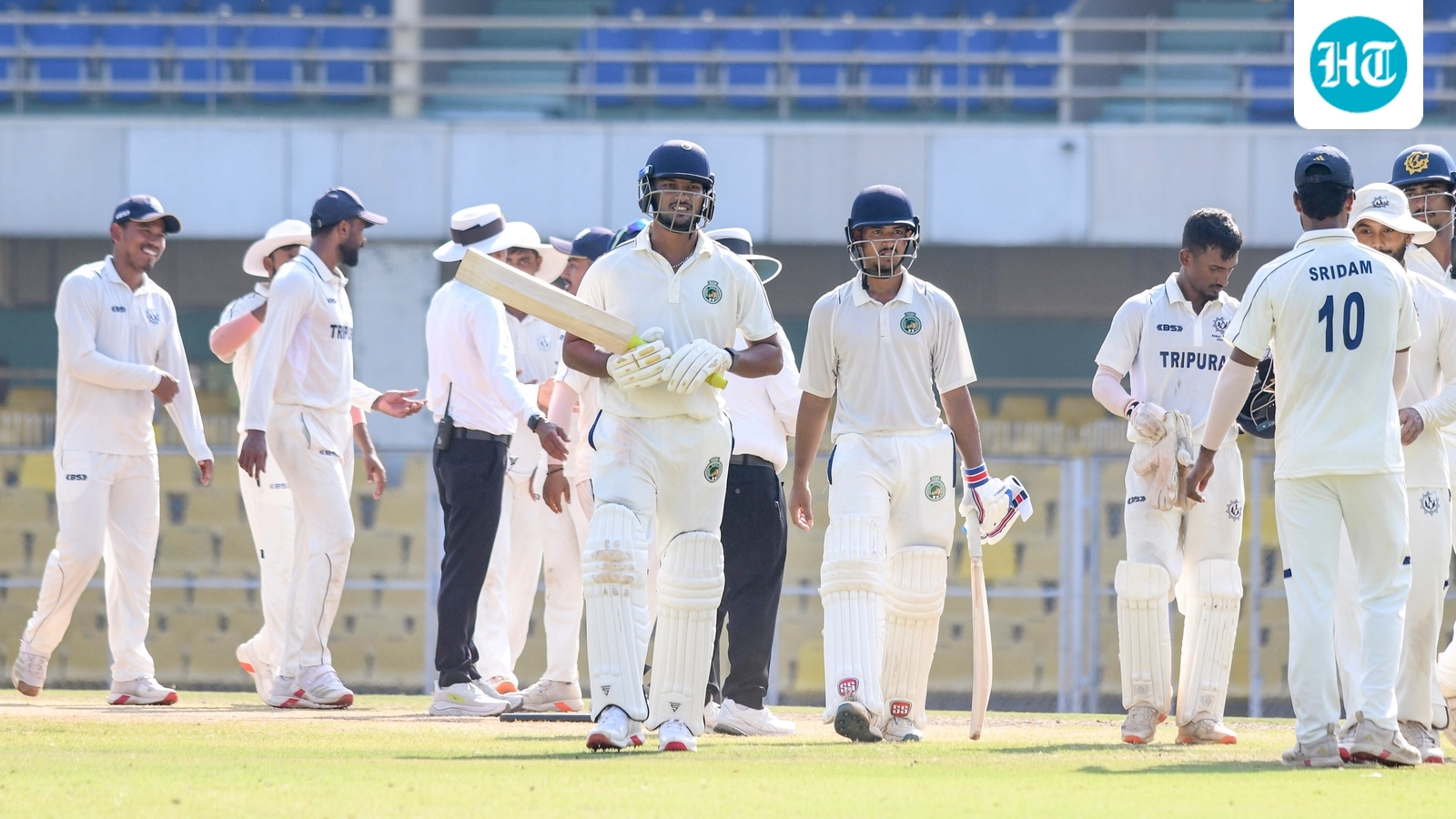
Chinmay Sutar’s unbeaten 400-run knock was the biggest talking point from the second round of the Ranji Trophy 2026-27 season. It was no mean feat as the right-hander became just the second batter in the history of the premier red-ball competition to record an individual score of 400. Moreover, he also registered the second-highest individual score in the Ranji Trophy, only second to BB Nimbalkar (443* vs Kathiawar in 1948-49).
Sutar, who switched from Mumbai to Mizoram earlier this year, scored 400 against Nagaland with the help of 46 fours and 7 sixes. Both Mizoram and Nagaland belong in the Plate Group, and with Sutar scoring this many runs, once again, a debate broke out regarding whether the Plate Group stats belong in the overall Ranji books.
For a while, chatter has suggested that the quality of the Ranji Trophy has been diluted due to the addition of six more teams to the Plate Group. Before the start of the Ranji Trophy 2026-27 season, former India captain Sunil Gavaskar had also voiced his concern towards the dwindling competition in the tournament, raising questions about the Plate Group. However, how can one deal with the conundrum?
Well, for starters, Rajneesh Gupta, a senior Indian cricket statistician, scorer, and analyst, agrees with Gavaskar, saying the Plate Group statistics need to be viewed with a pinch of salt. However, he had a solution in mind, suggesting the Plate Division could be looked at as a qualifying stage before the main event.
“One option is to treat the Plate Group as a qualifying stage before the main event. Under this model, the Plate Group would be treated as a preliminary qualifying tournament, and the runs and wickets scored in these matches would not be added to a player’s official First-Class career totals, keeping the main Ranji Trophy record book strictly for top-tier cricket. This will create heartburn for the concerned players, though,” he told HT.
“The simplest and most practical way forward is to allow Plate Group matches to remain First-Class games, but maintain two distinct record lists, one for the Elite Group and one for the Plate Group,” he added.
Mohandas Menon, another senior statistician, believes that nothing can be done as long as the Plate Group matches retain first-class status. “Unless the BCCI decides that these played games are not given the first-class status, then it can be taken without being recorded in the record books. But as long as it is being considered as a first-class game, we have to take it. We cannot say we’ll not take this,” he told HT.
The last few years have witnessed several records being set in the Plate Group. Teams like Arunachal Pradesh, Manipur, Meghalaya, Mizoram, Nagaland, and Sikkim have also brought other professional cricketers (players who were unable to break into their home state XI in the Elite division), and such batters or bowlers have smashed records left, right and centre.
These outstation players brought high skill, but the overall competition in the Plate Group remained low; hence, they had no trouble in smashing the records. The examples are many. Bihar’s Sakibul Ghani, during the 2021-22 season, became the first player to score a triple ton (341 off 405 balls)on his first-class debut, achieving the feat against Mizoram. Moreover, he also shared a 538-run partnership with Bablu Kumar, who too scored 229 not out.
Agni Veer Chopra, the son of director and producer Vidhu Vinod Chopra, who turned up for Mizoram in the 2023-24 season, became the first player to smash centuries in each of his first four first-class matches, eventually returning with 1804 runs at an average of 94.94 with nine centuries. The cases are many. Who can forget Tanmay Agarwal? Playing for Hyderabad, he smashed the record for the fastest first-class triple century, getting to the milestone off just 147 balls against Arunachal Pradesh. Moreover, he also smashed 26 sixes in this innings, the record for most maximums in a single first-class cricket innings. Chinmay Sutar is just the latest addition to the list.
For Menon, the solution is as simple as a statistician. He threw the ball into the BCCI’s court, saying if the board decides to declassify the Plate group matches as first-class contests, statisticians would happily ignore all the records being set.
“The BCCI would not like to do it. The guys from the Northeast and all, when they play these games, most of them are in that group. They won’t feel like they are participating in the Ranji Trophy if the BCCI decides to do that. BCCI can say that we will not consider it as a first-class game. Then, yes, then we will also not consider these stats,” he said.
“Now, Bishan Bedi’s record and all have been broken, most wickets in our Ranji Trophy season, and all those things. So, what to do about those things? We can’t help it, actually,” he added.
Same problem in T20Is
It’s just not the Ranji Trophy that faces this problem. The international T20Is present more of the same. Who holds the record for the fastest fifty in T20Is? Well, it’s not Yuvraj Singh (50 off 12 balls against England in 2007). The record belongs to Nepal’s Dipendra Singh Airee, who achieved the feat against Mongolia in 2023.
The highest team total in T20Is belongs to Zimbabwe, who scored 344/4 against Gambia in 2024. The lowest team total in T20I history belongs to the Ivory Coast, who were bundled out for 7 against Nigeria, while the best bowling figures are held by Bhutan’s Sonam Yeshey, who returned with 8/7 against Myanmar. Such stats are countless. The lowest team total in T20I history belongs to the Ivory Coast, who were bundled out for 7 against Nigeria.
And Rajneesh feels the challenge in T20Is is much bigger than the Ranji Trophy. “This dilemma is by no means confined to the Ranji Trophy; international cricket faces an identical challenge in T20 Internationals. Ever since official T20I status was accorded to all associate countries, global leaderboards have been flooded with heavily skewed anomalies,” he said.
“Just as international cricket has had to grapple with this dual-tier reality in the shortest format, domestic red-ball cricket now faces the exact same reckoning. This leaves statisticians in a unique predicament. As record-keepers, our job is to maintain objectivity without distorting the historical narrative. On one hand, we cannot subjectively throw away official scores without compromising the integrity of official data. On the other hand, leaving these numbers uncontextualized damages the historical sanctity of achievements earned against top-tier opposition,” he added.


