


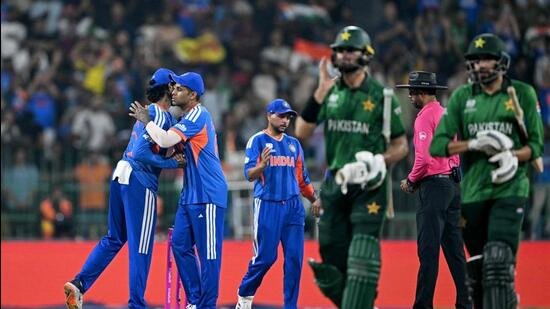
Mumbai: Pakistan cricket team has a good think-tank – in Mike Hesson they have a shrewd coach known for his tactical acumen, well versed with T20 format, and their captain Salman Agha is a strong character. It showed in their results ahead of the India game – having won five (T20I) games on the bounce, including a 3-0 whitewash of Australia.
For Sri Lanka’s spin-friendly playing surfaces, they have a variety of spin options to choose from, a surprise weapon in Usman Tariq. They also had the advantage of being based in Sri Lanka from the start of the tournament.
But, all of it came a cropper against India on Sunday evening at Colombo’s R Premadasa Stadium.
Captain Suryakumar Yadav was a step ahead of the opposition. India had an answer for every challenge and outplayed them.
Captain and part-time off-break bowler Salman Agha’s decision to bowl the first over and get Abhishek Sharma for a duck was the only move of the evening which clicked for Pakistan.
From there on, they were chasing shadows. At a certain level, even Agha was wasted as he bowled just two overs out of the possible four despite getting some impressive drift.
The role clarity the India players displayed was impressive. The same, though, can’t be said of Pakistan. Given the hype around the contest, the Indian players won half the battle with a calm and composed approach.
India’s spin all-rounder Axar Patel, who had an excellent game with the ball, said the team cut off the outside noise.
“We were just thinking about our plan and our execution when we are batting or bowling, we are just thinking about if we are bowling first or we are bowling second what we have to do? How the wicket was? All those things,” Axar said in the post match conference.
Pakistan fancied their chances after striking the first blow in the opening over. It was a decisive moment in the game. India had a back-up power-hitter in Ishan Kishan. He effortlessly stepped into Abhishek’s shoes to deliver a massive counterpunch. It ensured Pakistan didn’t get the chance to build on the psychological advantage gained by having a prized scalp.
The keeper-batter played a sensational 40-ball 77 to lift his side to a competitive 175/7 and he could do that because he chose the smart play. Pakistan’s gameplan was spin centric but with the ball turning, Kishan waited for the bad ball and did not go charging out of his crease.
India got to 52/1 in the Powerplay period with Kishan scoring 42 (25 balls) of those runs. Overall, Kishan hammered 66 runs off 37 balls against Pakistan slow bowlers, spoiling their spin-heavy strategy on a slow playing surface.
Pakistan coach Hesson acknowledged that Kishan’s approach unsettled his spinners. “I think he’s (Kishan) fearless. He’s able to score on both sides of the ground. So, he’s not just committed to the leg side. We know he’s incredibly strong there, but he can reverse. So, if you’ve got spin, especially in the Powerplay, it can be a challenge,” Hesson said in the post-match press conference.
Earlier, teams used to target Kishan on the off-side owing to his penchant for leg-side strokes. Pakistan spinners plan was the same but Kishan was better prepared this time. “I did work a lot on my off-side game, so then I can have them bowl where I want them to bowl. On a big ground, you get bigger gaps,” Kishan said in his post-match interview with the official broadcaster.
Hesson admitted Kishan’s impact. “I think the fact that he’s in a rare vein of form, applied a lot of pressure to our spinners and probably took them away from the basics, which the pitch was actually doing a lot when we bowled nice and slow and into it, but outside of that, no one really scored better than a run a ball.”
Saim Ayub finally got Kishan in the ninth over but India never ceded the early advantage provided by their opener.
Even with wickets in hand, they refrained from going in search of extra runs. It was disciplined batting with an eye on the big picture. Until the 18th over, the maximum they got was two 10-run overs, in the 12th and 13th. Tilak Varma stuck to a clear role of anchor, scoring a 24-ball 25.
“The way he (Kishan) played his shots, I told him to keep batting the same way, and that if a wicket fell, I would handle it at the other end and rotate the strike,” Varma told JioHotstar.
Captain Suryakumar Yadav (29-ball 32) being there for Pakistan’s trump card Usman Tariq was a perfect match up for India. Never once did the India captain make a premeditated charge at the unorthodox spinner, staying at the crease till the 19th over.
With wickets in hand, Shivam Dube (17-ball 27) and Rinku Singh (4-ball 11) had the freedom to attack in the last couple of overs.
Once India reached 175, the pressure was on Pakistan’s batters. The ball was spinning, and Suryakumar was smart with his bowling changes.
While Pakistan opted for spin, India stuck to pace with the new ball and it couldn’t have worked any better. There were two reasons to get Hardik Pandya to bowl the first over – one, his success against Pakistan and, second, getting opener Sahibzada Farhan early.
Coming into the game, in eight bowling innings against Pakistan in T20Is, Pandya had always been among the wickets, having taken 15 at an average of 14. He again provided India a dream start, getting a breakthrough of the fourth ball, by inducing a false shot from Farhan.
The importance of Farhan’s wicket was huge in the context that he was Pakistan’s best option to neutralise the threat posed by ace pacer Jasprit Bumrah. In the last Asia Cup tournament, Farhan in three matches against India, had scored a 40 and two half-centuries, the feature of his knocks being the comfort with which he had dealt Bumrah, against whom he scored at a strike rate of 150 without once losing his wicket.
With Farhan out of the way in four balls, Bumrah did Bumrah things. The India star produced a double blow in the innings’ second over to leave Pakistan reeling at 13/3.
Losing three wickets upfront to pacers on a pitch where the spinners were posing the real challenge was poor cricket by Pakistan.
The Indian spin attack built on the good work done by their pacers and shot out Pakistan for 114 and won the game on a canter. The maddest of formats, it might be said, was won by the sanest of teams.


