


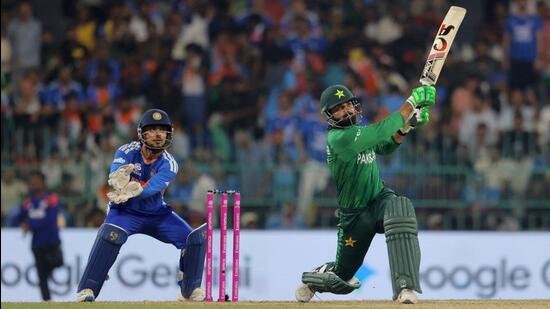
Mumbai: Suryakumar Yadav often passes light-hearted remarks sitting in press conferences. A comment from the India T20 captain in September last year though was made more than just in jest.
“I feel you should stop asking these questions on rivalry,” Suryakumar said during the 2025 Asia Cup, after an end result against a familiar foe that wasn’t any different to the one at the 2026 T20 World Cup in Colombo on Sunday.
“According to me, if two teams play 15-20 matches and if it (head-to-head record) is 7-7 or 8-7, then it can be called a rivalry. But 13-0, 10-1… I don’t know what the stats are. But, this is not a rivalry anymore.”
As plain spoken as it was, Suryakumar has a point. India versus Pakistan has ceased to be a rivalry in recent times. And not just in cricket.
The trend of lopsided encounters between two historical and storied rivals has largely cut across sports, men and women, since the turn of the century. The only major difference being that with cricket, it still carries an unusually high volume of hype off the field for an unusually high level of quality mismatch on it.
Be it in hockey, squash or tennis, to name a few mainstream sports where it delivered gripping contests or at least dramatic theatre in the past, India versus Pakistan now largely brings with it a taste of bland inevitability.
Gone are the days of the likes of Imran Khan, Javed Miandad or Waqar Younis bringing as much star power as Kapil Dev, Sunil Gavaskar or Sachin Tendulkar on to a cricket field and both teams playing their part in the spectacles of Sharjah through the late 1980s and 90s.
Or the days of Dhanraj Pillay and Shahbaz Ahmed weaving magic with their hockey sticks and whipping up a magnificent matchup in the 1990s. Or the days of an Aisam Ul Haq Qureshi-led Pakistan delivering a 3-2 Davis Cup classic with a Leander Paes-powered India on the grass courts of the Cricket Club of India in 2006.
The two men who competed in singles in that famous tie, Aisam and Aqeel Khan, also turned up to play singles well into their forties against the touring Indians in 2024. Even an under-strength India blanked the hosts 4-0 in Islamabad.
Perhaps that illustrates where sport in general has gone over the last couple of decades in Pakistan. Even if not, the numbers sure do.
In cricket, from an overall 73-58 head-to-head record against India in ODIs, Pakistan have won just four of the 18 ODIs against India from 2010 (their last win came in the 2017 Champions Trophy). The T20I numbers are 14-3 in favour of India, and the 61-run hammering in Colombo made it 8-1 in World Cups.
The stats are more glaringly unbalanced in hockey. The last time Pakistan beat India was a decade ago, in the 2016 South Asian Games final. Since then, the gulf has only widened, to such an extent that the question around most matches now is not who will win but by how many goals. A 2-1 scoreline in the 2024 Asian Champions Trophy comes as a rare surprise after the 10-2 romp for India in the Hangzhou Asian Games in 2023.
10-2, 8-1, 4-0: scorelines and head-to-heads have seldom seen a bridge this far in sporting contests between the neighbours.
“I wouldn’t call India versus Pakistan a rivalry anymore, be it in hockey or cricket or most other sports,” said Pillay, India’s hockey great whose battles with Shahbaz are part of hockey folklore.
“I might have played more than 50 matches against Pakistan in my days. And I remember every match would carry a lot of significance, and some great battles within the battle between individuals. People would be hooked, no matter where we played. That was what you called a proper rivalry. And the players felt it too.
“Today what we get to see is not a rivalry. It’s one team completely dominating the other. That’s because, from what I have seen, sports in general has really declined in Pakistan,” Pillay added.
In that decline, Arshad Nadeem stands as a bit of an outlier, and his rivalry with India’s javelin star Neeraj Chopra one of the few exceptions to the India-Pakistan sporting narrative. And yet, after beating Chopra to become Pakistan’s first individual Olympic gold medallist at the Paris Games in 2024, Nadeem spoke about the challenges of infrastructure and training in Pakistan, and how little support he received – financially and otherwise – during his journey to the top.
Squash is another sport where Pakistan boasts of historic dominance and legendary players, and can still level up for a fight with the Indians (the Indian men’s team beat Pakistan 2-1 to win the gold at the Asian Games in 2023). But even there, much like with Nadeem, it’s largely down to individual brilliance and freak talents.
As a collective, Pakistan sport, much like its cricket team in Colombo on Sunday, seems to be going nowhere. And India-Pakistan contests, across most individual or team sports, only one way.
“I fear that Pakistan cricket should not end up going down the road where its hockey finds itself now,” said Pillay.


