



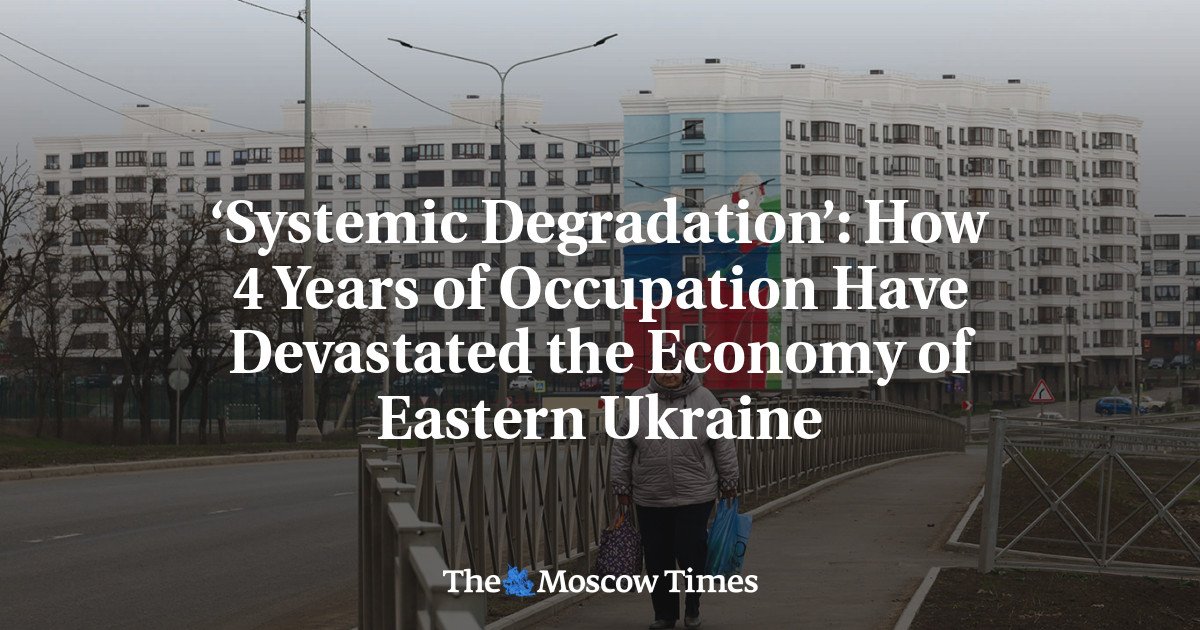
In late January, a concerned resident of the occupied Ukrainian city of Melitopol contacted local media with a tip.
The local metalworking plant was in a sorry state. Footage shared by the resident showed massive holes in the roof and a dusting of snow on the factory floor and finished car parts, all while workers huddled around a fire for warmth. They hadn’t been paid in two months.
“Rumor around the factory has it that those who quit won’t get any money at all, and we don’t know where else to turn,” one former plant worker later told the pro-Russia outlet.
People need to work, even in a warzone. But in occupied Ukraine, that’s become exceedingly difficult. Russia’s four-year rule has devastated the economy of an area that was once considered the country’s industrial center.
What little information that leaks out suggests that jobs are scarce, industry has vanished and money is hard to come by. In a region already torn apart by war, the lack of means to put food on the table only exacerbates day-to-day hardship, experts and people from the region told The Moscow Times.
“Available jobs skew toward low-paid budget-sector or occupation-linked roles” and “independent private business has been hollowed out, raided and taken over,” said Jade McGlynn, head of the Ukraine and Russia program at King’s College London’s Center for Statecraft and National Security, in an email to The Moscow Times.
She described the situation in the occupied regions as “systemic degradation.”
“Overall, people face unstable work, wage arrears, degraded infrastructure and services that function unevenly and unpredictably,” McGlynn added.
The vast swath of eastern Ukraine in question was largely brought under Russian military control in the early months of the war. In the fall of 2022, Putin formalized the illegal annexation of the Donetsk, Kherson, Luhansk and Zaporizhzhia regions after a series of widely criticized referendums. The Crimean peninsula was annexed in 2014.
bloknot-zaporozhie.ru
As of this week, the four-year anniversary of the war, Russia occupies about 20% of Ukraine’s territory, an area where 3-5 million people are estimated to reside.
Ukraine’s Economy Ministry and Social Policy, Family and Unity Ministry — which is charged with reintegration of the occupied regions — did not respond to emailed questions or an interview request, respectively, for this article.
Beyond the frontline areas where direct exposure to fighting has effectively shut down normal life, people reel from bureaucratic dysfunction and their employers’ neglect.
This fall and winter, in the city of Berdiansk, port workers’ pay was withheld for more than three months. The Zaporizhzhia region’s Transport Prosecutor’s Office launched an investigation and found that 41 million rubles ($535,000) needed to be paid back. An official was “held administratively liable,” but the office released no further details on what led to the episode.
Elsewhere, similar stories play out with shocking regularity, like employees of a water utility going unpaid last summer in the town of Lysychansk or, in November, Russian media reporting that coal mines in the Luhansk region were on the brink of closure.
Alexei Konovalov / TASS
“There are emblematic collapses due to Russia’s inability, or unwillingness, to provide even basic levels of infrastructure support beyond the military,” said McGlynn, referring specifically to the Berdiansk incident.
And these are only the cases that become publicly known. There is virtually no independent media in the occupied regions, and residents are under immense psychological and ideological pressure not to criticize the de-facto government administration.
According to people from the region who spoke with The Moscow Times, employment in sectors not bankrolled by the government — and therefore generally outside the coverage of pro-Kremlin media — can also prove unreliable.
“The situation on the labor market is complex and unstable,” said one 32-year-old woman living in an occupied region, who answered questions through an intermediary due to the danger of speaking with a journalist. “I have not been able to find a permanent job. The income level is below average.”
Petro Andryushchenko, a former adviser to the mayor of Mariupol, the second-largest city in Donetsk before the war began, said this is in part due to Russia’s treatment of the region “like a colony.”
“[The regions] don’t have a real economy,” he told The Moscow Times. “They just take what they can take for free — our resources, our agriculture, all kinds of things.”
He was referring to reports that Russia has launched large-scale resource extraction enterprises, such as the mining of coal and iron ore, using seized Ukrainian industrial assets.
Last year, Prime Minister Yulia Svyrydenko, then the country’s chief economic official, said that Kyiv evaluated the value of natural resources in the occupied regions at $350 billion.
Alexander Reka / TASS
For Andryushchenko, who now heads the Center for the Study of the Occupation, Mariupol presents a case study for issues facing the wider occupied territories.
“Of course, shops, restaurant services [and similar things] are working,” he said.
But many locals he is still in touch with have been hard-pressed to find new work. The once-booming industrial manufacturing business disappeared early in the war after the destruction of Azovstal, the vast steel plant that once employed 11,000 people.
Now, he said, people get by “because the Russian budget sends money — and that’s it.”
The grim portrayal of life on the ground casts doubt on Moscow’s projects to drum up business and buoy economic realities.
This includes the establishment of free economic zones in the occupied regions in 2023, which are primarily centered around lessening the tax burden to encourage investment and business.
Dmitry Yagodkin / TASS
These initiatives — and extraction activities — appear to be doing little to offset the immense expenses of annexation. This is to say nothing of the billions of rubles flowing from the regions strictly for military expenditures.
The occupied regions regularly rank among the biggest recipients of subsidies from Russia’s national budget. In 2026, they will all receive record financing, from a high of 78 billion rubles ($1 billion) for Donetsk — the second highest among all regions of Russia, including occupied territory — to 14 billion ($183,000) for Kherson.
The figures raise questions of how sustainable Russia’s occupation is from a financial perspective.
“These regions obviously receive more than the regular region in Russia percentage wise, but population wise the share is small, so it’s not going to break the budget of the federal center,” said Tatiana Mikhailova, an economist and visiting professor at Penn State University.
Even so, the high cost of sustaining the war effort is likely something that the Kremlin is willing to continue bearing, Mikhailova said, even if the effects are felt back home.
“And so essentially, in the end, it will lower the living standards across [Russia],” she added. “It’s only a question of priorities.”
A Message from The Moscow Times:
Dear readers,
We are facing unprecedented challenges. Russia’s Prosecutor General’s Office has designated The Moscow Times as an “undesirable” organization, criminalizing our work and putting our staff at risk of prosecution. This follows our earlier unjust labeling as a “foreign agent.”
These actions are direct attempts to silence independent journalism in Russia. The authorities claim our work “discredits the decisions of the Russian leadership.” We see things differently: we strive to provide accurate, unbiased reporting on Russia.
We, the journalists of The Moscow Times, refuse to be silenced. But to continue our work, we need your help.
Your support, no matter how small, makes a world of difference. If you can, please support us monthly starting from just $2. It’s quick to set up, and every contribution makes a significant impact.
By supporting The Moscow Times, you’re defending open, independent journalism in the face of repression. Thank you for standing with us.
Continue
Not ready to support today?
Remind me later.
×
Remind me next month
Thank you! Your reminder is set.


