



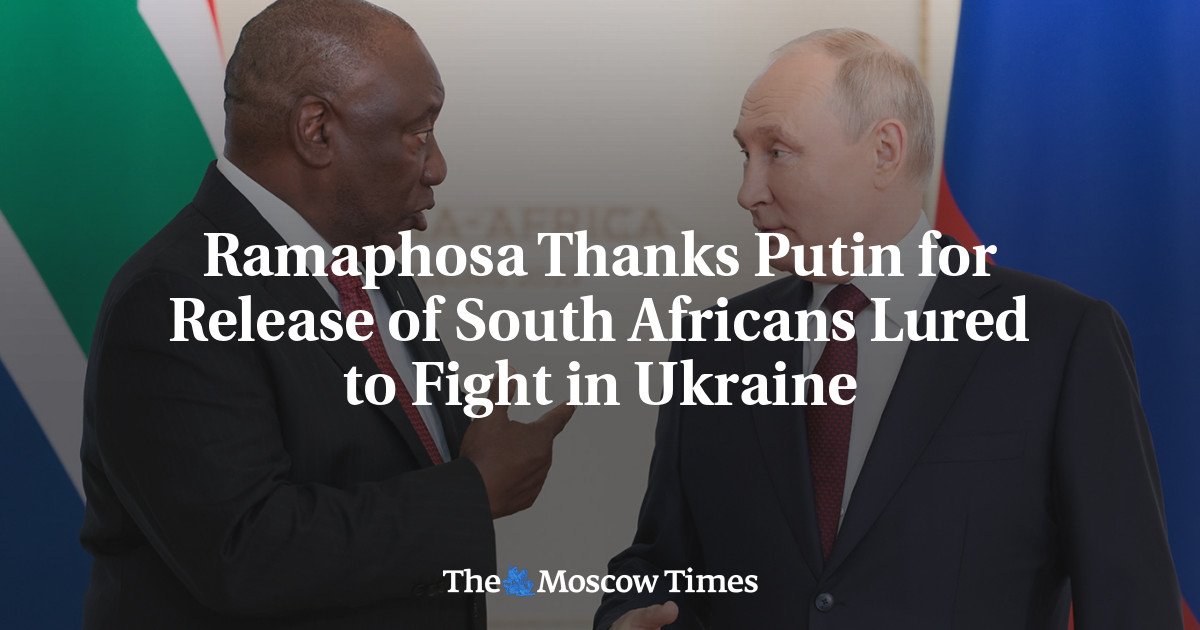
South Africa’s Cyril Ramaphosa on Tuesday expressed “heartfelt gratitude” to President Vladimir Putin for the return of men who were lured into fighting alongside Russian forces in Ukraine.
In November, South African authorities said they had received “distress calls” from 17 men who were trapped on the front line in Ukraine’s Donbas region after being tricked into joining mercenary forces.
Four of the men arrived back home last week, and 11 others were expected to return soon, according to South Africa’s presidency. The remaining two are still in Russia.
“President Ramaphosa has expressed his heartfelt gratitude to President Vladimir Putin, who responded positively to his call to support the process of returning the men home,” the presidency said in a statement.
“The investigation into the circumstances that led to the recruitment of these young men into mercenary activities is ongoing,” it added.
South African law prohibits its citizens from fighting for a foreign country’s army without government authorization.
The war sparked by Russia’s invasion of Ukraine in 2022 has attracted foreign mercenaries on both sides.
Ukraine’s foreign minister said in November that more than 1,400 citizens from 36 African countries had been identified among the Russian ranks.
AFP journalists spoke to four Kenyans recently returned from Russia who said they were deceived by a Nairobi recruitment agency under false promises of well-paid jobs.
A daughter of South Africa’s ex-president Jacob Zuma resigned from parliament after claims she was involved in recruiting men to join Russian mercenaries.
Reports in the South African press said the men were allegedly sent to Russia for security training by the opposition MK party, which is headed by Zuma, South Africa’s leader between 2009 and 2018.
A Message from The Moscow Times:
Dear readers,
We are facing unprecedented challenges. Russia’s Prosecutor General’s Office has designated The Moscow Times as an “undesirable” organization, criminalizing our work and putting our staff at risk of prosecution. This follows our earlier unjust labeling as a “foreign agent.”
These actions are direct attempts to silence independent journalism in Russia. The authorities claim our work “discredits the decisions of the Russian leadership.” We see things differently: we strive to provide accurate, unbiased reporting on Russia.
We, the journalists of The Moscow Times, refuse to be silenced. But to continue our work, we need your help.
Your support, no matter how small, makes a world of difference. If you can, please support us monthly starting from just $2. It’s quick to set up, and every contribution makes a significant impact.
By supporting The Moscow Times, you’re defending open, independent journalism in the face of repression. Thank you for standing with us.
Continue
Not ready to support today?
Remind me later.
×
Remind me next month
Thank you! Your reminder is set.


