









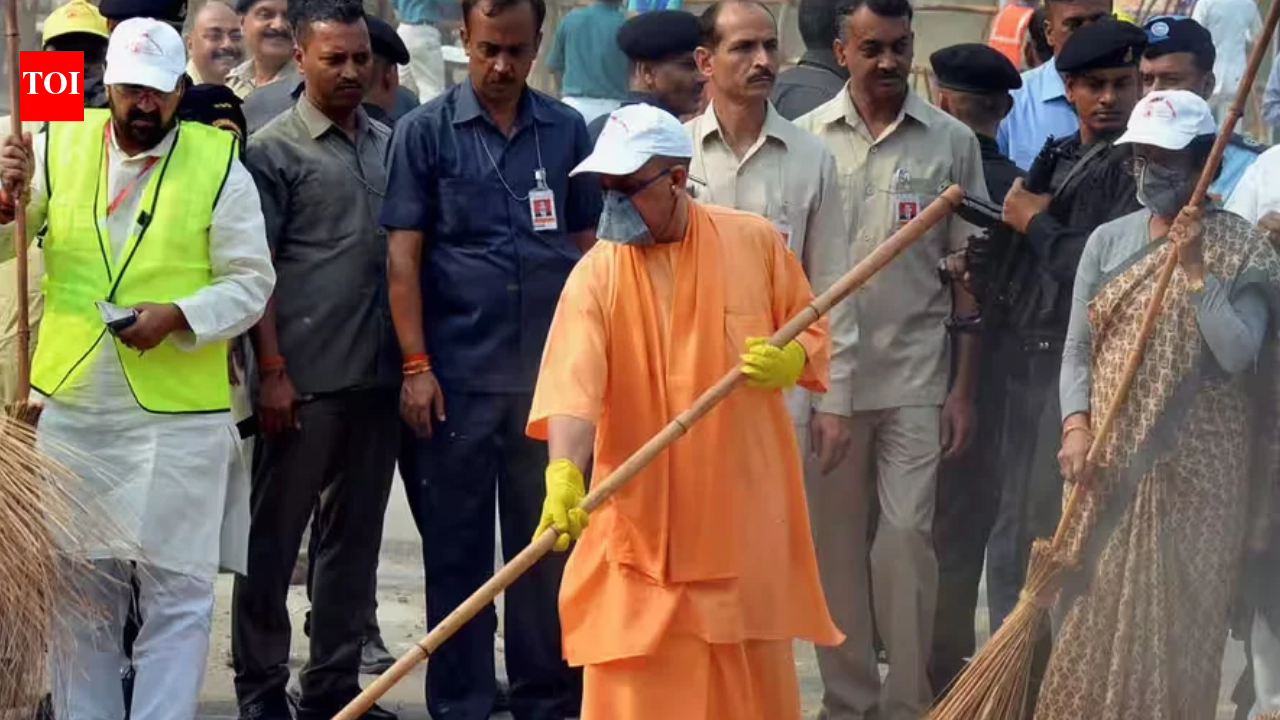
The implementation of Swachh Bharat Mission in Uttar Pradesh has been one of many success stories of Yogi government since 2017. The overall sanitation ecosystem developed by UP government has also been a mechanism worth emulating by the other state governments mainly because of diverse and difficult geo-social conditions in this state.Over the past nine years, Swachh Bharat Mission has emerged as one of the most significant sanitation and cleanliness programmes in Uttar Pradesh. Under the leadership of Chief Minister Yogi Adityanath, the state has sought to move from merely expanding sanitation infrastructure to creating a more comprehensive system encompassing household toilets, public sanitation facilities, solid and liquid waste management, cleanliness of public spaces and behavioural change.The transformation has taken place through two complementary components—Swachh Bharat Mission-Grameen (SBM-G) in rural areas and Swachh Bharat Mission-Urban (SBM-U) in cities and towns. While the rural mission has focused on sustaining Open Defecation Free (ODF) status and developing ODF-Plus villages, the urban mission has concentrated on household and public toilets, waste collection, processing and the broader objective of creating cleaner and healthier cities.Urban sanitation gets a major pushThe progress under Swachh Bharat Mission-Urban is particularly visible in the expansion of household sanitation facilities. Official statistics show that only 3,09,924 Individual Household Latrines (IHHLs) had been constructed in urban Uttar Pradesh up to 2017-18. Following the formation of the Yogi Government in May 2017, the programme received renewed emphasis, and the number rose to 7,58,949 by 2018-19 and has now crossed 9 lakh, reaching 9,00,113 IHHLs. This means that nearly 5.90 lakh additional household toilets have been constructed since 2017-18. Behind these numbers is a substantial improvement in access to sanitation for urban families, particularly those who previously lacked toilets within their homes.The expansion of household toilets has an impact that goes well beyond physical infrastructure. Access to a toilet within the home improves privacy and dignity, reduces dependence on public facilities and contributes to better hygiene practices. For women, children, elderly people and persons with disabilities, household sanitation can significantly improve safety and convenience.The approach of the state government, as articulated by Urban Development Department officials, is not confined to construction targets. The larger objective is to ensure that every eligible family has access to safe, clean and dignified sanitation facilities.Public sanitation infrastructure expands alongside household toiletsThe sanitation effort has simultaneously addressed the needs of people who spend significant parts of their day outside their homes. Under Swachh Bharat Mission-Urban 1.0, more than 10,000 community and public toilets and urinal blocks have been constructed across urban areas of Uttar Pradesh.Together, these facilities have created more than 70,000 toilet seats.Such infrastructure is particularly important in markets, transport hubs, commercial centres, major public places and other areas with high pedestrian movement. A city cannot become genuinely sanitation-secure if its residents have toilets at home but lack accessible facilities while travelling, working or shopping.The next phase of the mission is continuing this expansion. From 2024-25 onwards, Uttar Pradesh has added 2,623 public toilet seats and 1,104 urinal seats, taking the total number of additional public sanitation units created during this period to 3,727. The emphasis therefore reflects a two-pronged strategy: sanitation inside the household and sanitation in public spaces.From ODF to ODF Plus in rural Uttar PradeshThe rural component has a different but equally important trajectory. When the Swachh Bharat Mission-Grameen was launched nationally in 2014, its immediate objective was to eliminate open defecation by ensuring that rural households had access to toilets and encouraging communities to adopt sustained sanitation practices.The first phase achieved a dramatic expansion of rural sanitation infrastructure. Subsequently, the mission entered a second phase, moving from the ODF objective to ODF Plus. Here is where the state of Uttar Pradesh excelled in its implementation under yogi government.Under SBM-G Phase II, the focus is on ensuring that villages not only remain free from open defecation but also have systems for solid waste management, liquid waste management and visual cleanliness. This marks a fundamental change in the definition of rural sanitation.A clean village is now expected to have arrangements for the collection and management of household waste, treatment or safe disposal of wastewater, appropriate drainage and sustained community participation.The ODF-Plus approach is particularly significant because it addresses the problem of sanitation after the toilet has been constructed. Without proper waste and wastewater management, sanitation infrastructure alone cannot create a healthy living environment.Rural sanitation and the changing face of village lifeThe expansion of rural sanitation has had social as well as environmental implications. Household toilets have reduced dependence on open spaces and helped make sanitation a matter of dignity and household responsibility.The participation of Gram Panchayats, women’s self-help groups, frontline workers, schools and community organisations has become increasingly important in sustaining the gains. The emphasis is now on developing local systems that can be operated and maintained by communities themselves. This includes composting of biodegradable waste, collection and segregation of solid waste, management of plastic waste, drainage and treatment of grey water.Initiatives associated with GOBARdhan have added an economic dimension to rural waste management by encouraging the conversion of cattle dung and other organic waste into biogas and other useful products. Thus, sanitation is gradually being connected with the rural circular economy—where waste is viewed not merely as something to be discarded but as a potential resource.Uttar Pradesh’s sanitation story and women’s dignityOne of the most important outcomes of the Swachh Bharat campaign is its impact on women’s dignity and safety. The availability of household toilets reduces the need for women to travel outside the home or wait until dark to access sanitation facilities. Public toilets and urinal facilities are similarly important for women working in markets, offices and commercial establishments and for those travelling between cities and villages.The sanitation mission has therefore increasingly been viewed as a programme linked to women’s dignity, public health and quality of life, rather than merely a construction programme.Waste management: the next frontierThe sanitation challenge has also changed with rapid urbanisation. As Uttar Pradesh’s cities grow, municipal bodies face increasing quantities of solid waste every day. Consequently, Swachh Bharat Mission-Urban has progressively expanded its focus from toilet construction to door-to-door waste collection, source segregation, waste processing, scientific disposal and remediation of legacy waste.The national evolution of SBM-U from ODF cities to ODF+, ODF++ and Garbage-Free Cities reflects this wider approach. Uttar Pradesh’s urban local bodies are similarly required to move towards systems in which waste is segregated at source, collected efficiently and processed through composting, recycling, biomethanation, waste-to-energy and other appropriate technologies.Behavioural change remains centralThe most difficult part of sanitation is not always construction—it is ensuring that infrastructure is used correctly and maintained over time. Swachh Bharat has therefore relied heavily on behavioural change and Jan Bhagidari. Cleanliness drives, awareness campaigns, school programmes, citizen participation and community-led initiatives have sought to make sanitation a daily habit.This approach is particularly relevant to rural areas, where the sustainability of ODF status depends upon continued community participation. In cities, citizen behaviour is equally important for source segregation, responsible disposal of waste and maintaining public spaces.Nine years of change: a broader sanitation ecosystemThe journey of Swachh Bharat Mission in Uttar Pradesh during the past nine years can broadly be seen as a transition through three stages. The first stage was access—ensuring that households without toilets received sanitation facilities. The second stage was expansion—creating public and community sanitation infrastructure so that citizens could access toilets beyond their homes. The third stage is sustainability—building systems for solid and liquid waste management, maintaining ODF status in villages and making cities cleaner and progressively garbage-free.In the urban sector, the increase from 3.09 lakh IHHLs in 2017-18 to 9 lakh-plus today represents the scale of the infrastructure expansion under the Yogi Government. The construction of more than 10,000 public toilets and urinal blocks, creating over 70,000 seats, has supplemented household sanitation with facilities in public spaces.In rural Uttar Pradesh, the emphasis has similarly moved beyond toilet construction towards ODF-Plus villages, waste management, grey-water management and sustained cleanliness.The next challenge is to consolidate these achievements. For urban Uttar Pradesh, this means ensuring that every eligible family has access to a functional toilet, public sanitation facilities remain clean and usable, waste is segregated and processed and legacy waste is scientifically managed.For rural Uttar Pradesh, the priority is to ensure that ODF status does not slip, ODF-Plus infrastructure remains functional and every village develops sustainable systems for solid and liquid waste management.The larger significance of the Swachh Bharat Mission is that sanitation has moved from the margins of development policy to its centre. Over the last nine years, the mission has helped establish a new understanding: a clean Uttar Pradesh requires not only toilets, but also behavioural change, efficient waste management, clean public spaces and active participation by citizens and local governments.The transformation from the initial toilet-building campaign to a comprehensive sanitation ecosystem marks the most important phase of the mission’s evolution. In Uttar Pradesh, the expansion of household toilets and public sanitation facilities under the Yogi Government is now being complemented by the broader objective of creating cleaner villages, healthier communities and garbage-free cities.


