



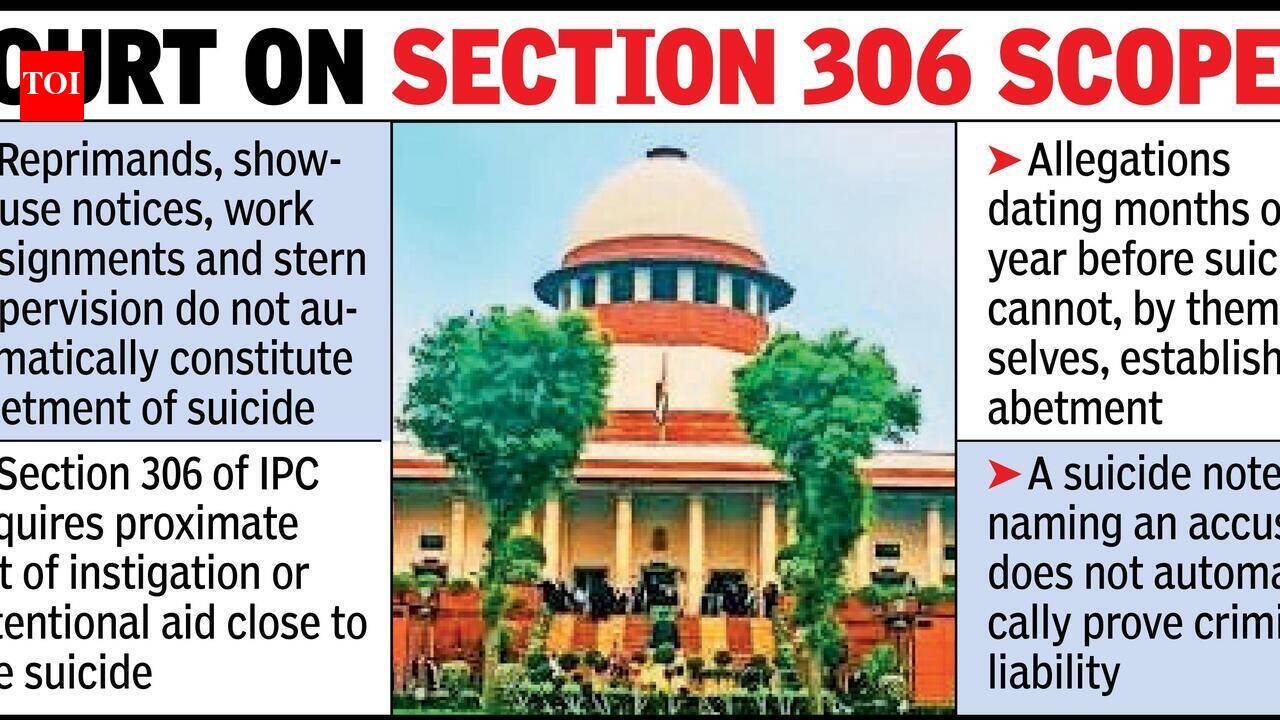
Nagpur: Supreme Court has held that ordinary administrative directions, disciplinary supervision, adverse remarks and even stern behaviour by a superior officer cannot be treated as abetment to suicide unless there’s material showing a conscious intention to drive the subordinate to take her own life.A bench comprising Justices Satish Chandra Sharma and Nongmeikapam Kotiswar Singh made the observation while allowing an appeal filed by former deputy conservator of forests Vinod Shivakumar through counsel Varad Kilor in connection with the 2021 suicide of Harisal forest range officer, Dipali Chavan.The court quashed Bombay High Court’s Sept 24, 2025, order and Achalpur sessions court’s Oct 24, 2024 order, and discharged Shivakumar from the criminal case.The bench said IPC’s Section 306 (abetment to suicide) requires direct or indirect instigation to suicide. “There must exist a proximate act amounting to instigation or intentional aid which creates such circumstances that would drive the victim to die by suicide,” the court held.The prosecution’s allegations against Shivakumar included official reprimands and show-cause notices, assignments relating to encroachment removal and village rehabilitation, an alleged role in registration of an FIR under Scheduled Castes and Scheduled Tribes (Prevention of Atrocities) Act, and forcing Dipali Chavan to trek in the forest, which she alleged resulted in a miscarriage.Chavan, then forest range officer of the Harisal forest range, died by suicide on March 25, 2021, at her govt residence in Harisal, using her service pistol. The court found these incidents were remote from her death. The alleged miscarriage occurred in October 2020, more than five months before the suicide, while other allegations dated back to March 2020.The bench also examined Chavan’s three suicide notes, in which she blamed Shivakumar for harassment and held him responsible for her death. However, it said the notes did not establish an immediate act of instigation and criminal intent could not be inferred.In an important observation on the scope of Section 306, the court held that a superior officer reprimanding a subordinate over work, issuing a show-cause notice, giving administrative directions or initiating disciplinary action would not, by itself, constitute abetment to suicide.“Such a charge requires proof of the accused’s intention to instigate the suicide and a concrete act supporting that intention. Criminal liability under Section 306 IPC cannot rest upon the tragedy of the outcome alone; it must be founded upon the statutory ingredients of Section 306, which are absent in the present case,” the court said.


