



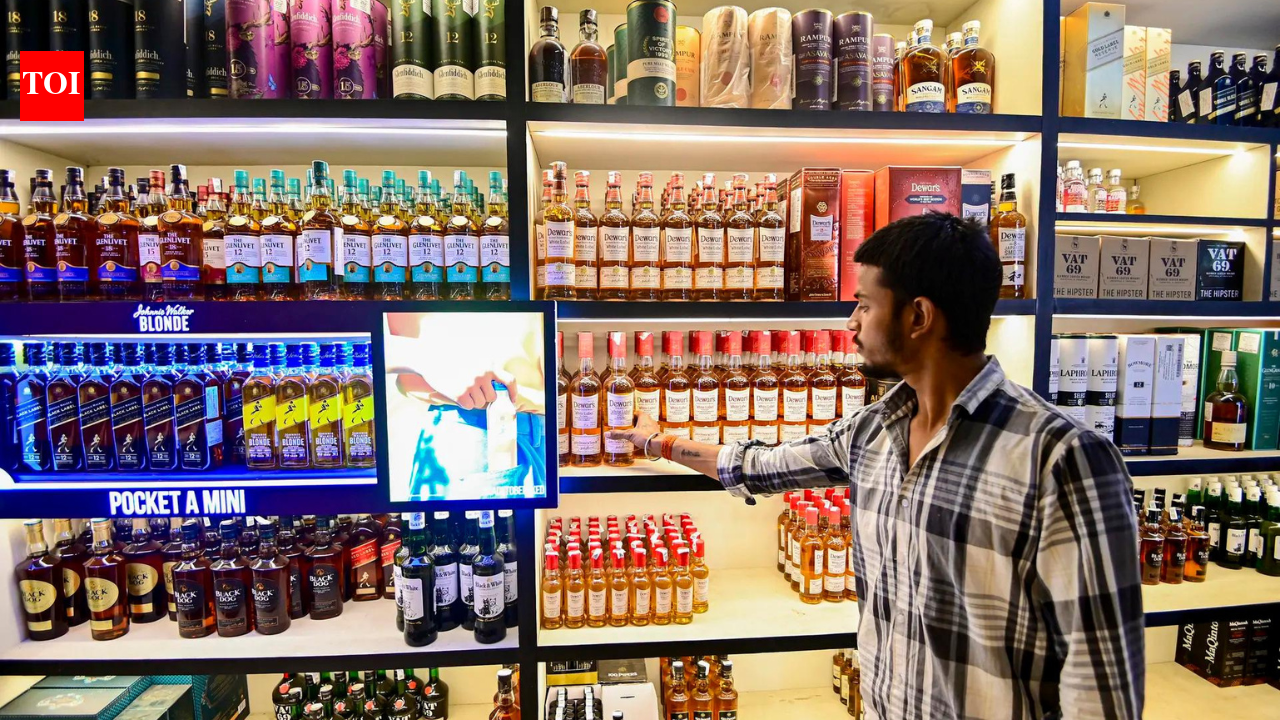
MUMBAI: A sharp rise in liquor sales, coupled with higher excise duties and price revisions by manufacturers, has delivered a windfall to state governments, with some states recording an 82% jump in excise collections in the first two months of FY27.While Uttar Pradesh led the country in absolute collections, Maharashtra retained its position among the biggest contributors to state excise revenues, highlighting the growing importance of liquor taxation in funding state finances.Monthly indicators compiled by the Comptroller and Auditor General (CAG) show that Uttar Pradesh collected more than Rs 10,600 crore in excise revenue during April-May FY27, nearly 9% higher than the corresponding period last year. Haryana posted the fastest growth, with collections surging over 82% to more than Rs 2,300 crore. Karnataka ranked second in absolute collections during the period, while Kerala recorded the second-highest growth rate.For Maharashtra, the latest data reinforces the state’s position as one of India’s largest liquor markets. According to the CAG’s State Finances 2024-25 report, Maharashtra collected Rs 25,466 crore in state excise duty in FY25, making it the third-highest excise-earning state after Uttar Pradesh (Rs 52,575 crore) and Karnataka (Rs 35,784 crore). It was followed by Andhra Pradesh (Rs 19,882 crore), West Bengal (Rs 19,521 crore) and Telangana (Rs 18,604 crore).Industry executives attribute the latest surge in revenues to a combination of factors, including an estimated 14% increase in liquor consumption, higher excise rates imposed by several state governments, and increases in manufacturers’ base prices, all of which have boosted tax collections.Alcohol meant for human consumption remains outside the ambit of the Goods and Services Tax (GST), giving states complete authority to levy and revise taxes. Apart from state excise duty, governments also impose value-added tax (VAT) and various cesses. These taxes may either be levied as a percentage of the product value or as a fixed amount per litre, allowing states considerable flexibility in designing their tax regimes.Several states have also begun tweaking their taxation structures. Karnataka recently became the first state to introduce an alcohol-in-beverage (AIB)-based excise system, while Kerala has proposed lower sales tax on low-alcohol beverages as part of efforts to reshape consumption patterns.The CAG report highlights the growing dependence of states on liquor revenues. State excise duty accounted for 13.5% of the combined States’ Own Tax Revenue (SOTR) in FY25, making it the second-largest source of tax revenue after state GST in many states.Over the past decade, excise collections across all states have risen by 173%, reflecting both higher consumption and repeated tax revisions. Telangana registered the steepest increase, with collections growing 388% between FY16 and FY25, followed by West Bengal (386%) and Andhra Pradesh (353%).The data also illustrates how policy decisions can dramatically alter state revenues. Bihar’s excise collections collapsed after the introduction of total prohibition in 2016, falling from Rs 3,142 crore in FY16 to just Rs 0.41 crore in FY25. Mizoram too witnessed a sharp decline in collections following the implementation of its prohibition law.For Maharashtra, where liquor excise remains a key contributor to the state’s own tax revenue, sustained growth in collections is expected to support government finances. However, economists note that while higher excise receipts strengthen fiscal resources, states must also balance revenue considerations with public health objectives as alcohol consumption continues to rise.


