



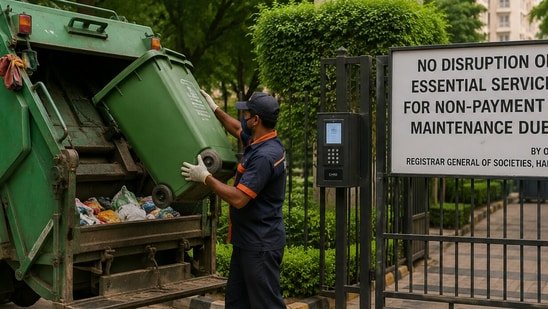
Resident Welfare Associations (RWAs) cannot cut off essential services, such as garbage collection, or deactivate digital access systems to force residents to pay outstanding maintenance dues, according to a recent ruling by the Haryana Registrar General of Societies. The order draws a clear line between an RWA’s right to recover maintenance charges and its authority to enforce them, reaffirming that housing societies cannot use basic civic amenities as a tool for coercion.


Legal experts say the ruling reinforces a long-standing legal principle that is often overlooked by housing societies. While RWAs are fully entitled to recover legitimate maintenance dues, they cannot deny residents access to essential services or impose coercive measures that effectively make a home uninhabitable. Any dispute over maintenance charges must be resolved through legal remedies available under applicable law, rather than through self-help measures intended to compel payment.
Also Read: Not just housing, but seamless transport to expand Delhi-NCR’s growth, say industry experts
The June 16 order also clarifies that maintenance charges must be levied in proportion to an apartment’s size and cannot be imposed uniformly on flats and villas of different sizes.
The case
The order stems from a dispute between residents and the N Block RWA of Mayfair Gardens in Gurugram, bringing to a close a legal battle that lasted nearly nine months.
The dispute began after the RWA, in 2025, revised the quarterly maintenance charge to a flat ₹5,000 for all 2BHK apartments and villas, irrespective of their size. It also approved a series of punitive measures against residents who defaulted on payments, including suspension of garbage collection, deactivation of park and access cards, withdrawal of plumbing and electrical services, and a 1% monthly penalty on unpaid dues.
Also Read: National developers quadruple NCR housing supply share amid infrastructure push and luxury demand
A group of residents challenged the decision, arguing that it was arbitrary and contrary to the law. They contended that homes of varying sizes could not be charged identical maintenance fees and that the RWA lacked the authority to suspend essential services to recover outstanding dues.
The Registrar General accepted the residents’ contention, holding that maintenance charges must be linked to the property’s size and that coercive actions affecting essential services fall outside an RWA’s powers.
What legal experts have to say about the matter
“The Haryana Registrar General’s view is legally sound and reinforces a principle that housing societies and RWAs often overlook. The right to recover maintenance dues does not translate into a right to disconnect or obstruct essential services. An RWA is not an adjudicatory authority and cannot impose penalties that have the effect of depriving a resident of basic civic amenities,” said Sonam Chandwani, Managing Partner, KS Legal & Associates.
“Maintenance disputes are contractual and statutory disputes which must be resolved through the remedies available under the applicable apartment ownership laws, cooperative laws, civil courts or other competent forums. Recovery cannot be achieved through self-help measures that effectively compel payment by making a property uninhabitable,” she said.
The ruling serves as an important reminder that while residents are obligated to pay legitimate dues, enforcement must remain within the boundaries of law. Any action that is arbitrary, disproportionate or contrary to statutory rights is vulnerable to legal challenge. The rule of law requires that dues be recovered through due process, not through denial of essential services, she said.


