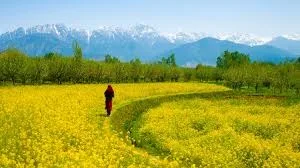
Experts caution cycle may repeat without long-term measures
Srinagar, Mar 24: After battling hazardous air during the onset of winter, Kashmir is witnessing a noticeable improvement in air quality this spring, with Air Quality Index (AQI) levels across the Valley returning to safer ranges, according to data from the Jammu and Kashmir Pollution Control Committee.
Current readings indicate that Kashmir’s AQI is largely hovering in the “moderate” range (70–90), with several areas intermittently recording “good” levels (below 50) following recent rainfall and snowfall that helped disperse accumulated pollutants.
This marks a significant recovery from November last year, when air quality across Kashmir deteriorated sharply, with AQI frequently entering the “poor” and “very poor” categories, raising widespread health concerns. The spike was driven by dry weather conditions, stubble burning in neighbouring regions, vehicular emissions, and increased use of biomass fuels for heating, compounded by thermal inversion that traps pollutants within the Valley.
A senior JKPCC official said the improvement now being observed is largely seasonal. “Meteorological factors play a crucial role. With the onset of spring, better wind circulation, along with rain and snow, helps in dispersing pollutants that remain trapped during winter months,” the official said.
However, experts cautioned against viewing the improvement as permanent.
“This is a cyclical pattern. Every year, air quality worsens in late autumn and early winter, particularly in November, and improves with changing weather conditions,” said environmental scientist Dr Irfan Rashid. “The concern is that underlying emission sources remain largely unchanged.”
Experts highlight that vehicular emissions, road dust, construction activity, and biomass burning continue to be the primary contributors to pollution across Kashmir.
“Unless emissions are controlled at the source—through better public transport, dust management, and reduced reliance on solid fuels—the improvement we see in spring will remain temporary,” Dr Rashid added.
Adding a meteorological perspective, independent weather forecaster Faizan Arif said the recent improvement is closely linked to changing weather patterns. “Frequent western disturbances, rainfall, and snowfall events this season have played a key role in cleansing the atmosphere. However, if dry conditions return, pollution levels can rise again quickly,” he said.
Long-term trends do show gradual gains, with average AQI levels across Kashmir remaining below 100 in recent assessments, while less urbanised and high-altitude tourist areas continue to record cleaner air, often in the 40–60 AQI range.
The administration is also expanding air quality monitoring infrastructure to improve data collection and policy response.
“We are strengthening the monitoring network and working on mitigation strategies, but sustained improvement will require consistent efforts and public cooperation,” the JKPCC official said.
Public health experts warn that repeated exposure to poor air quality, especially during winter, poses serious risks. “Even short-term exposure to high pollution levels can aggravate respiratory and cardiac conditions, particularly among vulnerable groups,” said physician Dr Sandeep Dogra.
As spring brings cleaner air across the Valley, Kashmir is experiencing a phase of relief. However, experts underline that without long-term interventions, the cycle of toxic winters and cleaner springs is likely to persist, keeping air quality management a critical challenge for the region.