



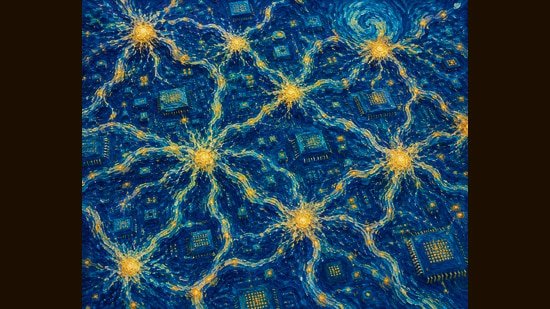
There’s little the brain cannot do. Even when it functions outside the body. In 2022, around 8 lakh brain cells, derived from humans and mice, learnt to play the 1970s video game Pong. Grown on a specialised microchip and connected to a computer in a Melbourne lab, the cells effectively took control of the paddle and sent tennis balls flying.


Earlier this year, the experiment levelled up. Around 2 lakh such brain cells mastered the iconic ‘90s first-person shooter game, Doom. Housed in the same lab – run by the Australian biotechnology company Cortical Labs – the neurons, playing as a lone space marine, slayed monsters and shut down demonic gateways. Halfway across the world, at Indiana University Bloomington, US, a team of engineers in 2023 showed that 3D bundles of living neurons could do even more: recognise speech patterns and work out mathematical equations.In Switzerland, meanwhile, neurons have entered the cloud. The biocomputing startup FinalSpark has developed a cloud-based platform that lets researchers around the world access and interact with dot-sized brain tissues growing in their laboratory. They can run experiments to see how these tissues learn and recognise tactile information such as Braille letters or form memories. And back in Australia, last year, Cortical Labs rolled out a shoebox-sized “biological computer” powered by millions of human neurons thriving on a silicon microchip.
What sounds like something straight out of science fiction is, in fact, the burgeoning world of organoid intelligence. It is the field that studies brain organoids or wetware: computers fuelled by cultures of brain cells and brain-machine interfaces, as a new form of computing. And in just a few years, organoid intelligence has moved from the fringes of neuroscience experiments to one of the most closely-watched and debated frontiers of science, reshaping artificial intelligence (AI), robotics, scientific modelling, drug discovery, personalised medicine and energy-efficient computing.
GREY’S ANATOMY
The human brain contains, on average, 86 billion neurons. In comparison, brain organoids typically comprise anywhere between tens of thousands to a few million cells. Typically harvested from a volunteer’s skin or blood sample, they are reprogrammed into induced pluripotent stem cells (iPSCs). This is a sort of reverse-ageing of the cells so that they become a blank slate and can assume different cell identities. They’re then turned into brain cells by exposing them to a nutrient-rich matrix that mimics the conditions in the brain.
What’s interesting is the bit that happens after this, says Alysson R Muotri, professor, department of paediatrics and cellular molecular medicine at the University of California, San Diego School of Medicine. These neural tissues self-organise into a structure that mimics human neurodevelopment. “In doing so, they become great tools to understand the initial stages of fetal brain development. They can generate electrical activity and form networks that help them communicate with each other,” Muotri says. This communication is what interests computer scientists. Using a sort of chip called microelectrode arrays (MEA), computer scientists can connect organoids to computers. The electrodes act as translators, sending electrical signals to the neurons and relaying their response.
While rudimentary versions of such biohybrid computers have existed since the 2000s, the first breakthrough came in 2013, when researchers in Vienna, at the Institute of Molecular Biotechnology (IMBA), published the technique of growing cerebral organoids that mimicked aspects of the developing human brain. Over the next decade, these structures were being used to study conditions such as microcephaly, Alzheimer’s disease and autism. In 2022, the field shifted again. Melbourne’s Cortical Labs had just taught neurons in a dish to play Pong, which caused a wave of excitement among scientists. Initially termed embodied sentience, the field was called Organoid Intelligence (OI) by 2023. Unlike Artificial Intelligence, which seeks to mimic the brain, OI explores how brain cells can be more computer-like.
What biological systems like these do exceptionally well – and what today’s AI systems still struggle with – is navigating different kinds of environments, adapting to change and learning from experience quickly and efficiently, says Alon Loeffler, senior application scientist at Cortical Labs.
Humans learn through experience and feedback. After all, even a two-year-old can learn what a cat is after seeing only a few examples. “AI often needs billions of training iterations to achieve the same result.” More recent experiments have also shown that multiple organoids of different kinds linked together to create assembloids might be even more effective than singular organoids at learning, remembering and responding. This can accelerate disease modelling for neurodevelopmental disorders and drug discovery.
LEVEL UP
Today, a small but rapidly expanding ecosystem of researchers and biotech startups are racing to combine the best of this biological development with computation. At the University of California, San Diego, Muotri’s team is already working on an organoid-based system that can help tackle complex environmental challenges, including forecasting oil-spill trajectories in the Amazon. “We’re teaching the organoids to detect hydrocarbons at extremely low, micro-molecular concentrations. This could potentially enable the identification of oil contamination near offshore platforms at a very early stage,” he says. Elsewhere, researchers at Johns Hopkins Bloomberg School of Public Health are studying how neural organoids mimic key features of learning and memory. This could help them understand neurodevelopmental and neurodegenerative diseases better, boost drug discovery and personalised medicine, and inspire new energy-efficient computing technologies.
Last year, Cortical Labs started shipping CL1, “the world’s first code deployable biological desktop computer”. Combining living brain cells with silicon-based computing and a life-support system, it is designed to make biological computing accessible to biologists. Each unit is priced upwards of $35,000. The lab also offers cloud-based access to its in-house cell cultures at $2100 a month.
In Switzerland, FinalSpark’s Neuroplatform also offers select researchers access to living neural organoids remotely so that they can carry out experiments in the field of biomedical research.
Beyond its scientific promise, much of the appeal of the nascent field stems from a larger concern: the growing environmental footprint of AI computing. The average human brain operates on just about 20 watts of power – about the same as a dim light bulb on a given day. AI uses up megawatts and gigawatts of electricity, while also massively straining water resources. This is where the development of wetware could truly make a difference, says Muotri. While it doesn’t mean that AI will be replaced by organoid intelligence, the latter offers the possibility of imagining a future where biological and silicon systems can work together.
“While biological systems are highly variable and difficult to standardise right now, as the technology progresses the advantages of low energy and learning in biocomputing systems will start to outperform the brute force of huge, power-hungry data centres and traditional AI ecosystems on autonomous tasks,” says Loeffler.


