



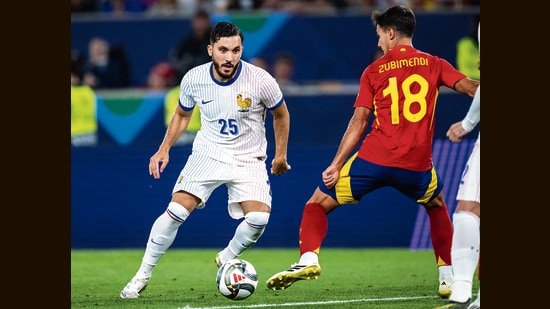
Is modern football devoid of beauty, soul, and spirit? Is it shackled by the voluminous variety and depth of data and its analysis? By obsessive, controlling coaches scanning for patterns? By the limitless commercialisation and professionalisation of the game, where anything that has a sniff of “inefficiency” has to be snuffed out?


The death of “joga bonito” —play beautifully — has been announced many times over in the past decades, with purists, poets, and pundits all lamenting the passing of a magical time where footballers danced on the pitch instead of just running with the ball, where the great artists—Garrincha, Pele, Maradona—moulded the game to suit their temperament, instead of tempering themselves to fit the game.
This nostalgic, melancholic idea of beauty in fade may be a romantic ideal, but it does not reflect the truth about football, in the modern age or otherwise. Despite all the things — the data, the analysis, the tactical micromanagement, or the business-first approach — that seem to overwhelm football now, nothing beats the great artist-player, and no team can rise to greatness without him or her.
Think about the most successful teams in the last few decades and look at the players who defined those teams: Zinedine Zidane’s France, the Spain of Xavi Hernández and Andrés Iniesta, Ronaldo and Ronaldinho’s Brazil, Lionel Messi’s Argentina, Andrea Pirlo’s Italy, or Barcelona with Xavi, Iniesta, Messi, Neymar and Luis Suarez, or Manchester City with Kevin De Bruyne, David Silva, and Bernardo Silva, or Real Madrid with Cristiano Ronaldo, or the Galactico era of Ronaldo, Roberto Carlos, Luís Figo and Zidane.
Each player here is composed of swaying hips and quicksilver feet, of twists and turns and hijinks, of eyes that see what others can’t see.
This World Cup will be no different. The team that will win it won’t be the one that controls the game the best, or the one that has fixed all leaks and trained to metronomic ruthlessness. It will be won by the team that has the player or players who can rise above the tyranny of efficiency and create a moment of magic out of thin air.
The reason why France and Spain are favourites is exactly this — Spain has Lamine Yamal, who dribbles the ball better than anyone in world football right now. At just 18, he is fearless in expressing his creativity and plays with the joy and freedom of a teenager at the local Sunday game. France is dripping with dribblers. Young boys who, not long ago, were unleashing their bagful of tricks inside the concrete jungles of suburban France. Michael Olise leads the pack, coming off a spectacular season for Bayern Munich. There’s Ousmane Dembele, with his back-to-back Champions League victories with PSG, and Kylian Mbappe, and Bradley Barcola.
But the player I will have my eyes on is Rayan Cherki. Manchester City’s newest recruit plays with trickery and flair reminiscent of prime Ronaldinho. He plays like he can’t care less about the importance of a game, as long as he can bring joy through fantastic, free football. He said as much himself in an interview: “Football for me is like art. It’s like music, it’s like drawing. If we don’t play with pleasure, you can’t play better, you can’t show what you want. And me, when I go on the pitch, I just want two things: the children, the dad, the mum, to forget for 90 minutes the life.”
(Email rudraneil@gmail.com. The views expressed are personal)


