



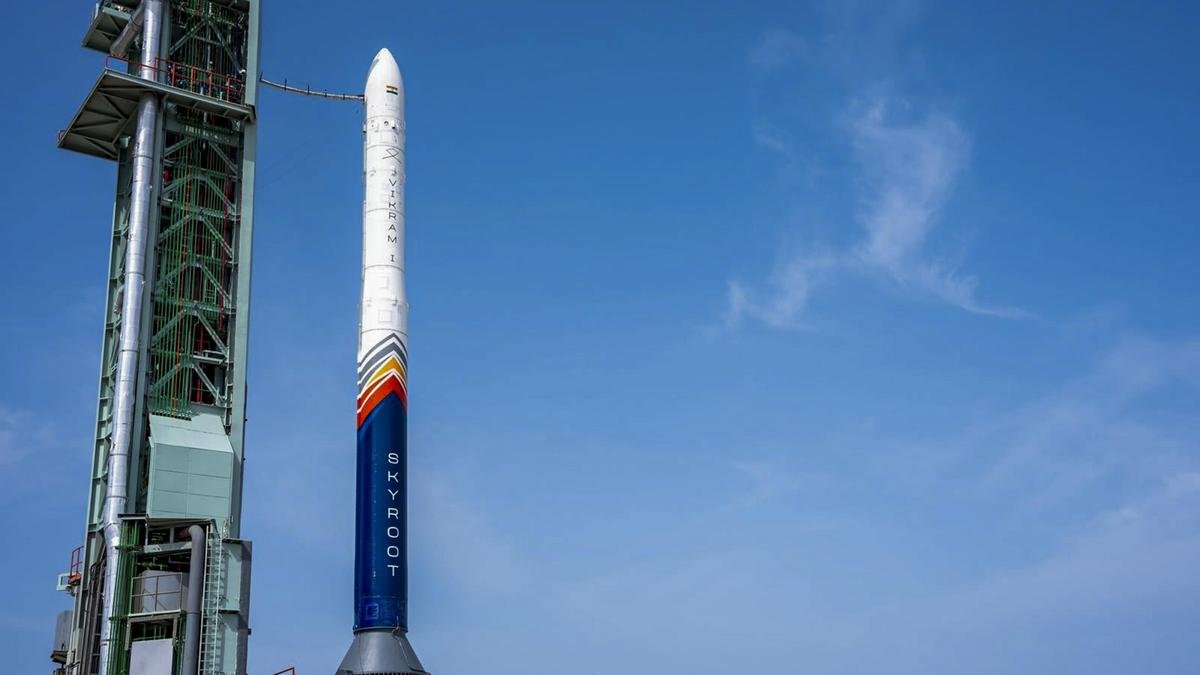
Five minutes past noon on July 18, the launch pad of Satish Dhawan Space Centre in Sriharikota roared back to life after a gap of 187 days.
The last launch from the space port was on January 12, 2026, involving the PSLV-C62 mission carrying the EOS-N1 earth observation satellite, which failed to complete its intended trajectory after an anomaly was detected during the end of the third stage of the launch vehicle.
Following this, there was a lull for nearly six months, which was revived with the successful launch of the country’s first privately developed orbital rocket, Vikram-1 on July 18.
The Vikram-1’s launch was part of the ‘Mission Aagaman’ (meaning arrival) and it marked India’s entry into an elite group of nations with private orbital launch capability making it only the third country in the world to achieve the feat through a privately developed launch vehicle.
Developed by private space launch company Skyroot Aerospace, Vikram-1 a seven-storey-tall, multi-stage orbital launch vehicle built with an all-carbon composite structure and powered by in-house developed propulsion systems, including 3D-printed engines and high-thrust solid-fuel rocket boosters. The rocket intotal carried six payloads of which two satellites, SCOPE and Grahaa, were injected to a Low Earth Orbit and the remaining on the upper stage were designated to carry out in-orbit experiments.
The successful launch of Vikram-1 has given a huge boost to India’s space programme as it comes just six years after the Government opened up the space-sector with reforms in 2020 to allow the participation of private players in the space sector.
Re-entry guidelines
Following the successful launch of Vikram-1, Indian National Space Promotion and Authorisation Centre (IN-SPACe), the single-window agency for all space-sector activities undertaken by private entities, has issued guidelines for the planned re-entry of space objects into the Earth’s atmosphere.
A document titled ‘Norms, Guidelines and Procedures for Implementation of Indian Space Policy-2023 in Respect of Authorisation for Undertaking Planned Re-entry of Space Objects’, released on July 23 outlines and do’s and don’t for planned re-entry of space objects.
Mission Drishti
For another private space entity, Bengaluru-based space start-up GalaxEye, it was a bittersweet experience as its Mission Drishti, the world’s first OptoSAR satellite, which developed it and launched in May onboard a Falcon 9 rocket by SpaceX from California, encountered an anomaly following a geomagnetic solar storm during the final stage of the launch and early orbit phase.
The start-up said that following the solar storm communication with the spacecraft became intermittent and was eventually lost.
GalaxEye said that during its active operating phase over a few weeks, Mission Drishti successfully validated critical technologies, operational processes, and infrastructure required to design, build, launch, and operate advanced space systems.
Concentrated funding
A new report by market research firm Tracxn has revealed that the Indian SpaceTech ecosystem now comprises 285 companies, with 274 remaining active and 72 having received equity funding. The report said that the total equity funding has reached $ 871 million across 241 rounds through July 2026.
The report further stated that the funding in India’s SpaceTech ecosystem remains concentrated in a few cities with Bengaluru leading the chart with $ 495 million raised across 106 rounds, accounting for 57% of total sector funding. According to the report seven of the top 10 funded.
SpaceTech companies are headquartered in Bengaluru followed by Hyderabad which has attracted $ 205 million, and Chennai with $80 million.
“Outside these three cities, funding remains limited: Ahmedabad ($45 million) and Pune ($14 million) together account for less than 7% of [the sector’s] funding,” the report stated.
Gaganyaan and Chandrayaan
ISRO was also involved with a few important tests related to the Gaganyaan programme.
On July 3, ISRO successfully conducted the ground test of the Sub-Orbital Launch Vehicle for Experiments (SOLVE) solid motor at the Static Test Facility, Satish Dhawan Space Centre which is another important event in the preparation for India’s human spaceflight mission.
Using SOLVE as a test platform, ISRO plans to carry out in future numerous tests for the Gaganyaan mission where in various conditions would be simulated to resemble the actual mission.
It also successfully conducted the Integrated Main parachute Airdrop Test (IMAT) for the Gaganyaan mission at the Aerial Delivery Research and Development Establishment drop zone in Sheopur, Madhya Pradesh. This test was the fifth in a series of IMAT to qualify the critical main parachute for the mission. The space agency said that the successful completion of IMAT-05 provides necessary confidence in the performance and reliability of the main parachute system for the first uncrewed Gaganyaan mission (G1).
During July, the space agency also completed three major qualification tests for crew module systems of the Gaganyaan mission. They include the float inflation test for crew module up-righting system, umbilical separation testing of Crew module Service module connect and disconnect system and crew module structure qualification test for apex cover separation loads.
The Chandrayaan-3 mission, which will be celebrating its third anniversary of its successful moon landing, continues to make headlines. Scientists at the Physical Research Laboratory (PRL), in a new study, have found that the geochemical composition of the Shiv Shakti Statio — the Chandrayaan-3 landing site — closely resembles that of a meteorite discovered in Antarctica.
Arresting departures
ISRO, which is yet to announce a launch mission after the January 12 failure of the PSLV-C62 mission, has a target to launch at least seven launches with the first one likely in the next two months, said its Chairman Dr. V. Narayanan. Of these two satellites have been built while others are in the final stages of integration.
The Department of Space (DoS) had issued a memorandum to curb the exodus of scientists and engineers who are working in critical missions of national importance, like Gaganyaan.
With over 100 ISRO personnel quitting the space agency in various centres across the country, DoS issued this memorandum addressed to directors of the ISRO centres and heads of units and asked them to address this issue and not to accept any requests for voluntary retirement or resignation from scientific and technical personnel of Group ‘A’ associated with the Gaganyaan or other important missions or projects until their realisation.
hemanth.cs@thehindu.co.in
Published – August 07, 2026 09:30 am IST


