



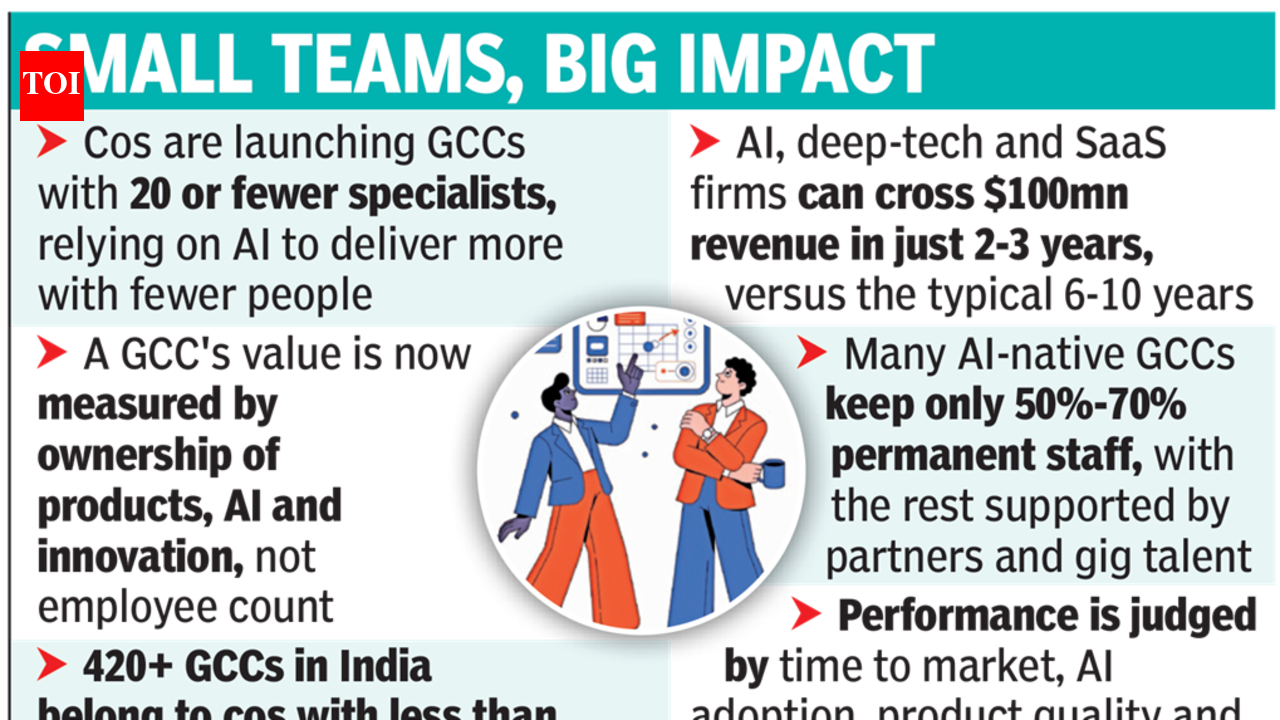
Bengaluru: The new global capability centre (GCC) model is increasingly smaller, leaner and engineering-led, with companies building specialised teams around AI and product engineering rather than focusing on scale and headcount.IT industry body Nasscom’s data shows more than 420 GCCs in India have parent firms with revenues of less than $100 million, pointing to the growing presence of smaller enterprises in the GCC ecosystem. A growing trend favours technology, product development and niche capabilities.US audio major Bose Professional’s Mangaluru R&D centre illustrates the shift. Focused on next-generation professional audio products, the centre began with one employee, has grown to 25 and is planned to scale up to 75, CEO John Maier told TOI last year. The company is also bringing more product development in-house to improve efficiency and speed of innovation.Nasscom cited McCain Foods, CoreStack, Blueshift, Veryon, Greenlight and Ava Care as examples of smaller specialised GCCs.Arindam Sen, GCC sector leader (TMT) at EY India, said smaller GCCs should not be treated as a fundamentally different operating model because of their size. A company with $1 billion in revenue may begin with a 20-, 50- or 100-person GCC, while a $60-billion enterprise may establish a centre with several hundred or even 1,000 employees.“Headcount alone should not define the category or determine the strategic relevance of a GCC,” Sen said.What is changing is the nature of work undertaken, with newer centres focused on AI, product engineering, cybersecurity and advanced analytics rather than transactional functions. Access to specialised talent, faster product development, intellectual property ownership and resilience can justify a smaller centre, Sen said.ANSR founder Lalit Ahuja said AI is reshaping GCC economics, allowing companies to accomplish more with smaller teams. Companies can begin with teams of 20 or fewer focused on specialised capabilities rather than building large workforces upfront.Some companies are cutting initial workforce assumptions by 30%-50%, with plans that once envisaged 5,000 employees being recalibrated to around 3,000, Ahuja said. Some AI-native GCCs also operate with a permanent core of roughly 50%-70% of their workforce, with the rest supported by flexible talent and service partners.He said the resulting productivity gains are changing how GCC performance is assessed, with metrics including faster time to market, improved quality and execution, a shrinking technology backlog, fewer software licences, and the ability to take on more high-value work.Nitika Goel, managing partner at Zinnov, said the sub-$100 million segment is a launchpad rather than a fixed category. On average, companies take six to 10 years to cross $100 million in revenue, but a fast-growing minority in AI, deep-tech and vertical SaaS can grow 40%-70% annually and cross the threshold in two to three years.That makes headcount an inadequate measure of a centre’s importance, she said.“What actually matters is value density, whether that team owns a global product or a critical AI capability, and how fast the parent starts routing more strategic work there.”Goel described the trend as the democratisation of the GCC model, citing RapidAI, Meltwater, Sonatype and Guardant Health. Such centres can become viable within 12-24 months, compared with the traditional three-to-five-year scale-up model.Sen said ROI should ultimately be linked to outcomes. A product engineering centre could be measured through release velocity, platform adoption, product reliability and revenue impact, while an AI centre could be be assessed on use cases deployed, productivity improvement, adoption and value realised.“The real question is not whether the centre is large enough, but whether it owns outcomes that matter to the enterprise,” Sen said.


