






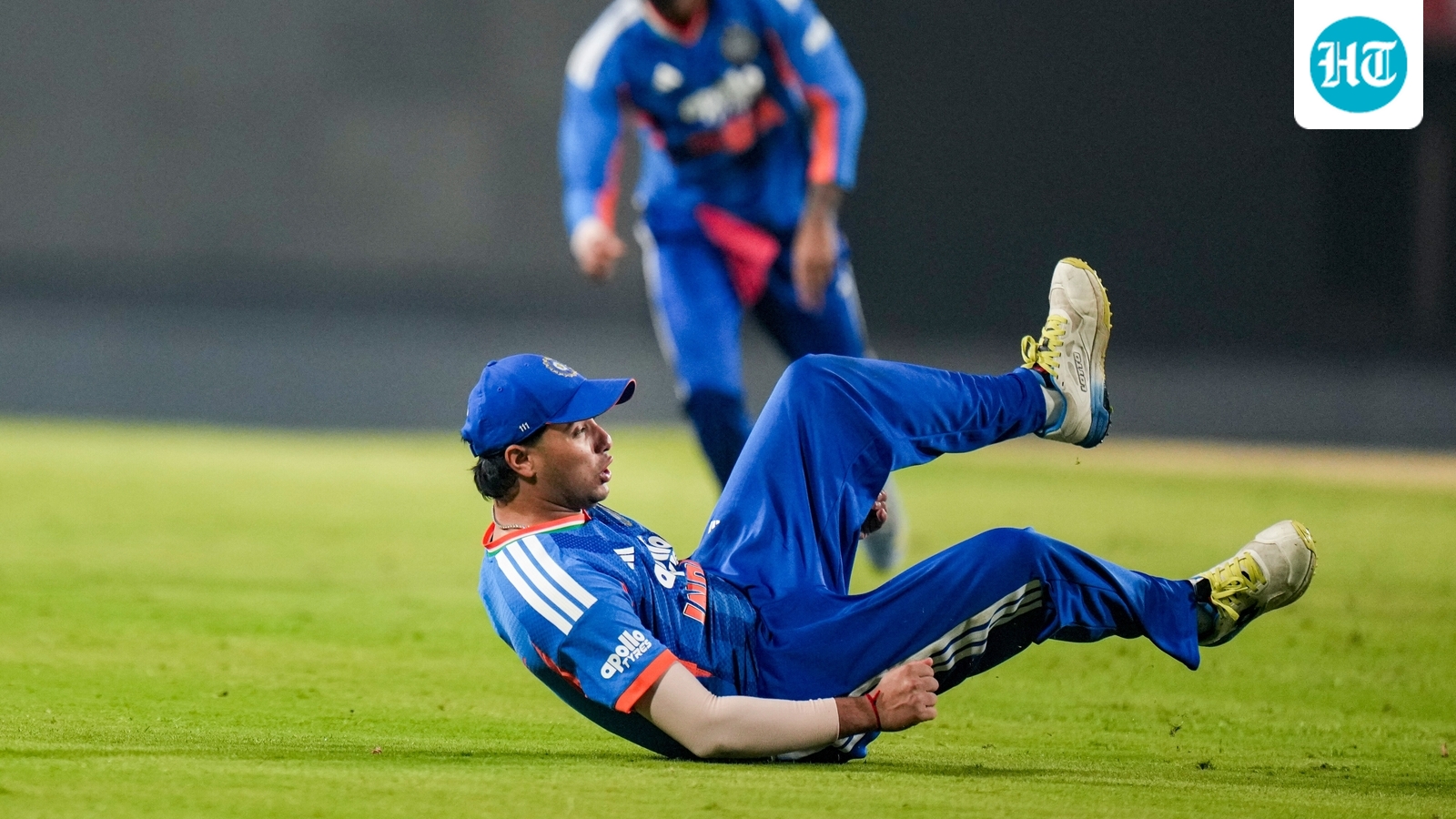
In the third over of the West Indies innings during the third T20I at Indore, Shimron Hetmyer slashed a delivery from fast bowler Mayank Yadav. It flew towards the short third man and seemed to be a pretty regular chance. But Abhishek Sharma got confused about whether he should take the catch in a conventional way or go for the reverse cup. The result was another drop. Another because the scenario perfectly summed up India’s catching woes in the shortest format.
Can a side consistently stay at the top of the game if their fielding standards continue to drop? India’s surge to the top in T20Is has been marked by a decline in the field over the past three years.
The chances are going down at an ever-increasing rate in the shortest format. In 2026, according to data provided by CricViz, India are the 11th worst team among the 12 full-members, with a catching efficiency of 74.4, ahead of only the West Indies, who are bottom with a catching efficiency of 73.8.
This year, Tilak Varma has been the safest Indian fielder, pouncing on a total of 23 catches, but despite this figure, he has also been guilty of putting down nine chances across 27 matches. The worst of India’s fielders have been Abhishek Sharma (57.8%) and Washington Sundar (62.5%). In essence, it boils down to one question: what exactly is going wrong?
How have all full-member nations performed as far as catching efficiency goes in 2026
If the last three-year period is considered, the catch efficiency rate has been steadily declining. If it was 80.4% in 2024, it came down to 79.8% in 2025, and now it’s 74.4% this year.
For context. Australia’s efficiency has increased, going up from 80.2 in 2024 to 83 in 2026. According to CricViz, India put down 33 chances in 26 matches in 2024; the number then decreased to 26, but the number of games played was 19. This year, the Men in Blue have dropped a whopping 55 chances in 32 matches.
Fielding coaches have recently changed, with T Dilip replaced by Subhadeep Ghosh, but the problem persists.
“I think fielding has now definitely taken a backseat in terms of application and in terms of building a certain culture,” said R Sridhar, the former India fielding coach, during a media interaction. “There is a clear culture in the way the Indian team is batting. And similarly, there’s a clear culture in the way the Indian team is bowling, especially in the ODIs, where Shubman Gill likes tall, hit-the-deck fast bowlers. But whereas in fielding, that (the culture) seems to be absent.”
“And what is really worrying is that the new kids coming into the squad are undercooked. Whoever is coming in, they don’t seem to be the kind of fielder a Kohli is or even a Surya or even a Shreyas, the generation of that block, I’m saying, because they seem to have been brought up on only one skill, that is, batting. So that’s a bit of a worrying factor, but that is not for the Indian team to worry. That is for the entire ecosystem to wake up and smell the coffee. So there are a lot of things to be done, but the fielding coach will have a job on his hands to train these young guns straight away,” he added.
Is there something that can be done to result in a mark improvement for the New Zealand series? Sridhar reckons the change will take time to be reflected, as it will depend on how each individual responds to the coaching style.
“In coaching, one size doesn’t fit all. You need to understand the person behind the player and have a different strategy for all of them. Understand their workload, understand what they are going through emotionally with their performances and bring them to the best possible place. Coach the face, not the symptom,” said Sridhar.
Sooryavanshi needs to put in the hard yards
Vaibhav Sooryavanshi took the world by storm with his 776 runs in the Indian Premier League for the Rajasthan Royals and made his India debut earlier this year in the series against England. In the IPL, the 15-year-old played on quite a few occasions as an impact sub, raising questions over his growth as a fielder.
Back in the day, there was a belief that younger players were safe fielders; however, the youngster has shown a need for someone to have a word with him about fielding. In 2026, Sooryavanshi has so far played eight matches for India, putting down two catches, and his overall efficiency stands at 71.4%.
In the Asian Games gold-medal match against Pakistan, Sooryavanshi almost collided with Abhishek. Hasan Nawaz’s chance went down when he was batting on 4, and he eventually went on to score 96, giving India a real scare. The answer for Sridhar is simple: someone needs to go and have a word with the youngster, asking him to put his part-time spin on the back burner and focus on fielding.
“Look, he’s 15. So he’s still a kid, right? So someone there has to really run his programme, I feel. I mean, although he’s in an international elite environment where athletes are aware of what they need to do and how they need to manage their workloads, someone as young as 15 sometimes needs to be told. Someone there has to make a schedule for Sooryavanshi, so he can get a lot of practice and be ready to field in the match as well. Because at 15, if you’re being subbed out, it’s not a great sign,” he said.
“We saw that he had a near-mishap in that Asian Games final. They dropped a catch. That was a mishap which could have really caused an injury. So these are things that need attention. Somebody has to take Vaibhav and show that he’s practising fielding every day. He can bowl a bit of left-arm spin, but we’ll save that for later. Now, it is very clear from my part that he has to work very hard on his fielding, and someone has to tell him that,” he added.


