






Arshdeep.
| Photo Credit:
K.R. DEEPAK
Not till the sixth outing in a cluster of eight did a team batting first finally manage to successfully defend a total. India’s 14-run victory in Sunday’s third Twenty20 International had to be earned the hard way, but at least it provided some solace to a fraternity that has been on a hiding to nothing since West Indies’ snappy white-ball tour of India began in Thiruvananthapuram on September 27.
There is much to be said of the advantages of chasing in India at this time of the year, when the dew is quite pronounced and gripping the ball in the second half of a match, especially for the spinners, is practically impossible. It’s not as if bowlers don’t account, or prepare, for this scenario. At practice, they often use wet, slippery balls to try and replicate the conditions they will most likely be confronted with in a match situation, but the nets does not entail the same pressure to deliver as a match, and therefore no amount of training can translate to perfecting a most difficult craft.
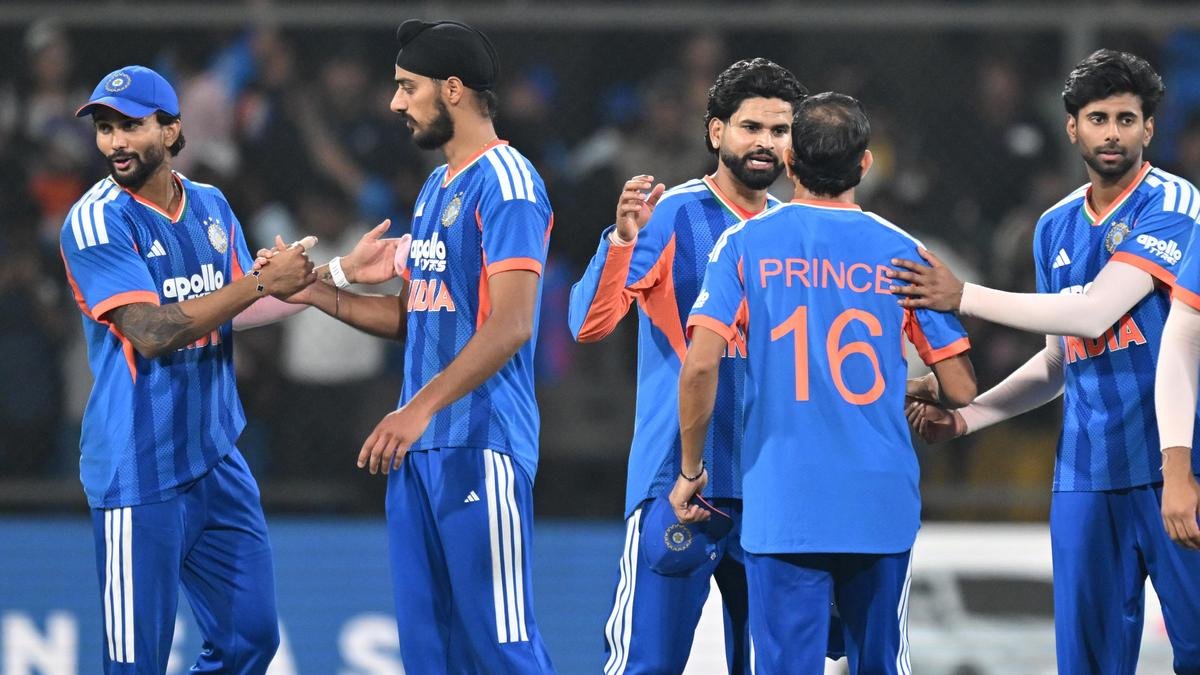
It is certainly no coincidence that the Indore victory came when there was no dew, thereby facilitating a hint of reverse swing expertly utilised by Arshdeep Singh, India’s highest wicket-taker in T20Is. Of course, India were also well served by the likes of Prince Yadav and Nitish Kumar, who delivered pinpoint yorkers at the death with great regularity. But even here, their cause was helped by a dry ball which they could send down with control, unlike a slippery orb that doesn’t quite leave the hand as the bowler would like it to be.
Prince Yadav.
| Photo Credit:
K.R. DEEPAK
Veritable run-fest
The One-Day International series provided a veritable run-fest, with Thiruvananthapuram somewhat of an outlier even though the Caribbeans got off to a frenetic start. John Campbell and centurion Justin Greaves added 135 for the opening wicket in just 114 deliveries to raise visions of a mammoth target on a pancake pitch until Kuldeep Yadav spun a wicked web in the middle overs with his tantalising left-arm wrist-spin. Again, Kuldeep operated in natural light with dew still to make an appearance; his craft shone through as he finished with four for 40 to ensure West Indies didn’t post more than 295, a total reined in with a whopping 50 deliveries to spare as Shubman Gill and Virat Kohli tore into the bowling.
Run-making touched ridiculous proportions three nights later in Guwahati. And yes, ridiculous is being used advisedly.
Campbell, red-hot skipper Shai Hope and the impressive Amir Jangoo provided the first instance of three batters slamming hundreds in the same ODI innings, propelling West Indies to 405 for seven. That’s more than eight runs an over for 50 overs, an extraordinary accomplishment that would guarantee victory 999 times out of 1,000. Only once before, a decade back, had a larger score been hunted down (by South Africa against Australia) internationally, so West Indies would have entertained some designs of squaring the series, but only some designs because they knew that even a run-rate of 8.10 didn’t hold any guarantee.
Mayank.
| Photo Credit:
K.R. DEEPAK
Their worst fears came true as the prayers of the Guwahati crowd were comprehensively answered. As facetious as it might sound, there was an unmistakable inevitability to India’s march to victory, this time attained also by eight wickets with 39 deliveries to spare. At the forefront again was Gill, who joined his predecessor Rohit Sharma as the only batter to smack more than one ODI double-ton. Gill’s partner-in-crime in the decimation of the bowling was Rohit; their opening salvo of 255, in 158 deliveries – is this even real?! – made this singularly one-way traffic. Evidently, no score is safe anymore. India mounted their highest successful run-chase but they did so without breaking sweat. It was great for the fans, who soaked in a very popular home victory, but what about the bowling fraternity? What about them indeed?
More carnage was to follow in New Chandigarh in the final, dead-rubber ODI, though this time, the boot was on the other foot. Hope’s grin on calling right lit up an already bright Saturday afternoon, a grin that would have made a Cheshire cat weak with envy when Jayden Seales packed off Gill and Kohli in the third over to leave the hosts gasping at four for two. To get to 351 from that point was a terrific accomplishment, aided by the fact that the early bounce and lateral movement dissipated under the unforgiving sin.
West Indies had never scored that many to win a match, and at various stages, it seemed as if they wouldn’t again, but their skipper didn’t buy into that theory. Having kept wickets for 50 wickets and picked up a groin twitch along the way, he made the most of a fortuitous promotion as opener – where he has tasted unparalleled ODI success – with an innings for the ages. Hobbling and wincing, he found a second wind to batter India into submission, raising victory with ten deliveries to spare.
Two National record chases in four nights set it up beautifully – for everyone except the bowlers – heading into the five-match T20I series. Once again, the start was flattering; West Indies floundered against Indian spin in high-scoring Lucknow, shot out for 171 with Axar Patel, Kuldeep and debutant Naman Dhir taking seven wickets between them. It was a total India would have reeled in in their sleep; with skipper Shreyas Iyer choosing that night to bring up his maiden century, it was all over in the blink of an eye, with 32 deliveries in reserve. Were we in store for a more equitable contest between bat and ball?
No sir, we certainly were not.
Over to Ranchi, and game two. Sanju Samson, that infuriatingly inconsistent opener who oscillates between the dreamy and the nightmarish with frustrating frequency, shed a lean trot with a blazing 82, and the captain and his deputy, Tilak Varma, produced an exhilarating final kick to propel India to 249 for five. It was worth more than West Indies’ 405 in the second ODI in all ways imaginable, yet it proved remarkably inadequate. Remarkably.
India plucked out Kamil Pooran – no relation to the more celebrated Nicholas – and Shimron Hetmyer off successive deliveries through the express Mayank Yadav in the very first over, and when Mayank also cleaned up Rovman Powell, West Indies were up against it at 58 for three. Hope – who else? – and Sherfane Rutherford pushed back spectacularly. There was no time to rebuild, no point in steadying the rocking boat. They both teed off, the left-handed Rutherford and his right-handed captain matching each other blow for pulverising blow while adding 120. Rutherford missed out on a century but Hope wasn’t to be denied, powering his team past the finish line with Romario Shepherd for company. It was the second time in three matches (and two different formats) that West Indies had completed a record chase. That they reached 252 with nine deliveries to spare amply demonstrated the dominance of the bat over the ball, which is why India’s 14-run win in Indore assumes greater significance even though they had an impressive 223 to defend.
At the interval, the pundits were busy dissecting if 223 was enough. Imagine that. More than 11 runs an over, and the experts are debating if the team batting first was a few short. Where are we headed? Is this how it is going to be, with towering edifices erected in the evening and razed to the ground by night? Will game after game follow a monotonous pattern of ball-bashing, aided by flat decks, small boundaries, light bats with extended sweet spots, and a profusion of power and cheekiness that leave bowlers tearing their hair out in frustration?
Both after winning in Guwahati and losing in Ranchi, India head coach Gautam Gambhir called for a greater balance between bat and ball. He lamented the punishment the bowlers (from both sides) were being subjected to. He did acknowledge that India should have done better in Ranchi when they had nearly 250 on the board, and you couldn’t argue with that because in some ways, as harsh as it might sound, the bowlers have readymade excuses and therefore carry the belief that they can be excused any mauling.
It’s against this backdrop that one recalls Josh Hazlewood’s remarks during IPL 2026, when he held forth on the challenges of bowling in T20 games, especially in the first six overs when only two boundary-riders are allowed.
“I think it’s definitely nice for the crowds to watch balls flying into the stands,” the Australian quick, one of the heroes of Royal Challengers Bengaluru’s back-to-back IPL triumphs, observed in April. “From a bowler’s point of view, it almost takes the pressure off a little bit because the batsmen are expected to get off to good starts. They’re expected to score big runs, they’re expected to get 230 runs probably every T20 innings they play.”
The Aussie great then held forth on the virtues of defensive bowling, reiterating that especially in 20-over cricket, it is not always imperative to go looking for wickets every ball. “If you can get a batter on two off six balls, the pressure that they’re under in that situation is huge,” he pointed out. “You can just see a player almost melt out there in the middle, they just cannot find the gap, cannot find the boundary. I feel like that’s the biggest pressure in the game now, it almost releases the pressure (on the bowlers) a little bit.”
That’s something Gambhir alluded to in Ranchi, and Nitish harped on after the Indore victory.
While it is true that the best dot ball is the one that comes with a ‘W’ attached to it, when the dice is loaded in favour of the batter and the odds are stacked against the bowler, it is essential to bowl within oneself and do the unglamorous rather than embrace bluster and bravado. Defensive bowling is a fine art – ask a Fanie de Villiers, or a Gavin Larsen or Chris Harris – and doesn’t mean that one doesn’t have the requisite skills to take wickets. It’s just an honest and intelligent acknowledgement of how things stand instead of giving in to ego and trying to show who the boss is.
White-ball bowling hasn’t quite evolved as dramatically and with as much impact as batting, which is understandable because cricket is, after all, a batter’s game.
But unless these ‘my batting strongest’ battles are more evenly spaced out, we are in real danger of killing the goose laying the golden eggs.


