



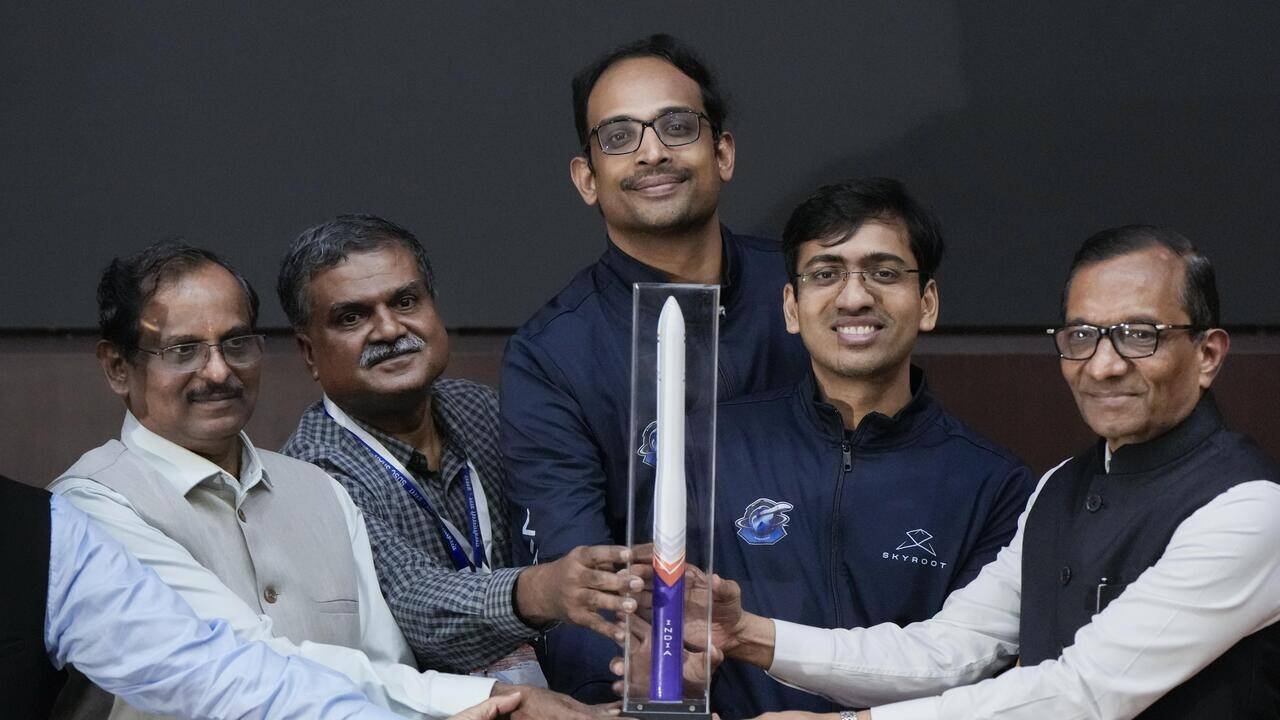
Hyderabad: When Skyroot Aerospace began building private rockets in Hyderabad in 2018, it was chasing an ambition few Indian startups had dared to pursue. With Vikram-1’s successful orbital mission, that ambition has now become India’s biggest private space breakthrough, and in the process, spawned a new generation of deeptech entrepreneurs.Over the past eight years, Skyroot has done more than build launch vehicles. It has seeded founders, attracted investor confidence and exposed a generation of engineers to complex technological challenges once largely confined to ISRO, DRDO and govt laboratories.Several former Skyroot engineers have since launched ventures in deeptech, aerospace and spacetech. Some, such as BluJ Aerospace, Red Balloon Aerospace and Perceptyne, are already in the public domain, while others continue to operate in stealth mode.The common thread is a deep understanding of the space value chain and its bottlenecks—from propulsion, avionics and actuation to regulation, manufacturing, qualification, near-space platforms and reusable launch systems.Perceptyne co-founder Raviteja Chivukula joined Skyroot a few months after it was founded and remained with the company until shortly after the Vikram-S mission in 2022.As an avionics consultant, he helped architect avionics and actuator systems, translating mission objectives—such as placing a payload in a 400-km orbit—into specifications for actuators, mission computers and automated checkout systems.“Building rockets is one of the most cutting-edge engineering challenges because a launch vehicle is an intensely multidisciplinary system,” Chivukula said. “That’s what always excited me.”His current company develops dexterous humanoid and semi-humanoid robots for the automotive and electronics industries, combining AI, mechatronics, controls and mechanical engineering.While his interest in robotics predated Skyroot, Chivukula said watching founders Pawan Kumar Chandana and Naga Bharat Daka build the company from scratch gave him the confidence to become an entrepreneur.“The biggest lesson was having an audacious goal and then building the team, raising capital and turning that vision into reality,” he said. “Skyroot showed that Indian startups can take on world-class engineering challenges.”‘Near-space startup Red Balloon Aerospace co-founder Sireesh Pallikonda, who left Skyroot with co-founder Dr CVS Kiran in 2025, said working at the company also provided first-hand exposure to India’s evolving space policy and regulatory ecosystem.As part of Skyroot’s founding team, Pallikonda handled international partnerships while Kiran focused on domestic relationships.“Any policy, guideline or recommendation that needed industry inputs gave us an opportunity to participate first-hand,” Pallikonda said.That experience helped the founders understand licensing timelines, govt and defence procurement, and customer requirements for near-space applications.Red Balloon is now developing super-pressure stratospheric balloons, tethered aerostats—technologies that India has traditionally imported from countries such as Israel and Russia—as well as long-endurance autonomous stratospheric airships for telecommunications and cargo applications.For Amar Srivatsavaya, co-founder and CEO of BluJ Aerospace, Skyroot fundamentally changed the scale of his ambitions.BluJ, founded in 2022, is developing advanced aerospace systems centred on hydrogen propulsion. Srivatsavaya, who left Skyroot after the Vikram-S launch, said the company gave him the confidence to pursue far bigger engineering challenges.“What Skyroot really gave me was the confidence to think big,” he said. “I don’t think I would have attempted something as ambitious as BluJ without that experience.”Industry leaders believe Vikram-1’s successful orbital mission will further accelerate that entrepreneurial cycle.Jainul Abedin, founder and CEO of Abyom SpaceTech & Defence, said Skyroot’s success has done for entrepreneurs what ISRO once did for scientists.“Just as ISRO inspired a generation of scientists, Skyroot has inspired a new generation of entrepreneurs to build globally competitive space companies,” he said.“For startups like Abyom developing reusable launch vehicles, Skyroot’s success enhances credibility, improves access to capital and strategic partnerships, and inspires the next generation of deep-tech entrepreneurs.”


