



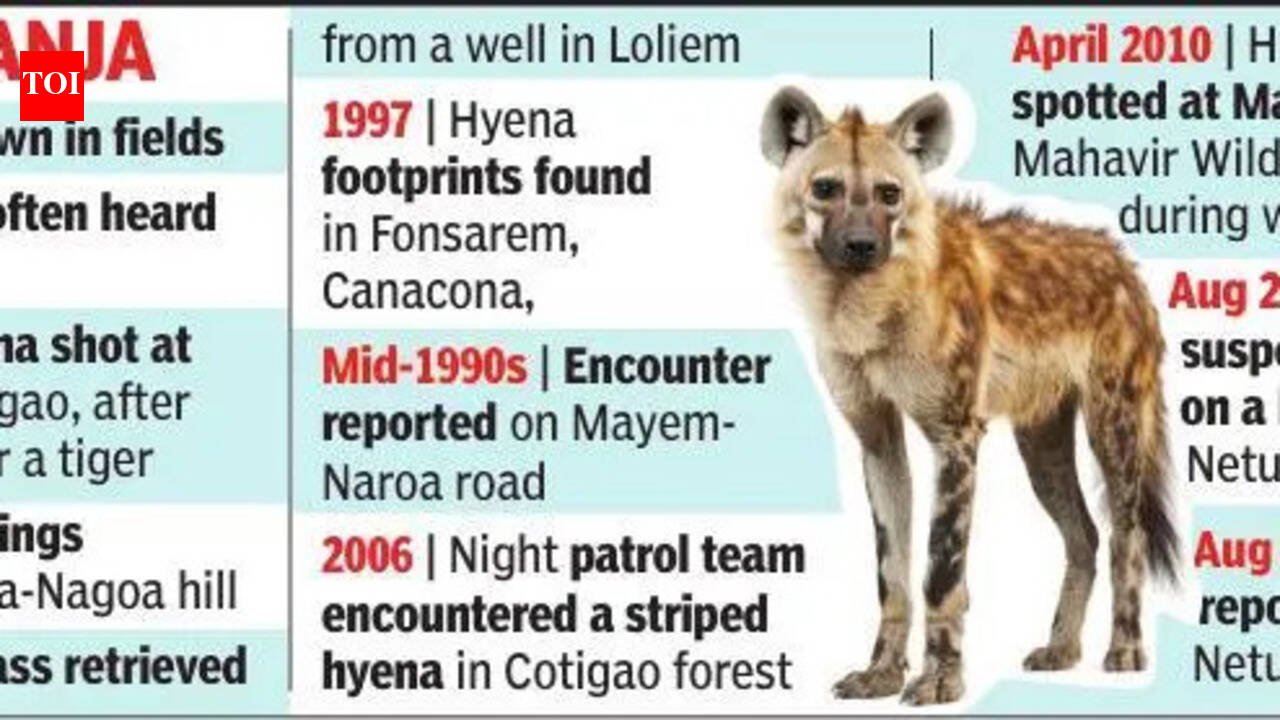
Panaji: The distinct howls of the striped hyena and jackal animated the nocturnal soundscape in the past decades. Over years, they have become rare as the larger mammals seem to have mysteriously disappeared from Goa.The striped hyena (Hyaena hyaena) may not be extinct yet, like the dodo in Mauritius, as wildlifers vouch for their presence beyond the state. But they have become more elusive than the Indian jackals (popularly called kole). Much misunderstood, they are called ‘yeul’ in Canacona and Sanguem, ‘balu’ in Bicholim and ‘bali’ in Salcete.The hyena’s long-distance call at night would fill locals with fear, as it revolved around a superstitious belief or two.“Children, adults and the elderly would be equally scared of hearing it at night,” Madhu Gaonkar, an environmental activist from Khandola said. “I was told that the hyena’s call is for mating. But people believe death would occur in the village after its call,” Jayanti Naik, a folklorist said. The belief may be based, perhaps, on strange happenings on rare occasions after their call, that science cannot explain, Naik stated.A few elders remember spotting hyenas during their childhood. “I would see them in the fields at dawn when watering our chilli crops with my parents in the late 1960s,” Naik stated.For others, their calls are unforgettable. “I could hear them often near our home in Sanvordem in the mid-1970s,” said Prakash Salelkar, former range forest officer (RFO).While their sounds have faded, their sightings were reported in stray cases over the years. At Headland, Mormugao, a news report on April 6, 1986, referred to the shooting of a hyena after being mistaken for a tiger.“Given the scale of industrialisation and urbanisation in Mormugao taluka, it is difficult now to imagine their presence in this area,” Malaika Mathew Chawla, an ecologist, said.However, this record is a reminder of their presence in Goa’s villagers, not just in the Western Ghats but also in coastal grasslands and shrubland, she said.In 1994, a hyena carcass retrieved from a well in Loliem by Kamu Prakash, RFO, Canacona, was skinned and kept on display for nature education purposes at Cotigao Wildlife Sanctuary (WLS).In the 1997 census, hyena footprints were found in Fonsarem, Canacona. Other cases included stray sightings on the Arpora-Nagoa hill during the 1980s and an encounter on Mayem-Naroa road in the mid-1990s. The last record was by one of Canacona forest officials in 2006 when a night patrol team encountered a striped hyena in Cotigao forest.In an interesting case, a bison carcass was found with its limbs and ribs separated from the abdomen in Neturlim in Aug 2010. The suspects were hyenas, as they have powerful jaws.In April, 2010, forest officials and two experts from the Wildlife Institute of India had spotted pug marks of a tiger and a hyena at Maida in Bhagwan Mahavir WLS during a wildlife census.Listed as ‘near threatened’ on the IUCN red list, these large mammals with grayish and black stripes on their legs and flanks, can survive if they have free movement and easy access to food and water. “When these habitats are broken up by large infrastructure projects like highways, the species are at a greater risk of local extinction due to threats like roadkill and conflict with humans,” Chawla said.Much speculation persists about their disappearance in Goa. “They depend on small animals such as mouse deer, rabbits and chicken for their subsistence,” Salelkar said. Rabbit population has decreased while chicken rearing has declined over the years. “In the past, every household had a ‘gudd’ (hen sty),” he said.Naveen Kumar, CF Wildlife, Goa, stated that the striped hyena prefers open scrub land forest area, digging holes or living in natural hollows and caves. “Such preferred habitats are fewer in Goa, though a few sightings were reported in the past from well-populated border areas of Maharashtra and Karnataka,” he said.The carnivores were reported in the state occasionally, as being scavengers, they travel far to find animal carcasses for their survival, Kumar stated.Goa will soon participate in the All India Tiger Estimation exercise of 2026. “This pertains to the enumeration of all animals (including hyenas) in state forests,” he said.But in the past few exercises, no cases of hyenas were reported from Goa. A sighting was, however, reported in the Cotigao-Neturlim area about seven months ago, he added.Wild enthusiasts are disappointed over the forest dept’s lack of interest in assessing its status. “Camera trap-based surveys could have been done in all areas where they had been sighted in recent years,” a wild enthusiast said.


